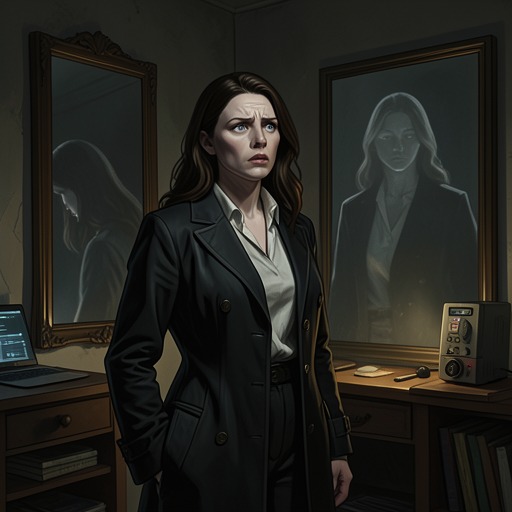
Maya Stern's nanny-cam sighting of Joe
Fool Me OnceMaya Stern’s apparent sighting of Joe Burkett on a nanny-camera recording is a pivotal collision between grief, visual evidence, and deliberate deception. A digital picture frame that Eileen Finn gives Maya as a nanny camera appears to show Joe playing with Lily after his death. The image is convincing enough to unsettle Maya’s understanding of what she has seen, but its accuracy in small details makes it harder to dismiss as an old recording; later, Hector and Isabella disclose that the footage was staged and altered before being placed in the frame.
The camera and the apparent sighting
Eileen gives Maya a nanny camera disguised as a digital picture frame, presenting an ordinary household object as a means of watching over Lily. Maya later views its footage on her laptop by inserting an SD card. The apparent sighting is not a vague impression: the recording shows Joe playing with Lily on the couch. For Maya, who understands Joe to be dead, the scene gives the familiar domestic image an impossible meaning. The camera does not merely record family life; it seems to contradict the central fact around which her life has been reorganized.
When Maya recounts the incident to Ricky Wu, he asks whether the footage might be an old recording made before Joe’s death. Maya rejects that possibility on specific grounds. Lily is wearing exactly what she wore on the day of the sighting, and the image comes from the precise angle of the camera on the shelf, aimed at the couch. The recording is therefore neither simply an old family clip nor an unlocated image inserted without regard to the room. Its apparent contemporaneity is what gives it force—and, as the later explanation shows, what required someone to reproduce the scene deliberately.
Testing what Maya saw
The footage becomes a question of evidence as well as perception. During a conversation about how she watches the camera, Maya explains that she uses a laptop and an SD card. Isabella took that card after pepper-spraying Maya. Later, when Maya tries to show Roger Kierce the recording, she opens the laptop and clicks play, but nothing appears: the SD card is missing. The absence prevents her from presenting the image when she wants another person to see it and leaves her account harder to verify in that moment.
Maya also discusses the sighting with Ricky Wu, who knows about her post-traumatic stress disorder. He distinguishes the auditory flashbacks she experiences from the visual claim at issue. Wu says that 30 to 40 percent of combat veterans with PTSD report auditory hallucinations, and explains that Maya’s symptoms have been exclusively auditory. He does not claim to prove that she saw Joe, but he does not accept PTSD as an adequate explanation for imagining her husband in a silent video. His response keeps two propositions separate: Maya’s diagnosis is real, but it does not, by itself, establish that this particular visual experience was a hallucination.
That distinction matters because the recording is not merely a private vision. Maya describes an external image with identifiable clothing, camera placement, and a specific moment with Lily. Yet those details cannot authenticate the footage: they can be accurate because somebody arranged them to be accurate. The episode makes the apparent opposition between a genuine recording and a fabricated one less secure. A convincing image can preserve the right angle and the right clothes while still presenting an event that did not happen.
The fabrication revealed
The later account from Hector and Isabella resolves the central mystery. Hector says that he dressed up as Joe and that they let the nanny camera record him. He took the SD card back to Farnwood, where the family had a CGI and Photoshop specialist alter the footage. About an hour later, he returned to the house with the card, and Isabella put it into the picture frame. What Maya saw was not an unaltered record of Joe returning to the family home, but a staged performance processed to make Joe appear in the camera’s view.
Isabella explains how she recognized that Maya had a nanny camera: the day after the funeral, Maya had a new digital frame already loaded with family photographs, despite not displaying pictures of Lily or hanging up her artwork. That observation connects the frame’s inconspicuous appearance to the scheme’s practical opportunity. The camera is useful precisely because it looks like a domestic ornament, while the SD card provides a portable route for recording, editing, and replacing the footage. The deception depends not on a supernatural return, but on people controlling what the device records and what Maya is allowed to see.
The camera’s vulnerability also has a broader personal context. Eileen later discovers that someone has obtained photographs taken inside her house and suspects her abusive husband, Robby. She had assumed that cameras using SD cards were not connected to the web and had not realized they could be hacked. Her experience does not establish that the same method produced Maya’s footage; instead, it reinforces the story’s distinction between a device that seems private and a recording system whose access and security its user may not understand.
Death, surveillance, and the image’s afterlife
The deception draws power from the family’s unresolved relationship to death and proof. Caroline Burkett tells Maya that she never saw Andrew’s body after his death, which left her unable fully to accept that he was gone. Remembering that experience, Maya says she begged to see Joe’s body so she could accept his death, but was not allowed to see it either. The fabricated image exploits the emotional space opened by that absence: a picture of Joe with Lily offers the return that the missing body cannot substantiate, while giving Maya no reliable proof that he survived.
The nanny camera’s role does not end with the false sighting. Later, a camera Maya places above the fireplace at Farnwood is used to livestream what happens in the Burkett house to the public. Shane recalls that the broadcast helps bring attention to Corey Rudzinski’s site and encourages people who had been afraid to speak about abuse or corruption to come forward. The same kind of device that first makes private family footage available for manipulation becomes a means of public exposure. Across these episodes, the camera is never a neutral witness: its significance depends on who controls the recording, the storage card, the editing, and the audience.
Maya’s sighting therefore changes meaning twice. At first, it seems to challenge the certainty of Joe’s death; in retrospect, it exposes a carefully constructed deception. Its lasting force comes from the narrow gap between what an image can show and what it can prove: exact details make the footage persuasive, but only the later account of its production explains how those details were made to fit.