Maya Stern—Joe Burkett marriage
Fool Me OnceMaya Stern and Joe Burkett’s marriage is presented through the sharp contrast between its playful beginning and its devastating end: a chance meeting at a Burkett family gala leads to a life together and the birth of Lily, but Joe’s death leaves Maya to mourn him while struggling with her own responsibility for what happened. Their relationship persists in memory, in the funeral rites Maya must endure, and in the questions the novel raises about what it takes to accept a death as real.
Meeting and Marriage
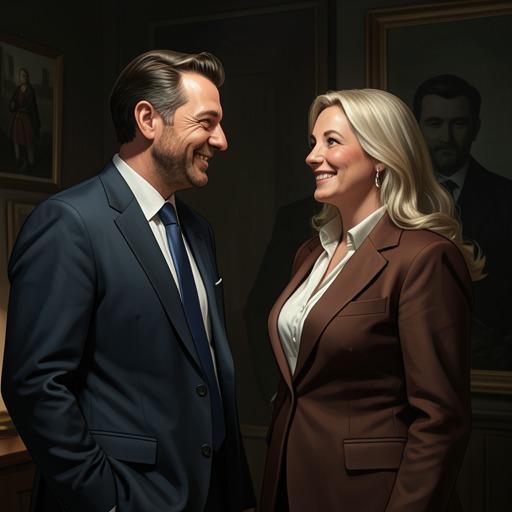
Maya and Joe first meet at a Burkett family charity gala. Maya is then an Army captain, dressed in military formalwear; Joe approaches in tails with a teasing line about how men in uniform are supposed to be the turn-on. Its awkwardness is precisely what makes Maya laugh, giving Joe the opening he wants. Even at Joe’s funeral, remembering his handsome, rakish smile can still bring a smile to Maya’s face.
A year after their meeting, they marry, and Lily arrives not long afterward. At the funeral, Maya wears a black dress borrowed from Eileen Finn, though she recalls that Joe would have preferred to see her in the military formals he liked. The detail makes their shared past immediate amid the funeral’s formal trappings: her clothing marks the occasion, while her memory of his preference restores the particularity of the man she has lost. Maya stands with Lily holding on to her leg, and the family they made together is present in the scene even as it is being forced to reckon with his absence.
Marriage Under the Weight of Death
The funeral brings Maya and Joe’s domestic life into contact with death’s public rituals. As Joe’s casket is lowered, Maya keeps her posture rigid and controlled. The discipline recalls her military bearing, a way of appearing strong when grief threatens to overwhelm her. Yet the ceremony also breaks through that composure: its sounds and sights call up the park, the glint of metal, gunshots, Joe falling, and Maya’s shirt covered in blood. She closes her eyes and pushes the memory away, but the funeral cannot separate the husband being buried from the violence of his death.
Maya’s grief is complicated by guilt. In a moment of feeling beside Judith Burkett, who is burying another son, Maya says that it is her fault and begins to say what she should have done. Her unfinished confession gives the marriage’s ending a painful double meaning: Joe is both the person she loved and the person whose death is bound to an act for which she holds herself responsible. The evidence does not make that remorse a simple account of their life together; instead, it shows how the marriage’s intimate history and its violent conclusion occupy the same memory.
Bodies, Mourning, and Acceptance
Maya’s conversation with Caroline Burkett reveals why she considers seeing a body important. Caroline describes never being shown Andrew Burkett after his death at sea. Although she knows he died in an accident, the closed casket left room for dreams and daydreams in which he survived and might return. She explains that seeing the dead is not for the deceased, but for the family who need to confront the loss. Her account gives Maya a language for a distinction central to the novel: knowing that someone has died is not always the same as being able to accept that death.
Caroline says she begged to see Joe’s body so that she could accept he was gone, even if he looked badly injured, but was not allowed to see him. Maya’s own insistence on seeing Joe is therefore more than a funeral detail. It reflects her understanding, shaped by military experience, that bringing bodies home and refusing to leave anyone behind serve those who survive as well as honoring the dead. The body becomes a point of contact between the fact of death and the family’s need to live with it—an especially charged need in a marriage whose ending is marked by violence and Maya’s guilt.
Continuing Bonds and Afterlife in Memory
Joe’s death does not erase the marriage’s presence in Maya’s life. The memory of their first meeting survives the funeral, and his preferences remain legible to her in the choice of what she wears. At the same time, the novel extends the question of how the dead remain present beyond Maya and Joe. Shane continues to miss Maya and recognizes her in Lily’s smile; Lily, who does not remember her mother, carries that resemblance without sharing the memories that give it meaning. The surviving bond is therefore uneven: for Shane, Lily keeps Maya close, while for Lily, her mother is an absence she cannot personally recall.
Near the end, Shane looks down at a newborn named Maya and wonders whether he and Maya were wrong to think death was simply final. That moment does not undo Joe’s death or settle Maya’s grief. Instead, it places the marriage within a larger pattern of memory and continuation: love does not prevent tragedy, but the dead remain entangled with the lives and relationships of those who survive them.