Maya and Judith Confront Andrew’s Cause of Death and the Douglass Payments
Fool Me OnceMaya and Judith confront the questions surrounding Andrew’s death and payments to Tom Douglass in a tense visit to Farnwood. Maya arrives seeking an explanation for years of payments to the investigator who examined Andrew’s drowning; instead, the confrontation exposes a family’s competing accounts of death, grief, and secrecy. Judith’s denials and moments of visible pain leave Maya with more suspicion than certainty, while later revelations show that some of the apparent clues surrounding Caroline and Roger Kierce were fabricated to manipulate her.
An investigative confrontation at Farnwood
Maya’s approach to Judith is not an impulsive first move. She has considered confronting Judith and Neil directly, but doubts that either would admit to hiding anything or leave incriminating evidence accessible. By the time she drives to Farnwood, she has decided the questions are important enough to risk a direct encounter. She enters through the service entrance, finds the compound apparently empty, and briefly considers searching for Isabella before deciding that breaking in would be too risky and that she has no time. Instead, she goes to see Judith.
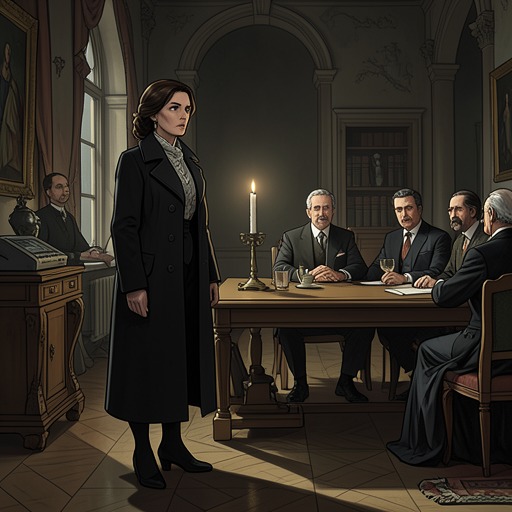
The meeting opens without the social courtesies of a family visit. Maya asks about Tom Douglass, and Judith first acts as if she does not recognize the name. Maya supplies the identifying detail: Douglass worked for the United States Coast Guard and investigated Andrew’s drowning. Judith’s crystal glass falls and breaks on the floor. Neither woman moves away from the shards. The moment makes Judith’s composure look less secure, but it does not establish whether she has been surprised by the investigator’s name, the history Maya knows, or the accusation about to follow.
Maya says that Douglass is now a private investigator and that the Burkett family has paid him almost ten thousand dollars a month for years. She demands to know why. Judith appears staggered, yet Maya cannot tell whether the shock comes from ignorance of the payments or from learning that Maya has uncovered them. Judith questions why she would pay Douglass, then calls Andrew’s death a tragic accident. The contradiction between that answer and the alleged long-running payments becomes the encounter’s central pressure point: Maya is not merely asking who Douglass was, but what his continued involvement might have concealed.
Competing accounts of Andrew’s death
Maya presses Judith to explain exactly how Andrew fell from the boat. Judith challenges the relevance of reopening the death years later, noting that Maya never knew Andrew. Maya insists that it matters and asks what Judith knows. She then states that Andrew committed suicide. Judith gives a stiff denial. Her reaction does not settle the question, but it makes clear that Maya has placed a charged account of Andrew’s death directly before his mother.
Maya returns to the payments. Judith’s attention appears to drift, and she murmurs that Andrew was only a boy and had not yet turned eighteen. The exchange shifts from an argument over investigation to the pain beneath it. Maya recognizes that she is confronting a mother about the death of her child; Judith’s grief seems real to her even as she continues to doubt Judith’s explanations. The scene therefore holds two possibilities in tension: Judith may be grieving a son whose death she could not accept, while her evasions may also protect information about what happened.
Judith later offers a conditional account rather than a direct admission. If Andrew did commit suicide, she says, she was his mother and could not see it or save him then; perhaps she can protect him now. She insists that Andrew’s suffering belongs to the past and has nothing to do with Joe or Claire. Maya does not believe that separation. Judith’s explanation gives her grief a motive—an attempt to protect Andrew after failing to save him—but does not explain why Douglass received payments for years. Maya leaves the question open because she still lacks enough information to connect the old death to the present murders.
Joe, Claire, and the family’s silence
Maya broadens the confrontation by naming the later deaths of Claire and Joe. Judith asks whether Maya is claiming that the two murders are connected. Maya answers that the same gun killed them both, a concrete link that changes the discussion from separate family tragedies to a possible pattern. Judith’s response is that Burketts do not commit suicide. It is a family claim, not an evidentiary resolution: it sits uneasily beside Maya’s assertion that Andrew took his own life and Judith’s insistence that his death was an accident.
The argument also turns to the family’s access to the dead. Judith says that none of them saw Joe’s body. When Maya asks why, Judith describes Andrew’s body as having remained at sea for more than twenty-four hours before her husband identified it, with the fish having badly affected it. Her account makes the family’s avoidance of Joe’s body intelligible as an expression of grief and fear, but it does not answer Maya’s question about what happened to either son. Instead, Judith’s explanation brings the physical difficulty of confronting Andrew’s remains into the conversation while leaving Joe’s death formally unconfirmed within the family’s experience.
Maya raises another alleged payment, this time to Roger Kierce, the police officer investigating the case. Judith denies knowing anything about it. Maya says Caroline told her; Judith questions whether Maya believed her. Maya points out that Judith has now been associated with payments to two men investigating the deaths of her sons. Judith calls the allegations nonsense and resists Maya’s suggestion that they ask Caroline directly, saying Caroline cannot be disturbed and needs rest. The exchange intensifies Maya’s suspicion, but at this stage the source of the alleged Kierce payment remains a claim passed through Caroline, not an established fact.
Grief as explanation and as cover
Judith explains Caroline’s condition by saying that the deaths of two brothers caused psychological problems. When Maya asks whether this means Caroline thinks her brothers are still alive, Judith describes delusions, paranoia, visions, and conspiracy theories as possible manifestations of desperate grief. She blames Caroline’s immaturity on being sheltered and overprotected by her father, arguing that Caroline could not accept the deaths of the strong men who had served as her support system. In the moment, this explanation offers Judith a way to frame Caroline’s claims as unreliable and her own family’s secrecy as protection of a vulnerable daughter.
Maya tests the explanation against another detail: why was Caroline not allowed to see Joe’s body? Judith says none of them saw him. She links the family’s inability to face such a sight to the condition of Andrew’s remains, but Maya is unconvinced that the grief surrounding Andrew explains the present-day deaths or the payments. Judith, in turn, says Andrew’s death has nothing to do with Joe or Claire. Each woman recognizes the other’s account without accepting its conclusions.
The later revelation changes how this part of the confrontation reads. Maya eventually learns that Caroline’s claims about believing her brothers were alive and about Kierce being on the family payroll were fabrications, delivered as part of a coordinated psychological experiment. The nanny-camera image, missing clothes, phone calls, and the stories attributed to Caroline were arranged to make Maya question her own judgment and provoke her into investigating. That later knowledge does not make every observation in the Farnwood conversation false: the payments to Douglass are still the specific allegation Maya brought to Judith, and Judith’s account of Andrew’s body remains her explanation. It does, however, show why Maya’s evidence must be separated from the manufactured story built around it.
An unresolved encounter with lasting consequences
The confrontation ends without a confession or a reliable account of Andrew’s death. Maya tells Judith that she does not mean to cause her pain, but insists that she needs to know why the family paid the Coast Guard officer who investigated Andrew. Judith answers with a question about why Maya needs to know, and Maya says only that it is a long story. Judith then warns her not to make the mistake of hurting her sons more. The warning leaves the exchange suspended between maternal grief and intimidation: Judith presents herself as a mother defending her dead children, while Maya hears a threat embedded in that defense.
For Maya, the visit supplies neither a solution nor a reason to stop. Judith’s visible distress complicates the easy assumption that every denial is calculated, but it cannot dissolve the contradictions between accident and suicide, family grief and concealment, or private investigator and unexplained payments. The scene’s significance lies in that unstable balance. Maya has confronted the person most closely tied to the family’s history, connected the deaths of Claire and Joe through the same gun, and made Judith respond to the possibility that Andrew’s death was not what the family claimed. Yet the answers remain incomplete, leaving Maya to distinguish genuine grief from deliberate misdirection as the investigation continues.