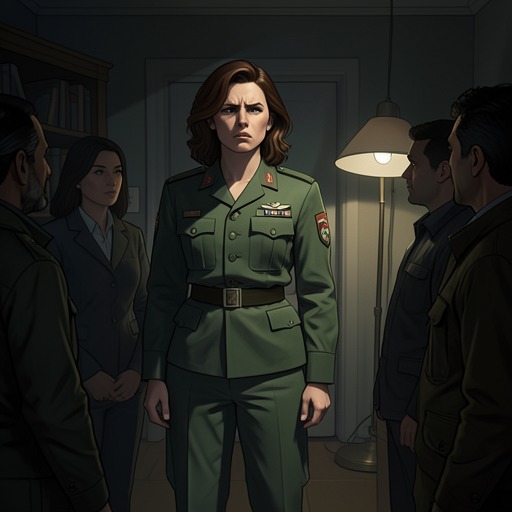
Maya fires a Hellfire missile at the black SUV
Fool Me OnceMaya fires a Hellfire missile at a black SUV during what begins as a rescue mission and ends as a morally compromised act of protection. Two trapped soldiers survive, but civilians in the vehicle die. The leaked footage first presents the strike as the work of an overzealous pilot; Maya’s later account changes its meaning. She acted without the required confirmation, knowing the target might include civilians, and chose the lives of her own soldiers over theirs. The event becomes both the defining controversy of her military career and the source of flashbacks whose persistence she explains not as remorse, but as the knowledge that she would make the same decision again.
Background and the Rescue Mission
Before the strike, Maya had built her career as an Army combat-helicopter pilot. She began flying UH-60 Black Hawks at Fort Campbell, then accumulated the flight hours needed to join the 160th Special Operations Aviation Regiment in the Middle East. Her missions often involved providing cover for ground troops. The Al Qa'im operation, near the Syrian-Iraqi border, began with that same protective purpose: four soldiers, including three Maya knew and loved, had been killed in an ambush, while two more remained alive but pinned down under enemy fire.
Maya and Shane flew a Boeing MH-6 Little Bird light helicopter gunship toward the surviving soldiers. From the aircraft, they heard the men’s terrified calls for help. Maya recalls that they sounded very young, and that the four already dead would have sounded the same. A black SUV was moving toward the survivors, apparently to finish the attack. The urgency was immediate: the two soldiers were exposed, and the vehicle was closing in.
The rescue depended not only on what the pilots could see but on a decision from Joint Operations Command at Al Asad. Maya and Shane waited for confirmation before engaging. The command radio signal kept cutting in and out, while the soldiers’ pleas for help came through clearly. The pilots cursed over the radio and demanded an answer. Then they heard the two men scream. In the version first presented by the leaked footage, the strike follows this pressure and apparent confirmation; Maya later discloses that this account omitted the order that should have stopped them.
The Strike and Its Immediate Outcome
Maya fired an AGM-114 Hellfire missile from the MH-6 at the black SUV. The vehicle exploded high into the air. Infantry troops moved in afterward and rescued the two soldiers; both had been hit, but both survived. At the time, Maya says, the action seemed righteous. Its immediate result could be understood as a successful rescue: the approaching threat was destroyed, and the surviving soldiers were brought out alive.
That outcome, however, does not settle whether the attack was authorized or justified. Maya later tells Shane that Joint Operations Command had radioed them to hold off. The command believed at least one person in the SUV might be a civilian, possibly underage, and assessed only a fifty-fifty chance that the occupants were enemy fighters. Maya’s account makes clear that the strike was not simply a response to an unclear radio or a mistake in equipment. She had received information that made the target’s status uncertain, and the decision to fire was hers.
She also reveals that she turned off Shane’s signal. The detail revises their shared memory of the mission: Shane had believed they acted after receiving authorization, but Maya tells him that the command had not given them the go-ahead. By controlling the signal, she prevented him from hearing the order directly. The difference between the public account and the truth is therefore not merely that the video failed to show every detail. The missing detail is Maya’s deliberate choice to remove the restraint that might have prevented the attack.
The Leak and the Public Account
The combat recording reached Corey Rudzinski, founder of CoreyTheWhistle, a site where confidential sources could expose illegal activity by government and business. CoreyTheWhistle had published material on subjects ranging from police corruption to covered-up accidents and prisoner abuse. Maya’s attack became another of its prominent disclosures: the site presented the deaths of civilians as the result of an overzealous female Army helicopter pilot. The footage was available elsewhere online, but Maya seeks it in Corey’s archive, returning to the source that had made the incident public.
The leak had consequences beyond the scrutiny of one strike. Maya had planned to remain in military service, probably for life; after the video appeared, that plan was destroyed. The recording could show the missile, the explosion, and the rescue, but its public framing did not contain the whole decision. The later conversation with Shane supplies what the video cannot: the withheld warning, the absence of authorization, and Maya’s reason for choosing to fire. In this way, the event changes from a disputed image of civilian deaths into a confession about command, responsibility, and whose lives Maya was willing to protect.
Flashbacks and the Meaning of the Choice
The strike continues to return to Maya at night. When she discusses what she calls her episodes, she resists treating them as ordinary hallucinations. The distinction offered to her is that vivid flashbacks are common with PTSD and may resemble hallucinations, while her experiences are auditory: she does not see the dead men, the mother, or the child. The event’s afterlife is thus carried through voices and repeated recollection rather than a visual replay of the victims’ faces.
Maya rejects the idea that guilt over the civilian deaths explains the flashbacks. She says she cared about the soldiers and not about the civilians, and that she made the choice because she would not lose another of her own. She does not say that the deaths were acceptable in a larger moral calculation; instead, she identifies the unsettling source of her torment as the certainty that she would do the same thing again. Each night, she is back in the helicopter, trying to find a way to save the soldiers, while the outcome cannot be changed.
The later narration preserves uncertainty about whether Maya’s claim of feeling no guilt is fully credible: she said she did not feel remorse, yet the flashbacks tore through her night after night. The contradiction is not resolved into a simple confession of regret. The event leaves her with a more troubling burden: she knows what she chose, understands that civilians died, and remains convinced that, under the same pressure, she would choose the soldiers again. The strike therefore defines both her capacity to protect and the limit she crossed in doing so.