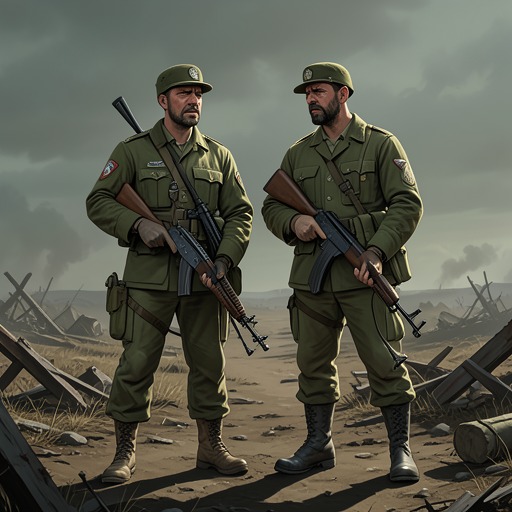
Maya's combat tape
Fool Me OnceMaya's combat tape is the recording Corey Rudzinski released and then considered exposing further through its audio. Its significance lies not only in the leak but in what did not follow: after Claire Walker intervened, Corey withheld the audio, and the decision became a revealing test of his whistle-blowing principles, Claire's loyalty to Maya Stern, and the difference between exposing the truth and deciding who must bear its costs.
The Leak and Its Unreleased Audio
The conversation between Maya and Corey makes clear that the release was not the end of the matter. Maya initially challenges the implication that Claire had leaked the tape, pointing out that Claire would not have had access to it. Corey corrects her: Claire contacted him after he released the tape. The distinction matters. Claire was not identified as the person who made the original release; she became involved in what Corey might do next.
What remained at stake was the audio. Corey tells Maya that Claire feared he would reveal the rest of the tape, and later specifies that she asked him not to release it. The evidence therefore separates two actions: Corey had already released the tape, but the audio remained unreleased. It does not establish the audio's contents, or describe the tape's images in detail. Its importance in the conversation comes from the possibility of further exposure and the harm that exposure could cause Maya.
Claire's Intervention
Claire's request was grounded in her effort to protect her sister. Corey says she described Maya as a pawn, compelled to act within a corrupt system; revealing the audio, he acknowledges, might serve the cause of truth while irreparably harming Maya. Claire persuaded him that publishing it would make him no better than people who target small-time wrongdoers. Her intervention thus set a limit on what she considered justified disclosure: the existence of material did not, by itself, make its publication ethical.
Maya later explains the same episode to Eddie Walker. She recalls that Corey did not release the audio and believes Claire talked him out of doing so. Claire had contacted Corey and joined his organization; she also gathered damaging information on the Burkett family to help the organization take them down. The withheld audio was one part of a wider relationship between Claire and the group, but the available account does not say that she joined solely to secure Maya's protection. Maya considers possible reasons, including a bargain or agreement with Corey, without presenting either as established fact.
Corey's Rationale and Its Limits
Corey does not portray his decision as uncomplicated altruism. He admits that he had wanted to release the audio later, when the revelation could draw more attention to his website and cause. Claire's request stopped that plan. He also agrees when Maya says he had been more interested in damaging the war cause than in avoiding harm to her. His admission exposes a tension at the center of his conduct: he pursued public accountability, yet also calculated the timing of disclosure for maximum impact and personal or organizational reach.
At the same time, Corey describes Claire's argument as persuasive. He says that part of him wanted to reveal the material in the belief that truth could set Maya free, but that doing so would cause her irreparable harm. The recording therefore becomes a point where competing claims—public exposure, political purpose, and an individual's protection—cannot be treated as interchangeable. Corey had the power to publish; Claire challenged his use of it; Maya, whose life would be affected, had not been the one controlling the decision.
Narrative and Ethical Significance
The tape's story is defined by an asymmetry between what has already been made public and what remains withheld. The released recording establishes that Maya's combat-related material has entered Corey's campaign, while the audio represents a further disclosure that Claire successfully prevents. Because the content of that audio is not specified, the episode's emphasis falls on the decision-making process rather than on a sensational revelation: who controls the material, whose interests its release serves, and who would suffer from it.
Claire's intervention also complicates the label of whistle-blowing. Corey speaks of accountability and freedom, but acknowledges choosing when to reveal information partly to increase exposure for his cause. Claire's appeal makes the human consequence of that strategy impossible to ignore. Maya's combat tape thus links the public logic of radical transparency to private obligations between sisters, while preserving an important distinction: Claire did not undo the original leak, but she did help prevent an additional release.