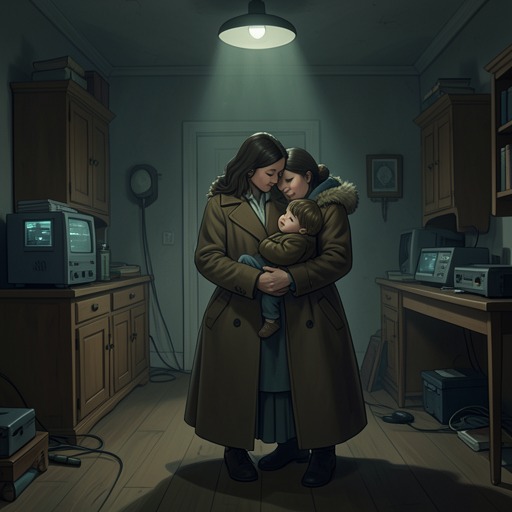
Maya’s Nighttime Panic Attack and Shane Finding Lily
Fool Me OnceMaya Stern’s nighttime panic attack turns an invisible trauma into a crisis shared by her family: the sounds of combat overwhelm her, Lily wakes frightened, and Shane has to find the child while Maya struggles to return to the present. The episode moves from private terror to a practical reckoning about care. Its immediate danger passes, but its consequences remain in Maya’s fear that her trauma has reached Lily and in Shane’s insistence that she seek help.
The Nighttime Episode
The episode begins in the fragile interval between wakefulness and sleep. Maya is neither securely in her bed nor back in the place the sounds seem to summon; she experiences herself as suspended between states, without a stable sense of where or when she is. Clamoring, screams, rotors, and gunfire crowd out rational thought. The narration makes the assault feel bodily and internal: the noise seems to come from inside her head, as if something there were scratching and screeching. Maya presses both hands against the sides of her head, trying to crush the source of the pain.
The sounds do not simply frighten her; they erase ordinary measures of time and location. Maya cannot tell whether the episode lasts minutes or hours. In that disorientation, the thought of picking up a gun and silencing the noise briefly enters the scene. Yet she does not know where she is, even though her bedside table and the small safe where she keeps a gun are close. The contrast is stark: a weapon belongs to the physical room, but the terror has made the room itself inaccessible to her. The passage presents the episode not as a deliberate choice but as a condition in which ordinary orientation and control have broken down.
A doorbell and Shane’s voice eventually penetrate the auditory disturbance. Their ordinary, recognizable quality marks a gradual return toward consciousness rather than an instant cure. Maya realizes that one of the screams has been her own. When she opens her eyes, the other sounds fade, but the retreat does not feel final: they remain capable of returning, and she understands them as sounds that never entirely disappear. The scene therefore closes the immediate assault without suggesting that the underlying trauma has ended.
Shane Finds Lily
Once awake, Maya looks toward the place where Lily had been sleeping and finds it empty. Her fear changes focus at once: she calls for Lily and tries to get up, but initially has trouble making it to a standing position. Shane is already at the house after hearing the doorbell and calling to her. He can enter because Maya gave him a key for emergencies, a practical provision that becomes crucial in the middle of the crisis. When Maya tells him she cannot find Lily, he runs upstairs.
Shane finds Lily at the top of the stairs and carries her back in his right arm. The discovery resolves the immediate uncertainty about where Lily is, but it also reveals what the episode has exposed the child to. There are tears on Lily’s face, and she cringes briefly when Maya hurries toward her. Maya recognizes that Lily has probably woken to her mother screaming. The mother’s first impulse is to close the distance; her next is to slow down and smile, trying not to intensify the child’s alarm. Lily instead buries her face in Shane’s shoulder. Relief that Lily is safe is thus joined by a painful recognition: the sound that trapped Maya in her own distress has frightened her daughter too.
Morning and the Unfinished Aftermath
The next morning brings a change in atmosphere, especially for Lily. Maya talks about the coming Soccer Day, including its rides and balloons, and within minutes the storm of the previous night has receded for the child. The same shift does not happen for Maya. Her fear persists because she can see that the episode has touched Lily. The passage’s contrast is not between a bad night and a clean new beginning, but between a child who can be drawn into the promise of the day and a mother who remains occupied by what happened.
Shane waits until Lily is settled with breakfast and out of earshot before asking Maya how bad the night was. Maya first says she is fine. Shane points out that lying to him has become easier; she acknowledges that he is right, then admits the episode was very bad. His response carries care as well as restraint. He wants to hug her, but the two of them do not do so, though Maya could have used the comfort. Their closeness is conveyed through the fact that he recognizes the evasion and asks directly, not through an embrace.
Shane suggests that Maya contact Ricky Wu, the therapist from the VA. Maya says she will call, but when Shane presses her about when, she defers until what she is dealing with is over. That postponement exposes a conflict between the urgent demands Maya has placed ahead of treatment and the continuing need to address her condition. Shane looks toward Lily as he tells Maya that the matter is no longer only about her. His point follows directly from the night’s events: Lily was frightened by Maya’s screaming, and the consequences of Maya’s suffering now reach beyond Maya herself.
Significance of the Episode
The scene’s decisive turn is from isolation to shared responsibility. During the attack, Maya is cut off from time, place, and rational thought; the doorbell, Shane’s voice, and his arrival restore contact with the household, but cannot make the sounds vanish permanently. His emergency key allows him to act when Maya is unable to manage the immediate situation, and his finding Lily resolves the concrete danger that follows her absence from the bed.
The aftermath makes the emotional cost legible through small, specific actions: Lily’s tears, her brief recoil, Maya’s careful smile, and her retreat into Shane’s shoulder. The following breakfast conversation then shifts the episode from rescue to accountability. Maya admits that the night was very bad, but initially tries to minimize it and postpones calling for help. Shane’s concern connects that delay to the child who has already been affected. The event ends without a cure or a promise that Maya will call immediately; instead, it leaves her with a sharper understanding that what she experiences alone can alter the safety her daughter feels.