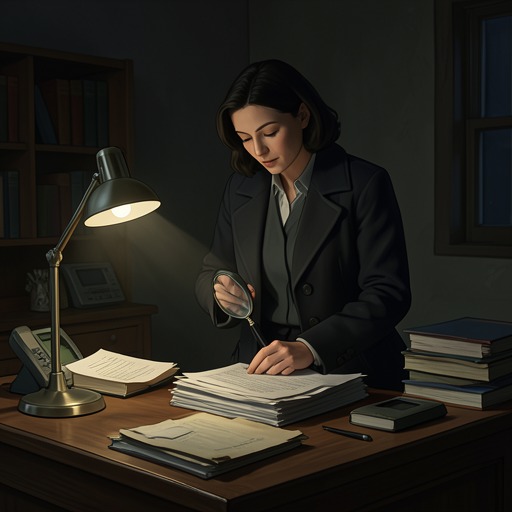
Murder of Claire Walker
Fool Me OnceThe Murder of Claire Walker is presented through the investigation and its aftermath rather than through a scene depicting the killing itself. Its significance sharpens as Maya Stern connects Claire’s discovery of a supposed payoff to her murder, then learns that the same gun was used to kill Joe Burkett. The crime is therefore both a devastating loss within Maya’s family and a clue pointing toward a larger, still-obscured connection.
Background and the Unanswered Investigation
Maya confronts Corey Rudzinski over what he did after Claire was murdered. She asks whether he contacted the police or told them what Claire had been investigating. Corey says he did neither, explaining that he had to stay off the grid when she died. Maya rejects that softened description: Claire was not merely dead; she had been brutalized and murdered. Corey acknowledges the gravity of what happened, but his explanation does not answer Maya’s central accusation—that he failed to help find her killer.
The exchange establishes an important gap in the case. Claire had been investigating something consequential, but the police were not given that information by Corey after her death. His claim about remaining off-grid supplies a reason for his absence from ordinary channels of response, not a resolution of what Claire had uncovered or why her investigation ended in murder. Maya’s anger is directed as much at this lost opportunity to pursue evidence as at Corey’s personal failure to act.
Claire’s Discovery and the Burkett Connection
Maya later tells Judith Burkett that Claire found out about a supposed payoff. Judith checks that Maya means the alleged payment and receives confirmation. The pause that follows leaves the disclosure hanging between them: the payment is described as supposed, but Claire’s discovery is presented by Maya as a fact. The evidence does not specify the payment’s amount, recipient, or purpose, so its importance lies in the connection Maya draws between Claire’s investigation and the deaths that followed.
Maya places Claire’s murder beside Joe’s and reveals that the same gun killed them both. Judith reacts with disbelief, while Maya challenges her to explain why the two killings could not be connected. The exchange turns the murder from an isolated family tragedy into a possible link in a chain of events involving the Burkett family. It also reveals that Roger Kierce had not told Judith about the matching-gun evidence, leaving Maya to bring the connection into their confrontation herself.
The forensic clue has a specific origin. Investigators recovered .38-caliber rounds from Joe’s body and ran them through ballistics to check whether they matched bullets in other cases. Roger Kierce tells Maya that the test found a match. The result does not, by itself, establish who used the gun in either killing or explain the motive; it does establish a concrete connection between the cases and gives Maya grounds to question whether Claire and Joe were killed separately for unrelated reasons.
Withheld Evidence and Failed Responses
The murder’s investigation is marked by information that is missing, delayed, or held by people who might have helped. Corey did not contact police or disclose Claire’s subject of inquiry after her death. In a separate confrontation, Maya considers whether to approach Judith and Neil Burkett directly about a suspected payment. She hesitates: neither is home, and she doubts that an immediate confrontation would produce a truthful answer or preserve evidence. If records had once existed, she reasons, the family could have removed or concealed them by then. Her uncertainty about what, exactly, would be covered up shows that the payment is a lead rather than a fully established explanation.
The murder also becomes entangled with an effort to manipulate Maya’s response to Joe’s death. Maya later identifies the nanny-camera footage, missing clothes, and phone calls as parts of a calculated psychological experiment. She believes the family expected her to suspect that someone was deceiving her, investigate, and perhaps make a mistake that could be used to implicate her in Joe’s murder. Caroline Burkett had fed her false claims about her brothers being alive and about Kierce being on the family payroll. These fabrications came alongside real grief and uncertainty, making Maya question whether her perceptions could be trusted.
That manipulation does not explain how Claire was killed, and the evidence presented here does not establish that the staged clues caused her murder. Instead, it shows how Claire’s murder and Maya’s guilt over her sister’s death could be exploited after the fact. When Maya weighs possible explanations for seeing Joe in the nanny-camera footage, she considers both digital alteration and the possibility that trauma, medication, and guilt distorted her perception. The crime thus remains an objective investigative fact even as the people around Maya work to make her doubt what she knows.
Consequences and Narrative Significance
Claire’s murder changes the meaning of Maya’s inquiry at each return. First, it is a killing Corey failed to report or help investigate. Then it becomes connected to Claire’s discovery of a supposed payoff. Finally, the matching ballistics evidence links it to Joe’s death, while the lack of disclosure to Judith shows that even the existence of that link has been selectively withheld. Each revelation expands the case without immediately completing it: the shared weapon is evidence of connection, not a complete account of the crimes.
The event also gives Maya’s search a personal and investigative urgency that cannot be separated. Claire was her sister, and the family’s later attempt to destabilize Maya draws on her guilt about that loss. At the same time, Maya keeps testing claims against evidence: the alleged payment remains supposed, Corey’s stated reason for staying off-grid does not erase his inaction, and the ballistics match supports a connection without naming the killer. The murder’s narrative force lies in that tension between what is known and what remains concealed. Claire’s death is not merely the past that Maya mourns; it is a crime whose unanswered questions continue to shape her pursuit of the truth.