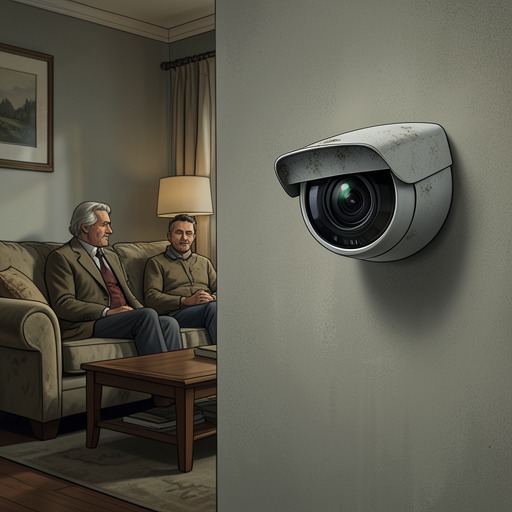
Nanny camera
Fool Me OnceThe Nanny camera is a surveillance device disguised as an ordinary digital picture frame, but its role in Maya Stern’s story expands far beyond household monitoring. It becomes a suspect witness: an image from it helps sustain the belief that Joe Burkett may be alive, even though the footage has been staged and altered. In the end, Maya turns the same kind of device outward, using a live feed to expose events at Farnwood to the world.
Design and Introduction
Eileen Finn gives Maya a device that initially looks like a digital picture frame. Its disguise is its defining practical feature: the camera can sit among household objects without announcing that it is recording. Eileen describes it as a nanny camera hidden in the frame, placing surveillance inside a domestic object associated with displaying family photographs.
That contrast becomes pointed in Maya’s home. When the device later appears in the den, Shane Tessier observes that the frame is unusual for Maya: she does not keep photographs of Lily around or display her daughter’s artwork. The frame therefore attracts Isabella Mendez’s attention precisely because it does not fit the household’s ordinary habits. Its concealment is effective, but not invisible to someone who knows what the room usually contains.
Images, Storage, and Uncertainty
The camera’s recordings do not immediately provide a clear account of what has happened. In one viewing, the camera comes on again but its view is blocked. Maya first suspects that Isabella Mendez is standing directly in front of it, then rejects that explanation: Isabella is too short to obscure the lens with her back, and the visible color is green rather than the red blouse Isabella wore the previous day. The small visual discrepancy turns the frame into a puzzle instead of a transparent witness.
When Maya later tries to show Roger Kierce the recording on a laptop, she turns the screen toward him, clicks play, and gets no image. The SD card is missing from the computer’s USB port. The absence matters as much as any footage: the recording cannot be reviewed at the moment Maya intends to use it, and the missing storage medium leaves the chain of custody uncertain.
The later explanation shows that the camera’s image was not reliable proof of Joe Burkett’s return. Hector says that he dressed as Joe Burkett and let the camera record him; he then took the SD card to Farnwood, where the family had hired someone to alter the footage using CGI. Afterward, he returned the card to the house and Isabella Mendez put it back in the frame. The apparent sighting was thus assembled through performance, editing, and the movement of a removable card. The camera recorded an event, but the recording’s meaning was deliberately manufactured.
Hacking and the Limits of Security
The device also raises the possibility that a camera meant to protect a home can become a means of intrusion. Eileen Finn brings Maya photographs received through an anonymous, untraceable email address. The images show rooms inside Eileen’s house, including her children playing on a couch and Eileen at home after exercising. Maya recognizes their viewpoint as that of Eileen’s nanny cameras. Eileen believes Robby hacked them, though she had assumed the cameras were not connected to the internet because they used SD cards. The episode makes clear that removable local storage does not, by itself, settle whether a device can also be accessed remotely.
That disclosure changes the meaning of Maya’s own camera without proving that it was hacked in the same way. Shane arrives with two men to search Maya’s home for possible listening devices and cameras, then checks the frame in the den. Its Wi-Fi is switched off, which, in his assessment, means it cannot be used to spy remotely through its ordinary connection. He allows for less likely alternatives: a back way into the device, or someone entering the house and switching it off because they knew it would be checked. The inspection narrows the possibilities but does not establish how the camera was used or accessed.
Surveillance, Grief, and the Need for Proof
The Nanny camera’s images sit uneasily beside the story’s concern with bodily proof. Caroline Burkett explains that she never saw Andrew Burkett’s body after his death at sea. She says she could know he was dead and still imagine that he had survived, and recalls wanting to see Joe Burkett’s body for the same reason: she needed the physical evidence to accept his death. Maya later recognizes that Caroline never saw either brother in a casket. Against that context, the camera offers an image where family members lack a body. But the image can mislead: a face or figure on a screen cannot provide the certainty Caroline sought, especially when the footage can be staged and altered.
The device also changes how Maya and Shane deal with trust. After Shane learns about the camera, he says he would have listened and helped her investigate if she had told him sooner. Maya then recounts the camera, Isabella Mendez’s use of pepper spray, Joe Burkett’s missing clothes, and her visit to the workers’ compound where Isabella lived. Shane responds that he remembers the green shirt and questions why it would be missing if Maya had imagined everything. In this exchange, the camera’s uncertain evidence is weighed against a tangible detail outside the recording. It produces suspicion that must be tested against other facts, not certainty on its own.
From Private Monitoring to Public Broadcast
At Farnwood, Maya gives the camera a final, radically different use. A camera is placed above the fireplace, and someone working with Corey Rudzinski sets up a live feed through it. The result is not merely a recording to be reviewed later: people around the world watch events inside the Burkett house as they happen. The device that had once hidden inside a picture frame now makes a private interior publicly visible.
Shane later describes the broadcast as the turning point that brought broad attention to Corey Rudzinski’s site. He says the publicity helped people who had been frightened or powerless find the courage to tell the truth, and that corrupt governments and businesses fell. He also makes clear that Maya intended to expose the truth in real time, while the ending that followed was not what anyone expected. The Nanny camera’s trajectory therefore runs from concealed observation, through manipulated evidence and fears of hacking, to deliberate public transparency. Its significance lies not in guaranteeing truth, but in showing how control of an image—who records it, edits it, stores it, and gets to watch—can alter what people believe and what they are able to reveal.