Post-Traumatic Stress Disorder (PTSD) and the Persistence of Trauma
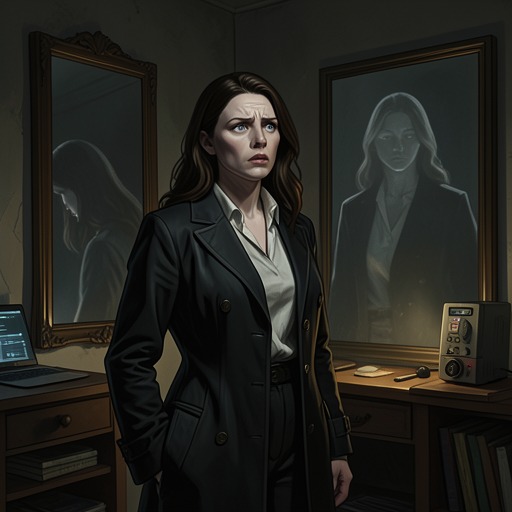
Fool Me OncePost-Traumatic Stress Disorder and the Persistence of Trauma is presented through Maya Stern’s recurring flashbacks, her account of the decision that haunts her, and the story’s wider concern with death that remains unconfirmed or unaccepted. Trauma is not simply a past event recalled at will: it returns, shapes present choices, and resists the distinction between what has ended and what is still being lived. The novel’s account is especially unsettling because Maya does not describe her symptoms as remorse for the civilians killed in the helicopter attack. What persists is the knowledge that, faced with the same situation, she would choose the same course again.
Symptoms and the Return of the Past
Maya’s experiences are initially discussed as episodes, a softened term she challenges by calling them hallucinations. Her doctor distinguishes that label from vivid flashbacks, which he says are common with PTSD and may resemble, or even be experienced as, hallucinations. He identifies an important feature of Maya’s episodes: they are auditory. At night, she does not see the dead. The distinction does not make the experiences less real or disruptive; rather, it clarifies that the past returns through a particular sensory form, with voices and sounds continuing to intrude into her life.
The recurring experience is also bound to a specific event. Maya describes being back on the helicopter night after night, trying to find a way to save the soldiers. The flashback repeats the crisis without allowing her to alter its outcome. Its force lies in this combination of repetition and helplessness: she must relive the decision, but cannot revise what happened. When she says that the flashbacks will not leave her, she gives the symptoms a temporal structure—the assault is over in history, yet still happening in recurrent memory.
The Choice That Haunts Maya
Maya rejects the assumption that her suffering comes from guilt over the civilians killed in the attack. She says she cared about her soldiers, and that she chose not to lose another of them. Civilian deaths were, in her account, collateral damage she accepted rather than a consequence she now regrets. She tells Shane that those deaths do not haunt her; what haunts her is that she would make the same decision if placed there again.
That admission makes her account more morally complicated than a simple story of belated remorse. The flashback is linked not only to what Maya did, but to her continuing identification with the reasoning that led her to do it. Shane hears the contradiction in her words: each night she tries to save the soldiers again, while the civilians are killed again in the repeated memory. His response does not resolve the contradiction. Maya refuses his attempted embrace, and the scene leaves her facing the persistence of a choice she cannot undo and does not disavow.
Trauma Beyond the Battlefield
The narrative connects Maya’s wartime trauma to other unresolved histories without treating them as identical. During a conversation about recovering soldiers’ bodies, Caroline Burkett explains that she was young when Andrew died and was never shown his body. The closed casket left her with dreams in which he had survived and could still return. Although she knows he died in an accident, she says she could not fully accept his death; seeing a body might have given her the reality she lacked. That experience informs why she asked to see Joe Burkett’s body: she wanted proof that he was gone, even if seeing it would be difficult.
Caroline’s account gives concrete meaning to the insistence that the dead be brought home. The body serves the living, providing a witnessable fact around which grief can take shape. Her longing for certainty differs from Maya’s recurring auditory flashbacks, but both stories show how an event can remain active when its ending cannot be securely apprehended. The book does not present memory as a clean substitute for evidence: visions of Andrew’s return persist alongside Caroline’s knowledge that he died, while Maya’s mind returns to a battlefield outcome she cannot change.
The Past as an Unfinished Chain
Maya’s reflections also place trauma within a chain of causes rather than at a single, isolated moment. She considers how Corey Rudzinski released the helicopter combat video and wonders whether he manipulated Claire into gathering information about the Burketts and EAC Pharmaceuticals, or manipulated Maya into taking the blame for Tom Douglass’s murder. These are her suspicions, not settled answers. Their narrative importance is that the leaked recording reopens the military past in the present, setting off consequences that reach into her family life and the deaths of Claire and Joe Burkett.
Later, Maya recognizes that the yacht incident was not where the story’s original trauma began. She describes trauma as something that ripples and echoes, keeping an earlier wound alive within the person who carries it. The narrative’s movement backward through events mirrors that idea: what appears to be a fresh crisis leads to an earlier one, and that earlier crisis points farther back still. The past is not offered as a single explanation that makes every later event inevitable; instead, its returns alter what the characters believe they are confronting.
Memory, Loss, and Continuance
The novel’s closing perspective extends the idea of persistence into family memory. Shane remembers that Maya said death was final, yet, looking at a baby named Maya, he finds himself unsure of that certainty. The child’s name and smile do not establish that the dead have literally returned. They show how a person can remain present in the lives of those who remember her, particularly through the child whose mother she was. Lily does not remember her mother, but Shane sees Maya in her and in the continuing work of caring for her.
That ending does not claim that trauma has been cured or that grief has reached closure. Instead, it places the past in a changed relation to the living. Maya’s wartime memories persist as painful repetition; Caroline’s loss persists through dreams and the absence of a body; and the family carries Maya forward through care, recollection, and a shared name. Across these different forms, the book treats persistence not as proof that nothing can change, but as the condition under which memory, responsibility, and attachment continue after the originating event has passed.