Surveillance, Trust, and Privacy
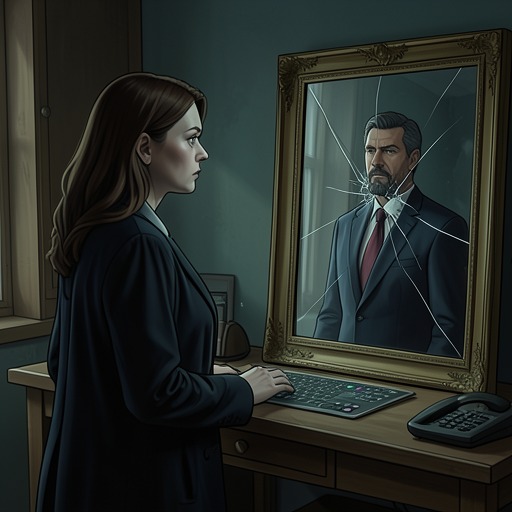
Fool Me OnceSurveillance, Trust, and Privacy gathers the novel’s recurring struggle over who gets to watch, what a recording can prove, and who controls its circulation. A picture frame concealing a nanny camera first offers Maya Stern a way to monitor care at home; later, its footage becomes entangled with loss, suspicion, hacking, and deliberate deception. Across the story, surveillance is never simply a matter of seeing: the power to record and interpret an image can offer reassurance, invade a private space, or make a false account appear real.
The Camera as a Household Safeguard
Eileen Finn gives Maya a digital picture frame that is, in fact, a nanny camera. She also provides an SD-card reader that plugs into a computer’s USB port and shows Maya how to remove the card from the frame at the end of the day. The arrangement makes observation feel manageable: the camera is disguised among family photographs, while its recordings are stored on removable media that Maya can review herself. Eileen says she does not expect Maya to find anything troubling and that Isabella Mendez seems like a good caregiver. The device therefore enters the home as precaution rather than accusation, even as its covert form makes secrecy part of its operation.
The camera’s practical promise rests on a fragile assumption: that the person being watched does not know it is there. When Maya considers whether Isabella Mendez has recognized the frame as a camera, she reasons that an attentive caregiver might notice both the sudden arrival of a new picture frame and its appearance the day after Maya buried her murdered husband. If Isabella Mendez knows, Maya fears, the footage may show only deliberate good behavior; a hidden camera loses its purpose once it is no longer hidden. The possibility of observation thus changes how Maya reads even an ordinary household object and makes trust inseparable from concealment.
Intimate Images and Uneasy Access
The recordings do not remain abstract evidence. Maya watches Lily crawl onto the lap of her dead husband on the computer monitor. The image gives her a view of a moment she would otherwise have missed, but its emotional force comes from what the camera cannot settle: it captures an apparent encounter without, by itself, explaining what Maya is seeing. Surveillance grants access to private family life while leaving interpretation—and the risk of misinterpretation—with the viewer.
The device also proves unreliable as a window. At one point the camera has switched on again, but its view is completely blocked; Maya guesses that Isabella Mendez is standing directly in front of the frame, her back to the lens. Later, as Maya moves to play footage on a computer, she discovers that the SD card is gone. The missing storage medium interrupts the simple chain between camera, recording, and review: access to the device does not guarantee access to its evidence, and the story does not make the card’s disappearance equivalent to proof of what happened.
Maya’s concern widens when she studies the black frame and notices the pinhole camera at its top. She recognizes that cameras built for this purpose may be capable of direct feeds or live viewing. She does not establish that anyone is watching through a manufacturer’s back door; rather, she sees the possibility that a device she can use to check on Lily could also expose her household to unseen viewers. The same kind of access that makes a camera reassuring from the owner’s side can feel like a breach when control is uncertain.
A Network of Watching
The nanny camera is only one element in a broader pattern of domestic observation. When Maya drops Lily at Growin' Up Day Care Center, she opens the center’s app and checks its in-room camera. She sees Lily changing into an Elsa costume. At home, Maya has relied on a frame and removable SD card; at the day care center, she can check a camera through an app. Together, these scenes connect surveillance across home and childcare, making remote looking an ordinary extension of caregiving while also raising the question of how much observation becomes routine.
Eileen explains that her interest in hidden cameras grew from public support for police wearing cameras: she cites a figure of 92 percent and wonders whether people might treat one another better if everyone were recorded. She says this led her to think people should record whatever they could. Her rationale casts recording as a possible check on behavior, not merely a tool for catching one particular person. But the domestic camera makes the limits of that ideal visible: recording everyone would distribute observation widely, while the person who installs or accesses the camera still has a distinctive power over the resulting images.
That power is not reliably secured by the presence of an SD card. Eileen later receives photographs through an anonymous email address and says she knows Robby sent them. She had thought the cameras were not connected to the web because they used SD cards, and admits that she had not put security measures in place. She recognizes that cameras can be hacked, comparing the risk to intrusions involving FaceTime and Skype cameras. The episode turns a device meant to make a home safer into a possible route for someone else to look inside it; Eileen’s suspicion identifies Robby, but the images’ arrival does not itself establish how they were obtained.
When Footage Becomes an Instrument
The most consequential use of the nanny camera is not simply observation but fabrication. Maya later confronts Judith Burkett over the staged camera incident. Judith explains that someone dressed as Joe Burkett was recorded by Maya’s nanny camera; the SD card was taken to Farnwood, where the family had hired a CGI and Photoshop specialist, and the altered card was returned to the house. Isabella then put it in the frame. The sequence gives the recording a constructed provenance: a real household device captured a performance, but the apparent evidence of Joe’s presence was processed and planted.
Judith describes the stunt as a way to provoke Maya after telling Rosa’s family that Maya had killed Joe, a claim they could not prove. The plan was to make Maya investigate and perhaps make a mistake that could expose her for murder, while also testing what she knew. The nanny-camera deception formed part of a larger psychological experiment: Caroline supplied fabricated claims about believing her brothers were alive and about Roger Kierce being on the family payroll, while missing clothes and phone calls added to Maya’s uncertainty. The camera did not create the entire web of deception, but its manipulated footage helped make suspicion feel like evidence and doubt feel like a loss of sanity.
By the time the story addresses the camera above the Farnwood fireplace, the footage has become widely known; the narration compares its reach to something going viral. That public afterlife contrasts with the frame’s original domestic scale. An object introduced to monitor a caregiver has become a means of staging a family secret, then an image circulated beyond the household. Its passage from hidden lens to manipulated record to public video makes control over context as important as control over the camera itself.
Secrecy, Disclosure, and Trust
The novel also places surveillance within disputes about who has the right to keep information private. Corey Rudzinski acknowledges that he withheld audio from Maya’s combat tape for his own purposes, planning to release it later to maximize the revelation’s impact, website traffic, and exposure for his cause. He invokes confidentiality for sources, while Maya challenges the contradiction between protecting secrets and condemning governments and businesses for keeping them. Their disagreement echoes the camera’s domestic problem: recording may expose wrongdoing, but choosing what to reveal, when, and to whom is itself an exercise of power.
These strands keep the concept unresolved rather than treating visibility as a simple cure for mistrust. Maya’s camera can reveal a tender moment with Lily, yet its view can be blocked, its card can disappear, and its footage can be altered. Eileen sees recording as a way people might behave better, but her own cameras may be vulnerable to intrusion. The day-care app extends observation as routine care, while the staged Joe Burkett footage demonstrates how a recorded image can be made to serve a lie. In this world, trust depends not only on what is visible, but on who controls the recording, whether its origins can be trusted, and whether the person being watched ever consented to the gaze.