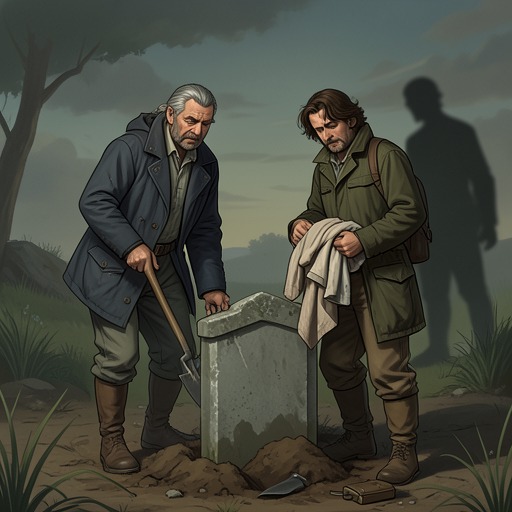
The Body as Proof of Death and a Means of Farewell
Fool Me OnceThe Body as Proof of Death and a Means of Farewell is the novel’s recurring question of how the living can know that someone is truly gone. A funeral and a death certificate may mark a death publicly, but neither necessarily gives a bereaved person the sight of the body that would make the loss emotionally undeniable. The idea gathers force around Joe Burkett’s closed-casket funeral and Caroline Burkett’s memories of Andrew Burkett: in both cases, the absence of a visible body leaves room for dreams, uncertainty, and imagined survival. By the ending, the novel complicates the demand for physical proof, suggesting that a bond with the dead may persist even when a person accepts that death has occurred.
Death and the Limits of What Can Be Felt
Maya’s response to death begins with an effort to detect something that might remain after the body has died. Standing alone beside the mound of earth that will cover Joe, she tries to sense a presence, as she has done in other mourning situations. She finds nothing. The passage considers the belief that life continues as energy, motion, or an eternal soul, but Maya’s repeated experience of being near the dead inclines her toward a harsher conclusion: nothing is left behind. Her search makes the body’s importance more than ceremonial. It is the material boundary between the life that was present and the possibility that some part of it remains.
Yet even Maya’s certainty does not remove the need for ritual. She stays at the graveside until Eileen Finn returns with Lily. At Joe’s funeral, Maya had left arrangements to his family and regarded the choice of a closed casket as unimportant to her; because Joe had been shot in the head, she understood why the family might not want the body displayed. Her acceptance is practical and emotionally detached, not a claim that seeing the dead never matters. Caroline’s later questions reveal how differently the same funeral arrangement can affect someone who needs a physical encounter to accept a loss.
Joe Burkett’s Funeral and Official Proof
The closed casket becomes newly significant when the family’s probate proceedings reveal that Joe has no official death certificate. Nearly two weeks after his death, the family has held a funeral, but the legal process still requires proof. Heather explains that because Joe was murdered, verification from official authorities within the police department is needed; an associate is checking the relevant case law, and the delay may last another day or two. The contrast is stark: the funeral has already enacted the family’s farewell, while the paperwork has not yet established the death for probate.
That delay changes the meaning of the casket. Maya had not chosen it; she had let Joe’s family make the decision, assuming the ritual would help them. Caroline tells her that she asked to see Joe’s body and was refused. Her question—whether Maya herself saw him—exposes a gap between attending a funeral and having direct confirmation of the person’s death. The closed casket can protect mourners from a disturbing sight, especially after a fatal head wound, but it can also withhold the very evidence a bereaved person seeks. In Joe’s case, the absence is both physical and bureaucratic: Caroline was denied the body, and the authorities have not yet supplied the official proof.
Caroline Burkett’s Need for Closure
Caroline explains her insistence on seeing Joe by turning to the military practice Maya knows: bringing the dead home because, as Maya puts it, those who serve do not leave anyone behind. Caroline accepts the duty to honor the dead but argues that recovering a body also serves the family. The dead can no longer benefit from its return; loved ones need to see the deceased so that the loss becomes real and they can find closure. Her reasoning shifts the emphasis from what is owed to the dead to what survivors need in order to recognize death.
Andrew’s death at sea made that need unresolved for Caroline. She was young when she was told his body had been recovered, but no one showed it to her; that funeral, too, had a closed casket. She still dreams of Andrew alive, standing by the soccer net and making saves. She knows he died in an accident, yet says she also does not know, because the absence of a body leaves an opening between knowledge and felt certainty. At times she imagines that he survived the fall, swam away, and lives on an island. The imagined survival does not function as proof that Andrew is alive; it expresses how grief can continue when the loss was never made tangible to her.
Caroline sees Joe’s funeral repeating the same conditions. She begged to see his body, even if his injuries made the sight disturbing, because she hoped that seeing it would help her accept that he was gone. Her request was refused by two of her brothers, and the missing death certificate compounds her unease. She connects Joe’s unviewed body with Andrew’s and recognizes a pattern: both brothers died young, and in neither case was she allowed to see the body. That resemblance draws her toward the possibility that either man might still be alive. Maya answers that they are not, but Caroline’s account makes clear why assertion alone cannot supply the evidence or closure she was denied.
From Material Closure to Continuing Bonds
The novel does not treat the body as a simple cure for grief. Caroline believes that seeing Joe could have made his death real to her, but her memories of Andrew show how the lack of that encounter can endure for years in dreams and imagined alternatives. Maya’s own grave-side search reaches the opposite conclusion—there is no life force left—yet the act of searching and her continued presence beside Joe’s grave show that a rational belief about death does not cancel the need to address the dead. The body matters because it can confirm an ending for the living, not because it can undo the relationship that preceded it.
The final movement revises Maya’s earlier certainty without supplying a literal return. Shane sees Lily smile with her mother’s smile, and, when the family has named a new baby Maya, he thinks again about the conversations he and Maya had about death. They had treated death as final; in the moment, Shane is no longer sure they understood it completely, and he feels that Maya is present. The image locates that presence in resemblance, memory, and naming rather than in a recovered body. Where Caroline searches for a corpse to make death undeniable, the ending imagines a different form of continuing connection: the dead remain consequential in the lives of those who love them. The novel therefore leaves the body essential as evidence and as a means of farewell, but not as the only measure of whether a relationship endures.