The Farnwood Shooting and Nanny-Cam Livestream
Fool Me OnceThe Farnwood Shooting and Nanny-Cam Livestream brings the Burkett family’s private crimes into public view. Maya enters the family home prepared to confront Judith, Neil, and Caroline with what she has learned; the nanny camera above the fireplace turns that confrontation into a live broadcast. Neil’s three shots make the episode a sudden struggle for life, while the camera ensures that the family’s version of events cannot remain the only one available.
The Camera and the Unstable Record
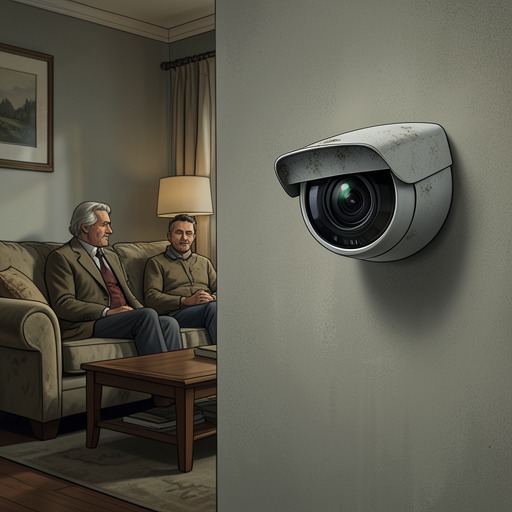
The device at the center of the event began as a gift from Eileen: a digital picture frame that concealed a nanny camera. It had already complicated Maya’s sense of what the household could see and record. On one occasion, the camera had switched on again with its view blocked. Maya first suspected Isabella, but the visible shirt was green rather than the red blouse Isabella had worn the previous day. Later, Maya checked the device and discovered that its SD card was missing. These earlier disturbances make the camera more than a simple household accessory: its image can be obstructed, its stored record can disappear, and its presence creates uncertainty about who has access to the home’s private scenes.
That uncertainty has a wider context. Eileen tells Maya that she received photographs taken inside her own house from an anonymous email address and believes Robby is responsible. The images include her children in the den and a photograph of Eileen herself at home. The episode does not establish that the same person or method connects those photographs to the Farnwood camera, but the episode’s surveillance thread repeatedly places intimate domestic spaces within reach of unseen watchers. At Farnwood, Maya changes the direction of that power: rather than merely being watched, the Burketts are made visible to an audience they cannot manage.
Maya’s Confrontation with the Burketts
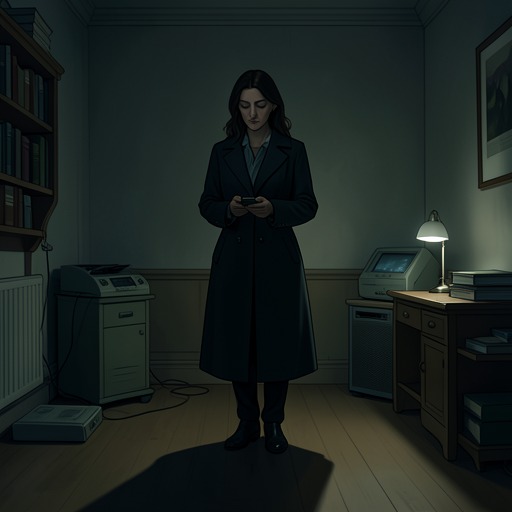
Maya waits in the foyer as Judith returns with Neil and Caroline. She does not greet their arrival with an attempt to flee or hide; she remains seated and begins with the simplest explanation for the apparent mystery. Drawing on Occam’s razor, she tells Judith that Joe did not survive the shooting and that Judith wanted Maya to believe otherwise. She then identifies Judith as the person behind the nanny-camera stunt, which was meant to unsettle her after Judith had told Rosa’s family that Maya killed Joe. Judith does not deny arranging it, instead challenging whether there is any law against trying to catch a killer.
Maya’s questions shift the confrontation from the camera trick to the knowledge behind it. She asks how Judith knew she had killed Joe. Judith’s response treats the question as an admission; Maya accepts that she killed him but argues that Judith knew because she understood Maya’s motive. Maya states that Joe murdered her sister, Claire, and says Judith knew it. Caroline rejects the accusation, but Maya’s claim turns the family’s apparent concern about Joe’s death into a confrontation over what they knew about his violence.
Maya also challenges Neil’s assumption that the crisis was only about protecting the family fortune and the EAC Pharmaceuticals scandal. She lays out her account of his actions: as the scandal gathered force and he lost faith in Judith’s plan, Neil sent the kidnappers after her to discover what she knew. He had also told them about her mental state and the phrase about Joe waiting for her, intending to weaken her. Neil confirms that the plan was meant to make her falter. Judith’s brief response that it was stupid marks the collapse of the family’s effort to keep control of the situation.
The Crimes Behind the Family’s Story
Maya insists that Joe’s culpability extends beyond Claire’s murder. She names Theo Mora and Tom Douglass as further victims, refusing to let the family contain Joe’s crimes within the explanation of the pharmaceutical scandal. When Judith dismisses Theo’s death as a hazing incident gone wrong, Maya brings forward what Christopher Swain told her: Andrew was cracking, and on the boat he told Joe he planned to turn them all in for what they had done to Theo. Andrew then went alone to the top deck, and Joe followed him. The account gives the confrontation a second family secret: Andrew’s death at sea is tied to his intention to expose the group’s conduct, not merely to an unexplained loss.
Judith attempts to redirect the consequences. She proposes blaming the EAC Pharmaceuticals scandal on Joe and allowing the family to present his death as justice served, arguing that this would spare the others from having to live under suspicion and might also protect Maya. Her appeal acknowledges both her responsibility and her wish to protect her remaining children, but it would make the public account another deliberate concealment. Maya refuses the proposed deal. Neil then offers a different solution: he will shoot her and portray her as an armed intruder who admitted killing Joe and was about to kill the family. Judith smiles, and Caroline nods. In that moment, the three Burketts appear to close ranks around Neil’s plan.
The Shooting and the Public Aftermath
Neil fires three times. The number echoes the three shots Maya fired at Joe, turning the repetition into a grim reversal: the person who had survived the earlier shooting is now on the floor, unable to move. As voices around her discuss checking her pockets and observe that she has no gun, Maya smiles toward the fireplace. The gesture points to the camera above it and to a record of the scene that the family’s staged account cannot easily erase.
Shane later explains that Maya had arranged the broadcast after asking him to keep an eye on Hector and Isabella. She contacted someone working with Corey Rudzinski; the person’s name remained unknown, but that contact helped set up a live feed using the nanny camera. People around the world watched what happened inside the Burkett home as it happened. The broadcast begins as an act of deliberate exposure, but its ending was not what anyone expected: the public sees a murder unfold before their eyes.
The livestream therefore reverses the camera’s earlier uncertainty. A device associated with hidden domestic observation becomes a means of public witnessing, and the family’s attempt to silence Maya is itself recorded. Shane recalls that the exposure brought Corey Rudzinski’s site enormous attention and, in its wake, helped people who had been afraid to speak come forward against corrupt governments and businesses. The scene’s consequence is both immediate and broader: the Burketts cannot keep the shooting private, and the technology Maya used to expose hidden truths carries the family’s violence beyond Farnwood.