Tom Douglass
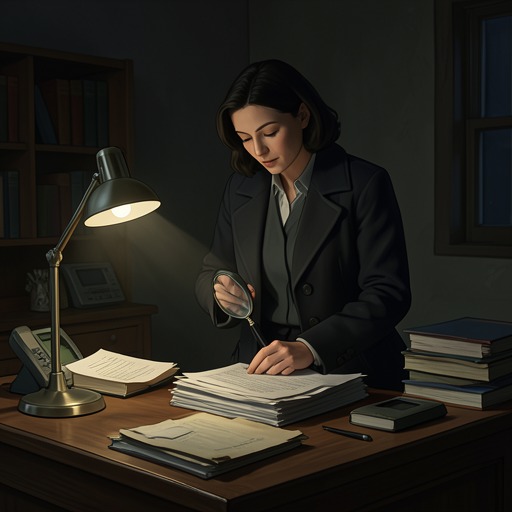
Fool Me OnceTom Douglass is a former United States Coast Guard investigator turned private investigator whose work connects the Burkett family’s account of Andrew Burkett’s death at sea to Claire Walker’s later investigation. Although Tom is reconstructed largely through other people’s discoveries, his career, the family’s continuing payments, and his death in a locked storage shed make him a crucial link in Maya Stern’s search for what Claire uncovered.
Identity and Background
Tom served in the United States Coast Guard and investigated the maritime death of Andrew Burkett. He later retired from service and opened Tom Douglass Investigations, a small, one-man private-investigation business based in Livingston, New Jersey. The work he generally took on was comparatively ordinary: marital investigations and background checks. He had retired from private practice three years before Maya began tracing his name, but the payments associated with his business had not stopped.
Tom’s wife, Mrs. Douglass, knew that he had investigated Andrew’s death and that the case was how he first met the Burkett family. She told Maya that the family had been pleased with his work and hired him again after he opened his own business. That account establishes a public explanation for the later relationship: a family impressed by a former investigator’s work retained him as a private client. Maya, however, came to suspect that the original maritime investigation had created a more consequential obligation.
The Burkett Connection and Claire’s Investigation
The financial trail gives Tom’s old business an unsettling afterlife. A printout shown to Maya lists monthly payments of nine thousand dollars to Tom Douglass Security. The amount matches the purported secret payments to Roger Kierce, raising the possibility that the two payment streams were connected, though the matching sums alone do not establish why either payment was made. Tom’s retirement did not end the transfers, and the money was still coming years after he had stopped working.
Corey Rudzinski explains that Tom had been a local private investigator whose business mostly handled domestic cases and background checks. That ordinary profile makes the sustained payments harder for Maya and Corey to dismiss as routine. Corey also distinguishes Tom’s trail from Claire’s work on EAC Pharmaceuticals: according to what Claire told him, Tom had nothing to do with that company. Claire believed instead that he was connected to something bigger, a distinction that redirected Maya’s search from one corporate lead toward the Burkett family’s older dealings.
When Maya speaks with Mrs. Douglass, she puts forward her suspicion that the family had hired Tom to report Andrew’s death as an accident. Mrs. Douglass confirms the known sequence—Tom investigated Andrew’s death, met the family through the case, and was hired again—but the exchange does not independently establish Maya’s accusation as fact. The gap between the widow’s explanation and Maya’s theory is central to Tom’s role: his work may have begun as a formal investigation, but what he learned appears to have given the family a continuing reason to pay him.
Disappearance and Discovery
Tom disappears while his wife is trying to understand what he was doing. His private routines leave a narrow digital trace: he still uses AOL, and he has sent or read no email for almost a month, the same period in which his wife says he vanished. Corey finds a recent message from Julian Rubinstein about an unpaid bill. Rubinstein rents Tom a storage shed behind a body shop in Livingston, and Tom pays him in cash rather than through automatic card payments or paperwork. The missed payment is what prompts Rubinstein’s reminder, giving Maya and Corey a concrete lead to follow.
Maya and Corey go to the shed together. Corey brings a gym bag containing ski masks, flashlights, and a chain cutter; the cutter slices through the padlock. When the door opens, an arm protrudes from inside. The rest of the body begins to slip out, badly decomposed. Maya identifies the corpse as Tom from its size, gray hair, and comparison with photographs she had seen. The shed itself is empty beyond the body, an absence that offers no immediate explanation of what Tom kept there or why he was placed inside it.
The discovery does not settle the case. At the scene, Maya says the lock was already broken when she arrived and that she called the police after seeing the arm. She tells investigators that Claire had spoken with Tom not long before Claire was murdered and that she wanted to learn why. Later, Roger Kierce confronts Maya with blood found in the trunk of her car: it is type AB-positive, the same blood type as Tom. The finding adds a direct forensic connection between Tom and Maya’s car, but the evidence presented does not explain how the blood got there or identify who killed Tom.
Narrative Role and Significance
Tom’s importance lies in the way the investigation reconstructs him through separate, initially ambiguous traces: a former Coast Guard inquiry, a family’s later hiring of him, monthly payments continuing after retirement, Claire’s private inquiry, an overdue cash-paid storage bill, a body, and blood in Maya’s trunk. Each clue changes the meaning of the previous one without, by itself, resolving the mystery. The payments could appear to be a legitimate retainer; Claire’s insistence that Tom was not connected to EAC Pharmaceuticals shifts attention elsewhere; and the shed’s hidden corpse turns a financial lead into a death investigation.
His case also gives Maya a route back to the question Claire left behind. Claire had spoken to Tom shortly before her own murder, and Maya’s search for the reason brings her to the storage shed and its concealed body. Tom therefore serves as both an investigator from the past and a victim whose unfinished work may expose the Burketts’ attempt to shape the account of Andrew’s death. The available evidence establishes his professional connection to the family and the discovery of his corpse, but it does not disclose everything Claire learned, the precise purpose of the continuing payments, or the circumstances that led to Tom’s death.