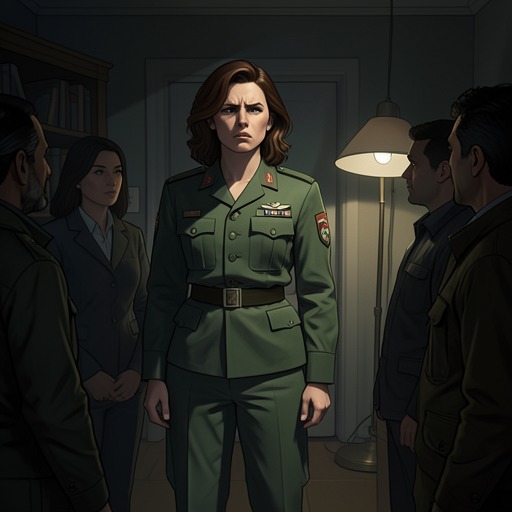
War Guilt and the Continuing Burden of Responsibility
Fool Me OnceWar Guilt and the Continuing Burden of Responsibility is the moral conflict at the heart of Maya Stern’s combat trauma: her flashbacks do not simply express remorse for civilian deaths, but return her to a choice she still believes she would make again. The novel’s decisive distinction is between suffering because she feels guilty and suffering because she recognizes what she chose—and cannot promise she would choose differently.
The rescue mission and the withheld authorization
The wound begins during a rescue mission near Al Qa’im. Four soldiers, including three Maya knew and loved, have been killed in an ambush; two others are pinned down while a black SUV approaches. Maya and Shane fly a Boeing MH-6 Little Bird gunship toward the vehicle as the surviving soldiers call for help. Their pleas reach the helicopter clearly, while the radio signal from Joint Operations Command at Al Asad keeps breaking up. The contrast makes the delay urgent: Maya and Shane wait for confirmation even as the soldiers’ screams make the danger immediate.
The later revelation changes the meaning of that wait. Maya tells Shane that Joint Operations Command had not authorized the strike. Its message was to hold off: at least one person in the SUV might be a civilian, possibly underage, and the assessment that its occupants were enemies was only about fifty-fifty. Maya had turned off Shane’s signal and relayed the information as though they had received permission. The apparent failure of communications had concealed a more consequential fact: the warning had reached Maya, and she chose not to pass it on.
Maya fires an AGM-114 Hellfire missile at the SUV. It explodes, and infantry reach the two trapped soldiers; both have been hit, but both survive. The rescue is real, as is the later disclosure that five noncombatants were killed, including a mother of two. The event therefore resists an uncomplicated account of either success or failure. The soldiers’ survival cannot undo the civilian deaths, while the deaths do not erase the immediate lives Maya believed she could still save.
A choice, not an innocent mistake
For a time, the mission appears righteous to Maya. In a later conversation, Shane recalls that they waited and followed protocol, and insists the civilian deaths were not their fault. Maya corrects him: they never received authorization. When he repeats that he heard the go-ahead, she explains that she had relayed it to him. Her admission removes the protection of a shared misunderstanding. Shane had acted on the account she supplied; Maya had acted on information she withheld.
Maya names her priority directly: she cared about the trapped soldiers, not the civilians. She had already lost people on her watch and refused to lose another if she could prevent it. That motive gives the decision its human force, but does not make it authorized or remove its cost. Her explanation is not that she mistook civilians for enemies; she accepted the possibility of civilian deaths as collateral damage. The ethical conflict lies in the collision between urgency and restraint, and in her choice to resolve it herself after receiving an order to hold off.
Flashbacks and the limits of therapeutic explanation
The mission returns through auditory flashbacks, carrying the cries of the soldiers into Maya’s later life. Ricky Wu suggests that her guilt over the dead civilians manifests in those episodes and that forgiving herself might make her nights easier. Maya rejects the neatness of that account. She objects to the idea that guilt is simply the obstacle she must remove to recover. Ricky acknowledges that forgiveness is not a cure, only a possible relief, but Maya’s response exposes how little the word guilt explains about her experience.
The difference is not that Maya feels nothing. She hates that five noncombatants were killed, and the conversation forces her to face the circumstances of their deaths. But she denies that civilian deaths are what haunt her most. What persists is her knowledge that the choice was hers—and that, placed in the same position, she would make it again. The flashback is thus not only a return of pain; it is a return to an unresolved judgment about her own conduct. Its repetition does not settle the question or transform the decision into an accident.
Responsibility carried into family life
The novel extends the mission’s consequences beyond the battlefield without suggesting that the later deaths were a direct physical result of the missile strike. Maya looks at children and families enjoying an ordinary day with Eddie and thinks of how distant war seems to those who feel safe. The narration overturns that apparent distance: war has touched Claire, and Maya understands her own actions in the helicopter as an echo that eventually reached her sister.
Maya’s belief that Claire would still be alive if she had not made mistakes over Al Qa’im is presented as painfully powerful self-blame, not as proof that the strike directly caused Claire’s death. What connects the events is the burden Maya carries: the earlier decision becomes inseparable, in her mind, from the later loss. Daniel and Alexa remain amid the scene of family life, but their happiness is shadowed by the absence of Claire. The war’s reach is rendered not as a battlefield transported intact into civilian space, but as a history Maya cannot keep separate from the people she has lost.
Responsibility without resolution
Corey Rudzinski offers another measure of responsibility when he explains that he thought Maya would have to live with what she had done, and that this might itself be punishment enough. His response recognizes the enduring burden without claiming it repairs anything. It also differs from Ricky Wu’s therapeutic hope: where Ricky speaks of easing Maya’s nights, Corey speaks of accountability that may remain with her.
The final confrontation with Shane refuses an easy resolution. Maya confesses both the concealed warning and the reason for her choice, then identifies what truly lingers: not remorse that guarantees she would act differently, but the certainty that she would repeat the decision. The continuing burden is therefore not reducible to a lesson learned or a guilt that can simply be released. Maya must live with the civilian deaths, the lives she saved, the truth she withheld from Shane, and her own recognition that the same priorities might govern her again.