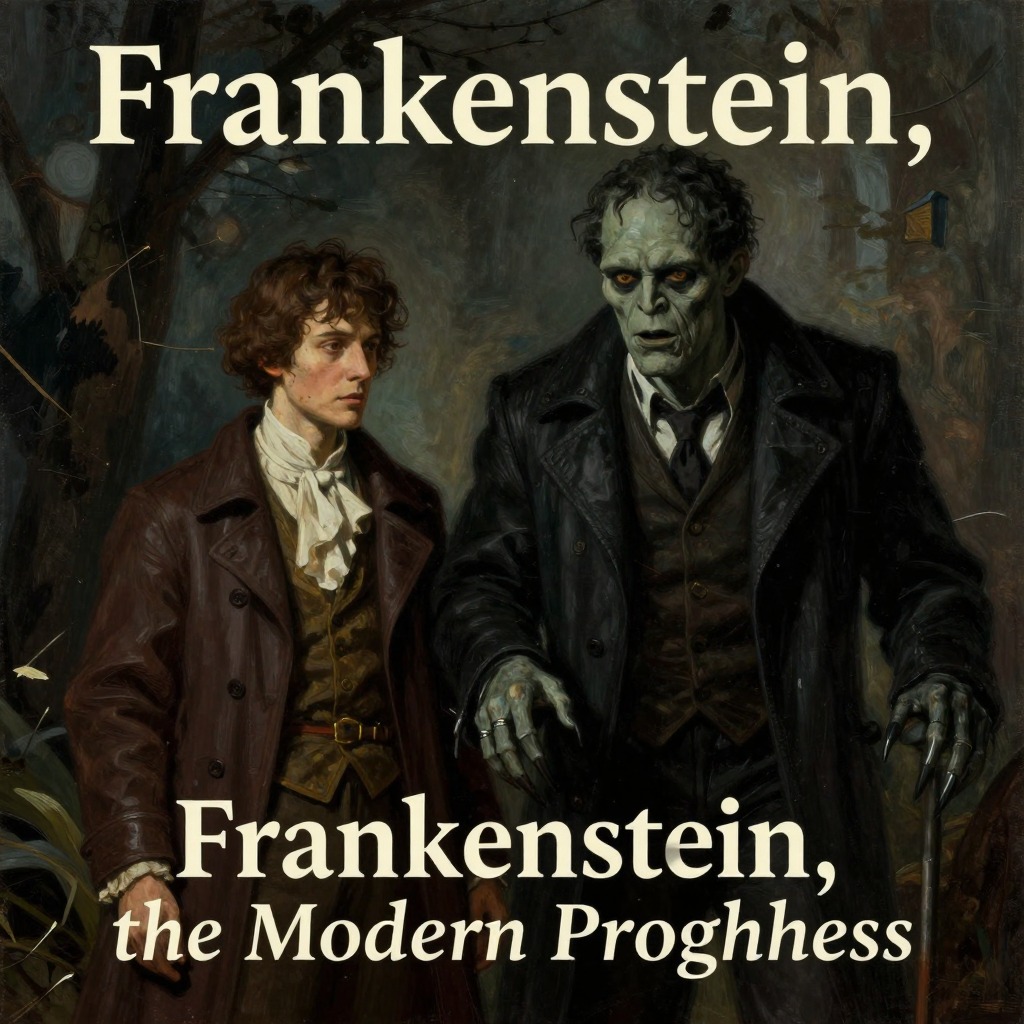
I am malicious because I am miserable
Frankenstein, or the Modern PrometheusThe monster's statement "I am malicious because I am miserable" stands as the most concise and powerful expression of the novel's core moral philosophy. Uttered during his confrontation with Victor Frankenstein on the glacier of Montanvert, this declaration encapsulates the creature's entire tragic trajectory: he was not born evil but became so through the relentless misery inflicted by his creator's abandonment and humanity's rejection. The line functions as both a self-diagnosis and an indictment, transforming the monster from a mere Gothic horror figure into a complex, suffering being whose crimes are presented as consequences rather than innate depravity.
Origin and Context of the Statement
The words emerge at a pivotal moment in the monster's narrative, after he has recounted his early experiences of isolation and rejection. Having described his benevolent intentions and his painful education in human cruelty, the monster directly addresses Victor's accusation of murder. He argues that his malice is a direct result of his misery, not an inherent quality. The full passage reads: "I am malicious because I am miserable. Am I not shunned and hated by all mankind? You, my creator, would tear me to pieces and triumph; remember that, and tell me why I should pity man more than he pities me?" . This reasoning establishes a moral calculus: the monster's evil actions are presented as a response to the evil done to him, a cycle of cause and effect that Victor himself set in motion.
The Monster's Early Benevolence and Its Destruction
The monster's claim that misery created his malice is grounded in the detailed account of his early life. After his creation, he experienced a period of innocent confusion and curiosity, learning to distinguish sensations and finding pleasure in nature . His initial encounters with humanity were marked by a desire for connection, not destruction. He secretly helped the De Lacey family by gathering wood and clearing snow, taking joy in their happiness . However, every attempt at direct human contact ended in violent rejection. When he finally revealed himself to the blind De Lacey, hoping for acceptance, Felix's horrified attack shattered his hopes . This pattern of rejection—from the villagers who stoned him, from the De Laceys who fled, from the rustic who shot him after he saved a drowning girl—systematically transformed his benevolent nature into vengeful malice. As he later tells Victor, "I was benevolent and good; misery made me a fiend" .
The Ethical Argument and Its Implications
The statement "I am malicious because I am miserable" functions as a sophisticated ethical argument that challenges simple notions of good and evil. The monster presents himself as a being whose moral character is shaped by his circumstances, not by any fixed essence. He argues that Victor, as his creator, bears responsibility for this transformation: "Remember, thou hast made me more powerful than thyself... I will be even mild and docile to my natural lord and king if thou wilt also perform thy part, the which thou owest me" . This places the novel's moral weight on the concept of creator's responsibility. The monster's malice is presented as a predictable outcome of abandonment and cruelty, not a mysterious or supernatural evil. Victor himself, in his final moments, acknowledges this logic, telling Walton that he was bound to assure the creature's happiness and well-being .
The Statement's Role in the Monster's Character Arc
The declaration recurs throughout the monster's narrative as a refrain that explains his escalating violence. After the De Laceys' departure, he declares "everlasting war against the species" , and after being shot while rescuing a child, he vows "eternal hatred and vengeance to all mankind" . Each act of cruelty he commits—the murder of William, the framing of Justine, the killing of Clerval, the murder of Elizabeth—is framed as a response to the misery of his isolation. Yet the statement also contains a tragic irony: the monster's self-awareness of this causal chain does not free him from it. He recognizes that his misery makes him malicious, but he cannot escape the cycle. In his final appearance, he tells Walton that even after destroying Victor's hopes, he did not satisfy his own desires: "still I desired love and fellowship, and I was still spurned" . The statement thus becomes a lament as much as a justification.
Thematic Significance and Narrative Function
"I am malicious because I am miserable" serves as the novel's most direct articulation of its central theme: the danger of knowledge without responsibility and the consequences of abandonment. The statement challenges the reader to sympathize with a murderer by presenting his crimes as the product of suffering rather than innate evil. It also functions as a critique of a society that judges by appearances, since the monster's ugliness provokes the very rejection that creates his malice. The line resonates with the novel's epigraph from Paradise Lost and its subtitle "The Modern Prometheus," suggesting that Victor, like his mythical counterpart, has created a being whose suffering he cannot control. The monster's final words to Walton echo this theme: "I was nourished with high thoughts of honour and devotion. But now crime has degraded me beneath the meanest animal" . The statement thus encapsulates the novel's tragic vision: that misery, not inherent evil, is the root of malice, and that those who create life bear an inescapable responsibility for the suffering that follows.