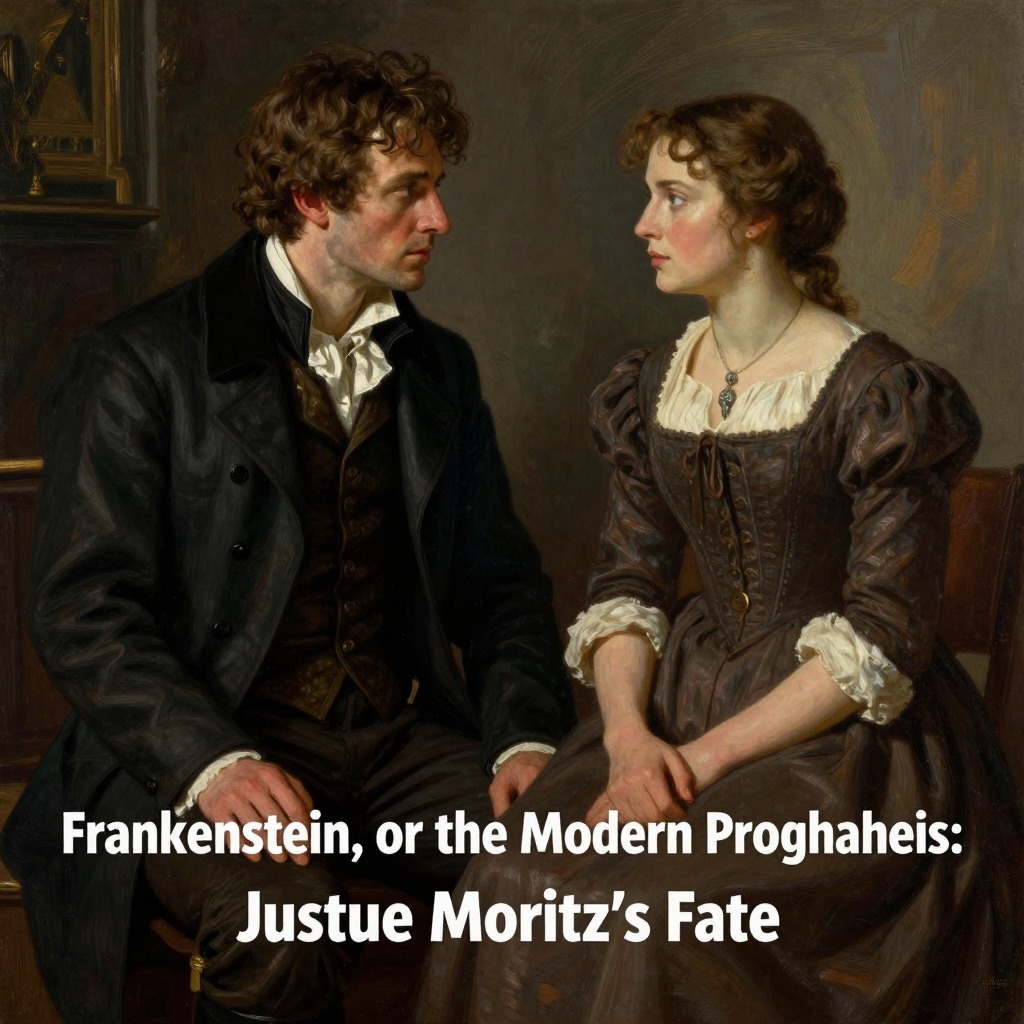
Justine Moritz and the Frankenstein family
Frankenstein, or the Modern PrometheusJustine Moritz enters the Frankenstein household as a child and becomes a beloved servant, but her life is shattered when she is wrongfully executed for the murder of William Frankenstein. Her death, a direct consequence of the monster's first act of violence, transforms her from a minor character into a central symbol of the novel's themes: the destruction of innocence, the failure of justice, and the catastrophic ripple effects of Victor's abandonment of his creation. Justine's fate is not merely a plot device; it is the event that crystallizes Victor's guilt and sets the monster on a path of deliberate, escalating revenge against the Frankenstein family.
Identity and Introduction
Justine Moritz was the third of four children born to Madame Moritz, a widow who, after the death of her husband, treated Justine with inexplicable cruelty. The girl had always been her father's favorite, but her mother could not endure her. Caroline Beaufort, Victor's mother, observed this mistreatment and, when Justine was twelve years old, prevailed upon Madame Moritz to allow the girl to live with the Frankenstein family. In Geneva, where republican institutions fostered simpler and more refined manners among all classes, a servant was not degraded. Justine learned the duties of a servant without sacrificing her dignity. She became a great favorite of young Victor, who remarked that one glance from her could dissipate his ill humor, for she looked so frank-hearted and happy. Caroline conceived a great attachment for Justine and gave her an education superior to what had been originally intended. Justine repaid this kindness with profound gratitude, adoring her protectress and endeavoring to imitate her phraseology and manners, so that even after Caroline's death, she often reminded the family of her.
Service, Devotion, and the First Blow
When Caroline Frankenstein fell ill with scarlet fever, which she had contracted while nursing Elizabeth, Justine attended her with the most anxious affection. After Caroline's death, Justine herself fell very ill. Further trials followed: one by one, her brothers and sister died, and her mother, left childless except for the neglected daughter, came to believe that the deaths were a divine judgment on her own partiality. A few months after Victor's departure for Ingolstadt, Justine was called home by her repentant mother. The poor woman was vacillating in her repentance, sometimes begging forgiveness, more often accusing Justine of causing the deaths of her siblings. Perpetual fretting threw Madame Moritz into a decline, and she died at the beginning of the winter. Justine then returned to the Frankenstein household, where Elizabeth Lavenza, who loved her tenderly, observed that grief had given a softness and winning mildness to her formerly vivacious manners.
The Murder of William and the Trial
On the evening of May 7th, the Frankenstein family, including William and Ernest, went for a walk in Plainpalais. William ran off to hide, and when he did not return, a search began. The next morning, Alphonse Frankenstein discovered the boy's body, with the print of a murderer's finger on his neck. A valuable miniature portrait of Caroline, which William had been wearing, was missing. The morning after the murder, Justine was taken ill and confined to bed. During this interval, a servant examining the clothes Justine had worn on the night of the murder discovered the miniature in her pocket. The servant showed it to another, who went to a magistrate, and Justine was apprehended. When charged, her extreme confusion was taken as confirmation of her guilt. At the trial, the evidence against her seemed damning: she had been out all night, was seen near the spot where the body was found, gave a confused account of her whereabouts, and fell into violent hysterics when shown the corpse. The discovery of the miniature in her pocket, which Elizabeth testified she had placed around William's neck just before he went missing, drew a murmur of horror from the court.
The Condemnation and Confession
Justine defended herself with composure, explaining that she had spent the night searching for the child and had sheltered in a barn when the city gates were shut. She could give no account of the picture. Despite Elizabeth's impassioned plea on her behalf, the judges condemned her. The ballots were all black. Victor, who knew the monster was the true murderer, was torn by a guilt he could not confess, for he believed his tale would be dismissed as the ravings of a madman. After the verdict, Justine confessed—a lie, she later told Elizabeth, extracted by her confessor, who threatened excommunication and hell fire if she remained obdurate. In the prison, she knelt at Elizabeth's feet, weeping, and declared her innocence. She faced her death with a resigned faith, telling Elizabeth, "Learn from me, dear lady, to submit in patience to the will of heaven!" On the morrow, Justine died on the scaffold.
Consequences and Thematic Significance
Justine's execution is the second death directly caused by the monster's actions and the first for which Victor feels an inescapable, personal responsibility. He had created the murderer; his silence, born of fear that he would be thought mad, condemned an innocent woman. This event deepens Victor's psychological torment, driving him to the brink of suicide and into a state of profound isolation. It also transforms Elizabeth, who had previously seen the world's evils as distant tales; now, "misery has come home." For the monster, the framing of Justine is his first calculated act of revenge against his creator, a demonstration that he can destroy Victor's happiness without being caught. Justine's fate thus serves as a crucial turning point: it solidifies the monster's turn toward deliberate malice and irrevocably binds Victor to a cycle of guilt, secrecy, and escalating tragedy that will consume his entire family.