Justine's innocence
Frankenstein, or the Modern PrometheusJustine Moritz, a young servant beloved by the Frankenstein family, is accused of murdering the child William Frankenstein. The evidence against her is circumstantial but damning: the miniature portrait of Caroline Beaufort, which William had been wearing, is found in her pocket; she was seen near the scene of the crime at an unusual hour; and her initial confusion under questioning is taken as a sign of guilt. Yet the reader, along with Victor Frankenstein and Elizabeth Lavenza, knows that Justine is entirely innocent. The true murderer is the monster Victor created, who placed the portrait on Justine's person to frame her. Justine's innocence is not merely a plot point but a profound moral indictment of a world in which appearance and prejudice can condemn the blameless, and in which Victor's silence—born of fear that his tale would be dismissed as madness—makes him complicit in her death.
Justine's Character and the Faith of Elizabeth
Justine is introduced as a girl of exceptional goodness. Elizabeth Lavenza, in a letter to Victor, recalls that Justine was a great favorite of his, and that her frank-hearted and happy look could dissipate his ill humor. After the death of Victor's mother Caroline, whom Justine had attended with the most anxious affection, Justine's own mother, Madame Moritz, called her home, where she was treated with alternating repentance and accusation. Upon her mother's death, Justine returned to the Frankenstein household, and Elizabeth declares, "I love her tenderly. She is very clever and gentle, and extremely pretty." Elizabeth's faith in Justine is absolute. When the accusation is made, Elizabeth is the first to cry out, "O God! I have murdered my darling child!"—blaming herself for having allowed William to wear the miniature. At the trial, Elizabeth speaks in Justine's defense, calling her "the most amiable and benevolent of human creatures" and stating that she would have willingly given her the bauble if she had desired it. Elizabeth's testimony is a powerful but ultimately futile appeal to the court's sense of justice.
The Trial and Justine's Defense
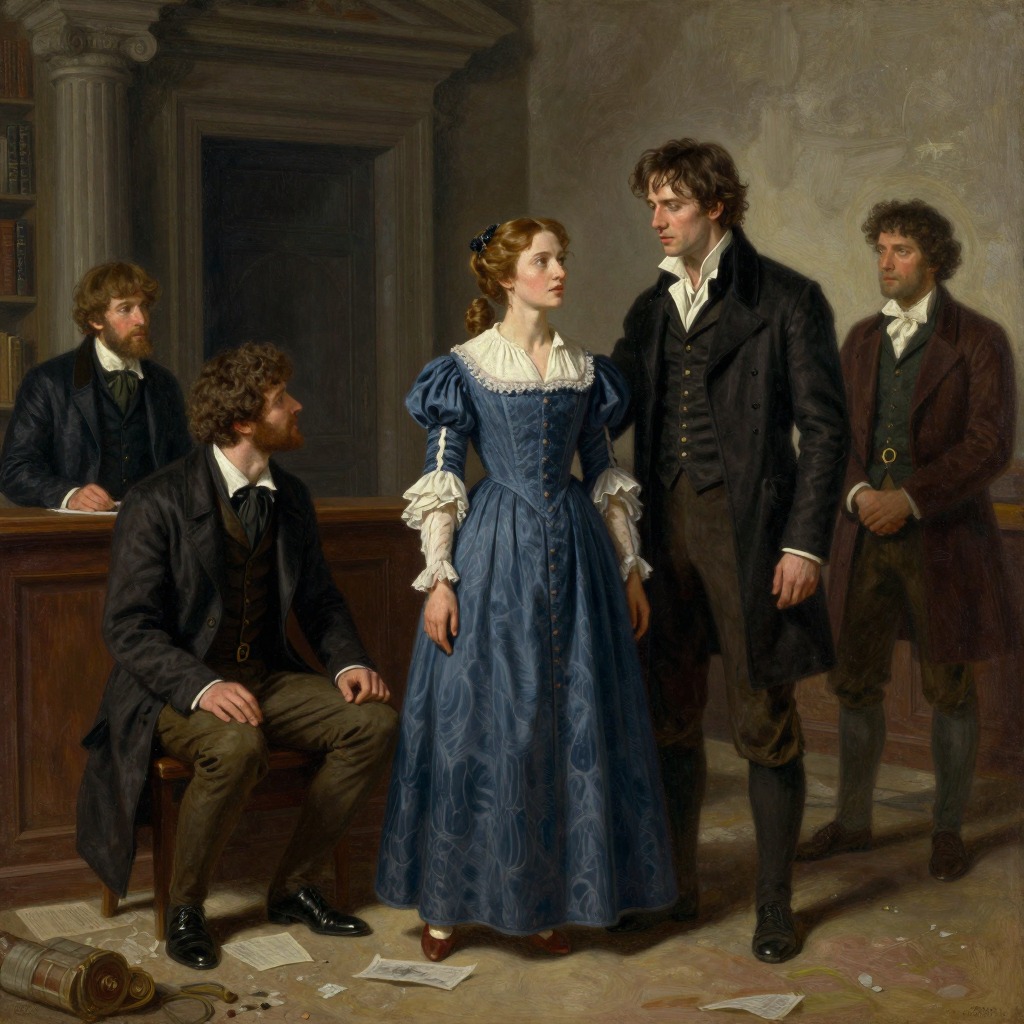
At her trial, Justine appears calm and dressed in mourning, her countenance rendered exquisitely beautiful by solemnity. She speaks in her own defense, declaring, "God knows how entirely I am innocent." She explains that she spent the evening of the murder at her aunt's house in Chene, that on her return she learned the child was lost and spent hours searching for him, and that when the gates of Geneva were shut, she took shelter in a barn. She cannot account for the portrait being in her pocket, saying, "I have no power of explaining it." Despite her coherent account and the character witnesses who speak well of her, the court is swayed by the weight of circumstantial evidence and the public's thirst for a culprit. The judges condemn her, and she is sentenced to death.
The False Confession and the Weight of Guilt
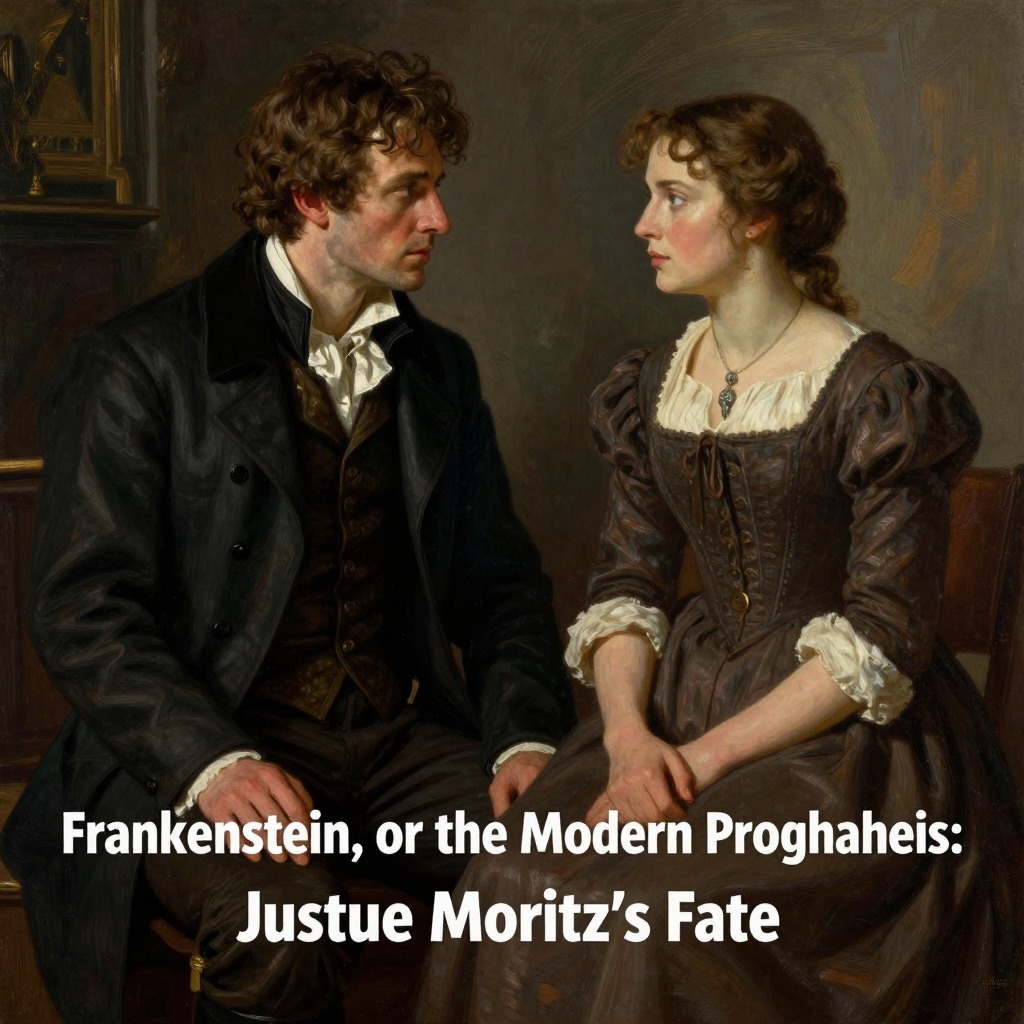
In prison, Justine confesses to the crime—but it is a lie, extracted under duress. She tells Elizabeth and Victor that her confessor threatened her with excommunication and hell fire if she remained obdurate. "In an evil hour I subscribed to a lie," she says, "and now only am I truly miserable." She expresses no fear of death, but rather a desire to be remembered as one unjustly condemned. Victor, who knows the truth, is tormented by his own guilt. He reflects that he is "the true murderer," and that the fangs of remorse tear his bosom. He considers confessing publicly but knows his tale would be dismissed as the ravings of a madman. Justine is executed on the scaffold, and Victor's prophetic soul declares that her death is only the first of many. The injustice of her fate haunts Victor throughout the novel; in his feverish ravings after the murder of Henry Clerval, he calls himself "the murderer of William, of Justine, and of Clerval." Even in his final pursuit of the monster, the memory of Justine's innocence fuels his rage and his sense of a curse that cannot be lifted.
Thematic Significance: Innocence as a Casualty of Ambition
Justine's innocence is the novel's clearest demonstration of how Victor's transgressive ambition destroys not only himself but the innocent around him. She is a victim not of her own actions but of Victor's secret and the monster's malice. Her death transforms Elizabeth's view of the world; Elizabeth tells Victor, "Men appear to me as monsters thirsting for each other's blood." The execution of an innocent girl, despite the efforts of those who love her, underscores the novel's critique of a justice system that relies on circumstantial evidence and public prejudice. Justine's fate also deepens Victor's isolation and despair, as he carries the knowledge of her innocence and his own responsibility, a burden that drives him further into madness and revenge. Her story is a recurring wound in the narrative, a reminder that the pursuit of forbidden knowledge has consequences that extend far beyond the knower.