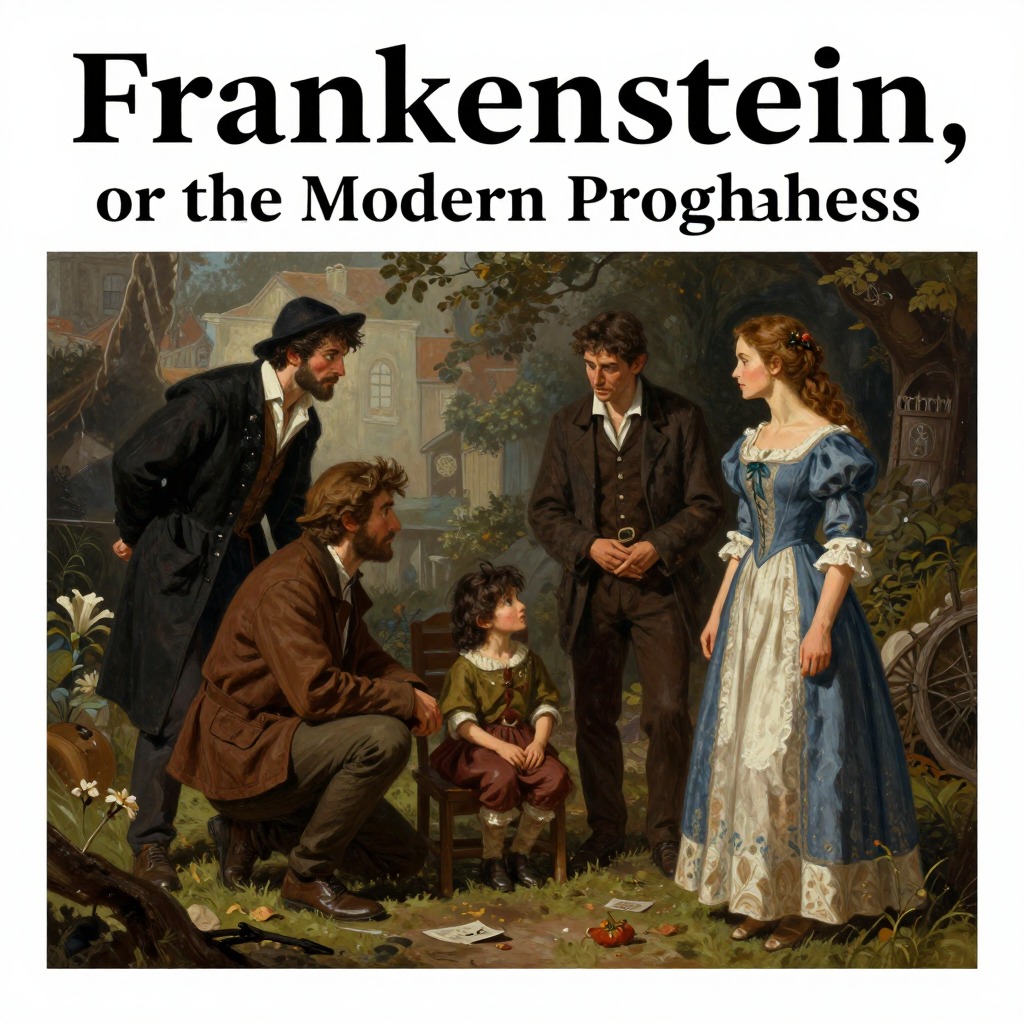
Letters of Felix and Safie
Frankenstein, or the Modern PrometheusThe Letters of Felix and Safie are a set of written documents that the monster discovers and preserves during his time in the hovel attached to the De Laceys' cottage. They become a vital piece of evidence within the nested narratives of the novel, serving both to illuminate the backstory of the family he observes and to later corroborate the truth of his own incredible account to Robert Walton.
Origin and Discovery
The monster finds the letters among the possessions of Felix and Agatha, who often have them in their hands. During his residence in the hovel, he procures the implements of writing and makes copies of these letters, which he later presents to Victor Frankenstein and, through him, to Walton. The letters are written by Safie to Felix during the period of her father's imprisonment and their subsequent escape. They are composed in French, a language Safie learns with the aid of an old servant, and they express her thoughts and feelings to her lover.
Content and Historical Significance
The letters reveal the full story of the De Laceys' ruin. They detail how Felix, moved by the injustice of the Turk's death sentence, vowed to free him. The Turk, in gratitude and perceiving Felix's love for his daughter, promised Safie's hand in marriage. The letters themselves, which Safie wrote to Felix, are filled with ardent thanks for his intended services to her father and gentle laments about her own fate. They also contain Safie's personal history: her mother was a Christian Arab who taught her to value independence and intellect, making the prospect of returning to a Turkish harem abhorrent. The letters thus explain the family's exile, their poverty, and the deep sorrow that the monster witnesses upon his arrival.
Role as Evidence and Narrative Function
The letters serve a crucial function as physical proof within the story's frame. When Victor Frankenstein, near death, recounts his tale to Robert Walton, the monster's narrative is embedded within it. Walton, initially awestruck but potentially skeptical, is brought to a greater conviction of the truth of Frankenstein's story not merely by his earnest assertions, but by the tangible evidence of the letters. Walton explicitly states that "the letters of Felix and Safie, which he showed me, and the apparition of the monster seen from our ship, brought to me a greater conviction of the truth of his narrative than his asseverations." This makes the letters a key device for bridging the gap between the seemingly impossible tale and the reader's (and Walton's) suspension of disbelief. They transform the monster's subjective experience into a documented, verifiable history.
The Monster's Education and Self-Perception
Beyond their evidentiary role, the letters are instrumental in the monster's intellectual and emotional development. He studies them diligently as he learns to read, and they open for him a wide field of wonder and delight. Through them, he gains a cursory knowledge of history, society, and the division of property, which leads him to a painful self-awareness. He learns of "immense wealth and squalid poverty, of rank, descent, and noble blood" and is forced to confront his own utter lack of any such advantages. The letters, along with the books he finds (Paradise Lost, Plutarch's Lives, and The Sorrows of Werter), deepen his understanding of human society and his own monstrous isolation, fueling both his desire for companionship and his eventual despair.