The Oath of Revenge
Frankenstein, or the Modern PrometheusThe Oath of Revenge is the solemn vow sworn by Victor Frankenstein at the graves of his murdered family, dedicating his life to the destruction of the monster he created, a pledge that transforms his existence into a relentless pursuit across the globe and ultimately defines his tragic end.
Origin and Context
The oath arises from the deepest well of Victor's despair. After the monster murders Elizabeth on their wedding night and Victor's father, Alphonse Frankenstein, dies of grief in his arms, Victor finds himself utterly desolate. He is released from a madhouse, and the memory of his misfortunes presses upon him. He begins to reflect on their cause—the monster he had created and sent abroad for his destruction. A maddening rage possesses him, and he desires and ardently prays to have the monster within his grasp to wreak a great and signal revenge on his cursed head. This internal fury crystallizes into a formal vow when Victor, having quitted Geneva, finds himself at the entrance of the cemetery where William, Elizabeth, and his father repose. Everything is silent except the wind in the trees; the night is nearly dark. The deep grief excited by the scene quickly gives way to rage and despair. They are dead, and he lives; their murderer also lives, and to destroy him Victor must drag out his weary existence. Kneeling on the grass and kissing the earth, he exclaims with quivering lips, "By the sacred earth on which I kneel, by the shades that wander near me, by the deep and eternal grief that I feel, I swear; and by thee, O Night, and the spirits that preside over thee, to pursue the daemon who caused this misery, until he or I shall perish in mortal conflict." He calls on the spirits of the dead and the wandering ministers of vengeance to aid and conduct him in his work, concluding with a plea that the cursed and hellish monster drink deep of agony and feel the despair that torments him.
The Monster's Response and the Pursuit
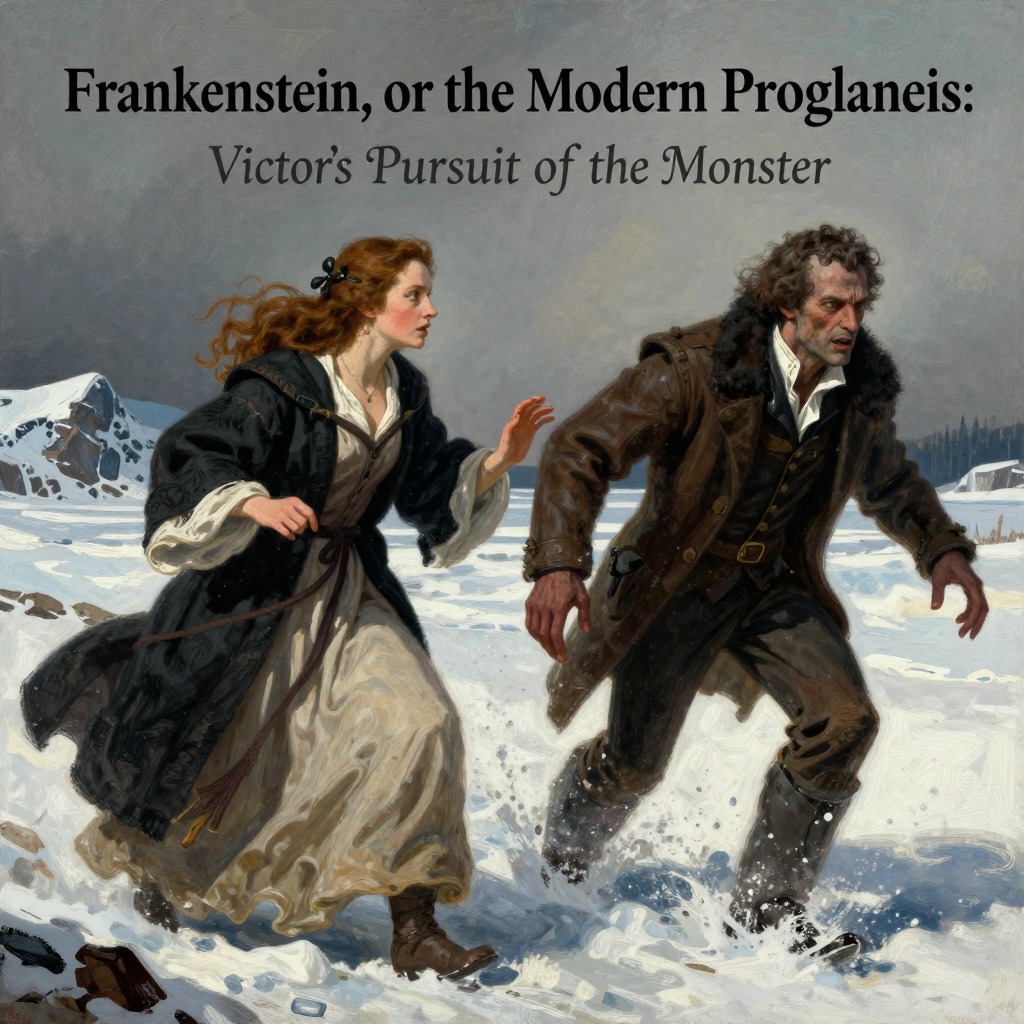
Victor's adjuration is answered through the stillness of night by a loud and fiendish laugh that rings long and heavily, re-echoed by the mountains. A well-known and abhorred voice, apparently close to his ear, addresses him in an audible whisper: "I am satisfied, miserable wretch! You have determined to live, and I am satisfied." Victor darts toward the sound, but the devil eludes his grasp. The moon rises and shines full upon the monster's ghastly and distorted shape as he flees with more than mortal speed. Victor pursues him, and for many months this becomes his task. Guided by slight clues, he follows the windings of the Rhone, then the blue Mediterranean, where he sees the fiend hide himself in a vessel bound for the Black Sea. Victor takes passage in the same ship, but the monster escapes. Amidst the wilds of Tartary and Russia, Victor follows in his track. Sometimes peasants, scared by the horrid apparition, inform him of the monster's path; sometimes the monster himself, fearing that if Victor loses all trace he will despair and die, leaves marks to guide him. The snows descend on Victor's head, and he sees the print of the monster's huge step on the white plain. Cold, want, and fatigue are the least pains he endures; he is cursed by some devil and carries about with him his eternal hell. Yet a spirit of good follows and directs his steps, sometimes preparing a repast for him in the desert or sending a slight cloud to shed a few drops that revive him when he is parched by thirst.
The Oath's Transformation and Final Justification
As Victor nears death aboard Walton's ship, his feelings toward the oath undergo a profound shift. He tells Walton that the strength he relied on is gone and that he feels he will soon die, while his enemy and persecutor may still be in being. Yet he no longer feels the burning hatred and ardent desire for revenge he once expressed; instead, he feels himself justified in desiring the death of his adversary. He examines his past conduct and finds it not blamable. In a fit of enthusiastic madness he created a rational creature and was bound toward him to assure his happiness and well-being. But his duties toward the beings of his own species had greater claims, and he did right in refusing to create a companion for the first creature. The monster showed unparalleled malignity and selfishness in evil, destroying Victor's friends. Miserable himself, he ought to die so that he may render no other wretched. The task of his destruction was Victor's, but he has failed. He renews his request to Walton, now induced only by reason and virtue, to undertake the unfinished work. Yet he cannot ask Walton to renounce his country and friends, and leaves the consideration of these points to him. Victor's final words to Walton are a farewell and a warning: "Seek happiness in tranquillity and avoid ambition, even if it be only the apparently innocent one of distinguishing yourself in science and discoveries." He then sinks into silence, presses Walton's hand feebly, and his eyes close forever, a gentle smile passing away from his lips.
The Oath's Consummation and the Monster's Self-Judgment
The monster himself, in his final appearance, provides the oath's ultimate commentary. He tells Walton that Frankenstein's death is also his victim, and that in his murder his crimes are consummated. He speaks of the anguish that was his during the lingering detail of its execution, of a heart fashioned to be susceptible of love and sympathy that was wrenched by misery to vice and hatred. He declares that he will quit the vessel on the ice raft and seek the most northern extremity of the globe, where he will collect his funeral pile and consume to ashes his miserable frame, so that its remains may afford no light to any curious and unhallowed wretch who would create such another as he has been. He will die, and the very remembrance of them both will speedily vanish. He springs from the cabin window onto the ice raft and is soon borne away by the waves, lost in darkness and distance. The oath, which began as a cry of rage and despair at a graveside, ends not with Victor's hand striking the fatal blow, but with the monster's own self-immolation, a final act that fulfills the vow's deepest purpose: the extinction of the horror Victor unleashed upon the world.