The Promise to Create a Female Companion
Frankenstein, or the Modern PrometheusThe Promise to Create a Female Companion is the central pact between Victor Frankenstein and the monster, made on the glacier of Montanvert, in which Victor agrees to build a female creature in exchange for the monster's oath to leave humanity forever. This promise, extracted through a combination of reasoned argument, threats of further violence, and an appeal to the duties of a creator, becomes the hinge on which the remainder of the narrative turns, driving Victor to England, the Orkney Islands, and ultimately to the destruction of the half-finished mate, an act that triggers the monster's final, devastating revenge.
Origins and the Monster's Demand
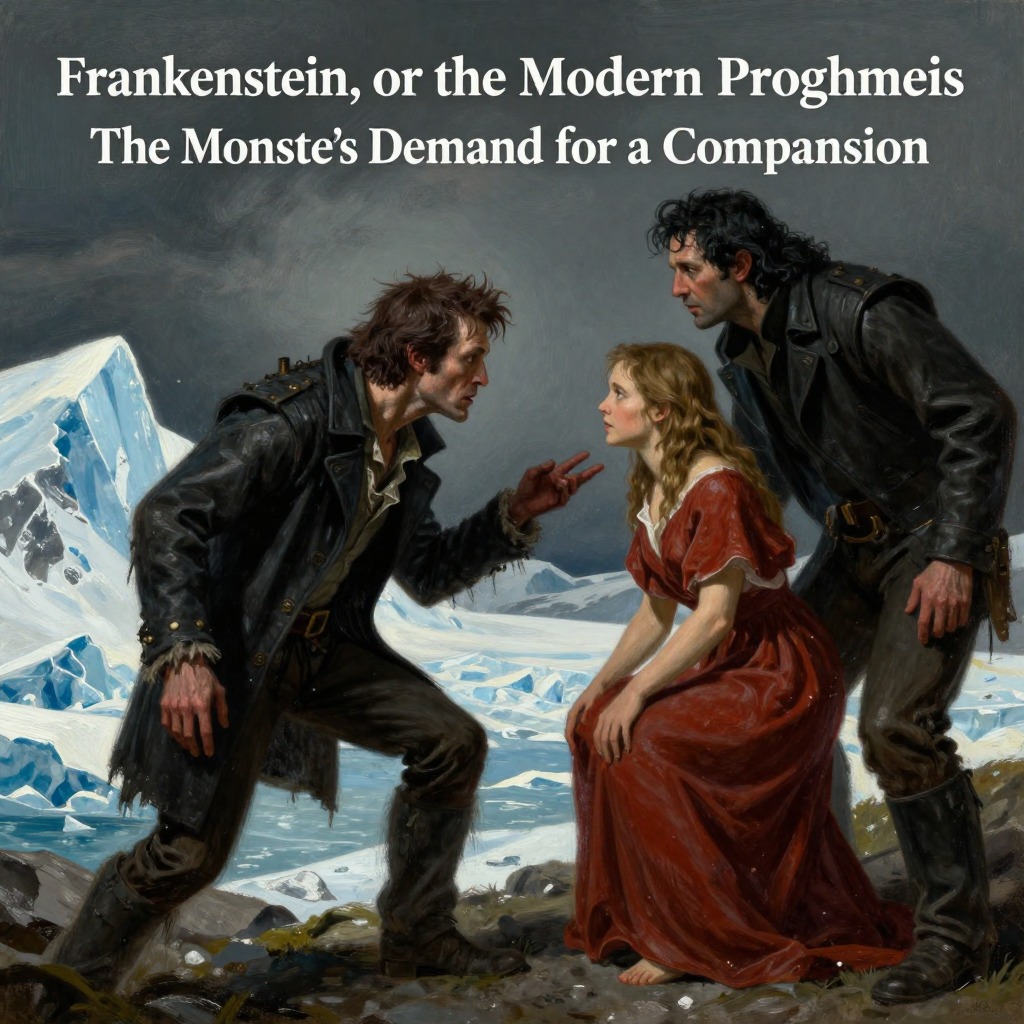
The demand for a female companion emerges directly from the monster's experience of absolute isolation. After recounting his education through the De Lacey family, his rejection by them, and his subsequent crimes, the monster confronts Victor on the glacier and states his case with a logic that Victor himself finds difficult to refute. "You must create a female for me," the monster declares, "with whom I can live in the interchange of those sympathies necessary for my being. This you alone can do, and I demand it of you as a right which you must not refuse to concede" . The monster frames the request not as a favor but as a right owed by a creator to his creature, a claim that Victor initially meets with fury, refusing outright and vowing that "no torture shall ever extort a consent from me" . The monster, however, counters by arguing that his malice is a product of his misery: "I am malicious because I am miserable. Am I not shunned and hated by all mankind?" . He promises that with a companion, he will quit Europe forever, retreating to the vast wilds of South America, where acorns and berries will suffice for food, and the pair will live harmlessly, cut off from all human society .
Victor's Agreement and Its Conditions
Victor's resistance crumbles under the weight of the monster's reasoning and the implicit threat of continued slaughter. After a long pause of reflection, he concludes that "the justice due both to him and my fellow creatures demanded of me that I should comply with his request" . He turns to the monster and says, "I consent to your demand, on your solemn oath to quit Europe forever, and every other place in the neighbourhood of man, as soon as I shall deliver into your hands a female who will accompany you in your exile" . The monster swears by the sun, the sky, and "the fire of love that burns my heart" that if Victor grants his prayer, he shall never behold him again . The pact is sealed, and the monster departs with superhuman speed, leaving Victor to begin the loathsome work.
The Promise's Collapse and Consequences
Victor's compliance is never wholehearted, and the promise unravels in a moment of horrified reflection. Working in a solitary hut on one of the Orkney Islands, he is seized by a train of thought that leads him to consider the potential consequences of his labor. He imagines that the female might become "ten thousand times more malignant than her mate," that the pair might hate each other, or that they might produce "a race of devils" that would make the very existence of the human species precarious (E00665–E00666). As he looks up, he sees the monster at the casement, a ghastly grin on his lips, and in a fit of passion, Victor tears to pieces the half-finished creature on which he was engaged . The monster, witnessing the destruction of his only hope for happiness, withdraws with a howl of "devilish despair and revenge" . He returns that night to confront Victor, who declares, "I do break my promise; never will I create another like yourself, equal in deformity and wickedness" . The monster, now beyond reason, pronounces his final threat: "I will be with you on your wedding-night" .
Thematic Significance and Final Judgment
The promise and its breaking crystallize the novel's central ethical dilemma: the responsibility of a creator toward his creature. Victor himself, in his final conversation with Walton, reflects on the decision and declares that he did right in refusing to create a companion, arguing that his duties toward the beings of his own species were paramount . The monster, in his final appearance, offers a different perspective, lamenting that he had once been "nourished with high thoughts of honour and devotion" but that crime had degraded him beneath the meanest animal . The promise thus becomes a test of Victor's moral character, one that he fails not only by breaking his word but by doing so in a way that ensures the destruction of everyone he loves. The broken promise is the direct cause of the murders of Elizabeth and Clerval, the death of Alphonse Frankenstein, and Victor's own doomed pursuit across the Arctic wastes.