The monster's burning of the cottage
Frankenstein, or the Modern PrometheusThe monster's burning of the De Laceys' cottage marks the decisive rupture between the creature and the human world, the moment when his last hope for companionship and kindness is extinguished and replaced by a conscious, permanent commitment to revenge. After the failed attempt to befriend the blind De Lacey, which ended with Felix tearing the monster from his father's knees and striking him violently with a stick, the creature retreated to his hovel in a state of utter and stupid despair. The family he had watched for months, whose gentle manners and loving interactions had taught him the meaning of virtue and affection, had departed forever, breaking the only link that held him to the world. For the first time, the feelings of revenge and hatred filled his bosom, and he did not strive to control them, allowing himself to be borne away by the stream and bending his mind towards injury and death.
The Destruction of the Cottage
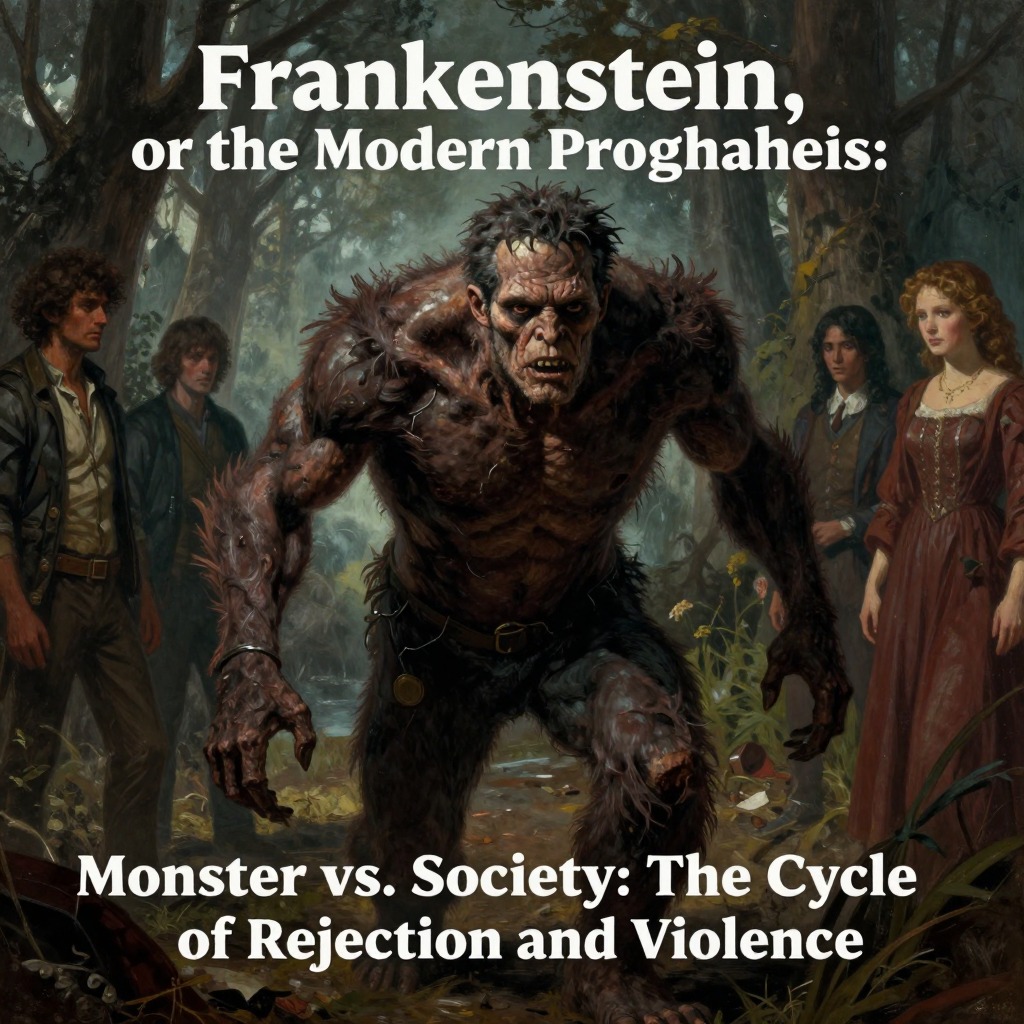
As night advanced, a fierce wind arose from the woods and quickly dispersed the clouds that had loitered in the heavens; the blast tore along like a mighty avalanche and produced a kind of insanity in his spirits that burst all bounds of reason and reflection. The monster lighted the dry branch of a tree and danced with fury around the devoted cottage, his eyes still fixed on the western horizon, the edge of which the moon nearly touched. A part of its orb was at length hid, and he waved his brand; it sank, and with a loud scream he fired the straw, heath, and bushes which he had collected. The wind fanned the fire, and the cottage was quickly enveloped by the flames, which clung to it and licked it with their forked and destroying tongues. As soon as he was convinced that no assistance could save any part of the habitation, he quitted the scene and sought refuge in the woods. Before setting the fire, he had placed a variety of combustibles around the cottage and destroyed every vestige of cultivation in the garden, ensuring that nothing of the De Laceys' life there would remain.
The Psychological Rupture
This act of arson was not merely an expression of rage but a deliberate severing of the creature's own moral and emotional development. The De Laceys had been his only school of human nature; through watching them, he had learned language, history, the concepts of virtue and vice, and the longing for sympathetic connection. Their flight confirmed what the villagers' attacks had first taught him: that his hideous form made him an object of horror from which all humans would flee. The gentle words of Agatha, the animated smiles of Safie, and the mild exhortations of the old man were not for him and never would be. In burning the cottage, he destroyed the physical space where his education in humanity had occurred and where he had dared to imagine a future of belonging. The act was also a declaration of war against the entire species, and more than all, against his creator, who had formed him and sent him forth to insupportable misery.
Aftermath and the Turn to Revenge
After the fire, the monster wandered in the wood, no longer restrained by the fear of discovery, giving vent to his anguish in fearful howlings. He was like a wild beast that had broken the toils, destroying the objects that obstructed him and ranging through the wood with stag-like swiftness. The cold stars shone in mockery, and the bare trees waved their branches above him; all save he were at rest or in enjoyment. He, like the arch-fiend, bore a hell within him, and finding himself unsympathized with, wished to tear up the trees and spread havoc and destruction around him. Yet this was a luxury of sensation that could not endure; he became fatigued with excess of bodily exertion and sank on the damp grass in the sick impotence of despair. From that moment, he declared everlasting war against the species. The thought of his creator crossed his mind, and he resolved to proceed toward Geneva, the native town he had learned of from Victor's papers, to seek the justice he had vainly attempted to gain from any other being that wore the human form. The burning of the cottage thus set in motion the chain of events that would lead directly to the murder of William Frankenstein, the framing of Justine Moritz, and the systematic destruction of Victor's family.