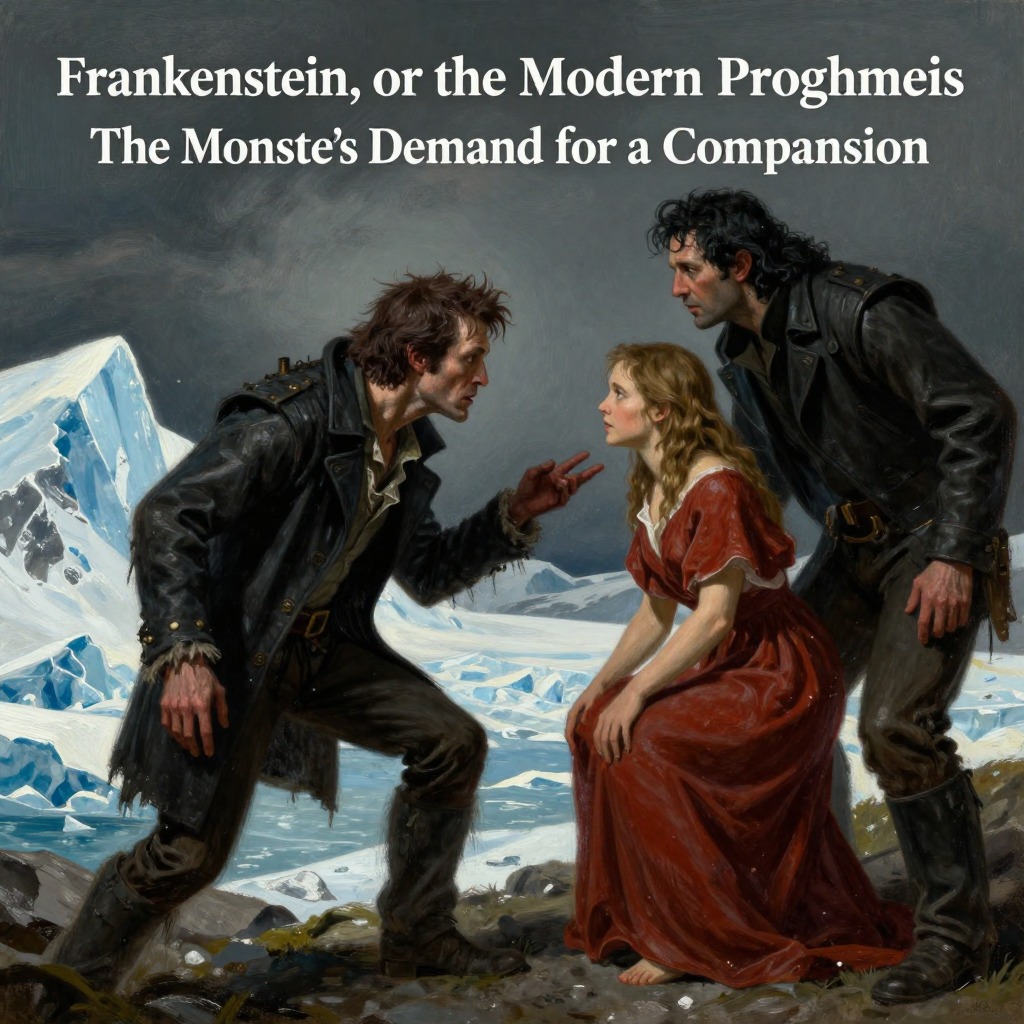
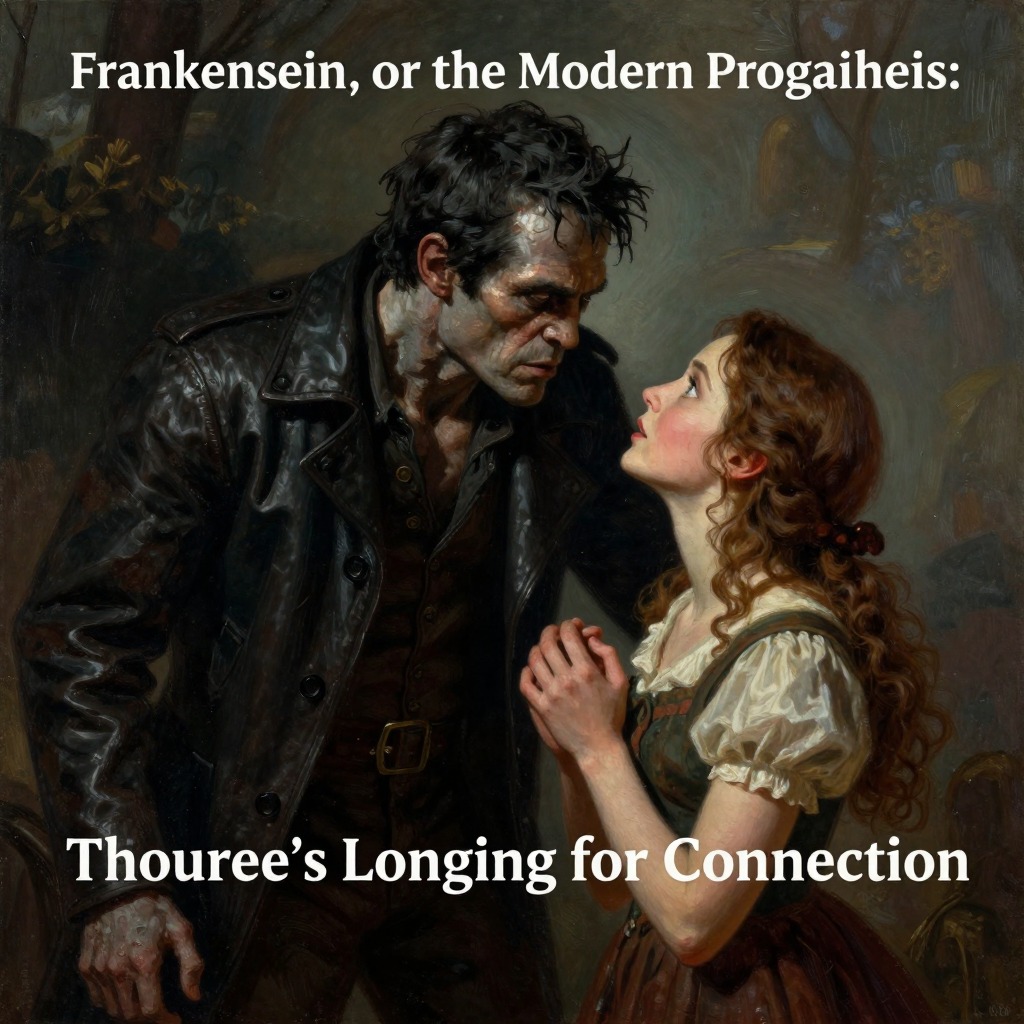
The monster's request for a female companion
Frankenstein, or the Modern PrometheusThe monster's request for a female companion is the pivotal demand that drives the second half of the novel, transforming the creature from a supplicant for sympathy into a bargainer who holds the lives of Victor's remaining loved ones as collateral. Made on the glacier of Montanvert, high above the valley of Chamounix, the demand crystallizes the central ethical dilemma of the book: whether a creator owes happiness to his creation, and at what cost to the rest of humanity.
The Confrontation on the Glacier
After the monster finishes the tale of his early life and his rejection by the De Lacey family, he fixes his looks upon Victor in expectation of a reply. Victor, bewildered and unable to arrange his ideas sufficiently to understand the full extent of the proposition, hears the monster state his demand plainly: "You must create a female for me with whom I can live in the interchange of those sympathies necessary for my being. This you alone can do, and I demand it of you as a right which you must not refuse to concede." The latter part of the monster's tale had kindled anew in Victor the anger that had died away while he narrated his peaceful life among the cottagers, and as the monster said this Victor could no longer suppress the rage that burned within him. He replied, "I do refuse it; and no torture shall ever extort a consent from me. You may render me the most miserable of men, but you shall never make me base in my own eyes. Shall I create another like yourself, whose joint wickedness might desolate the world. Begone! I have answered you; you may torture me, but I will never consent."
The Monster's Reasoning and Threats
The monster, instead of threatening, declares himself content to reason. He argues that he is malicious because he is miserable, shunned and hated by all mankind. "You, my creator, would tear me to pieces and triumph; remember that, and tell me why I should pity man more than he pities me?" He warns that if he cannot inspire love, he will cause fear, and chiefly towards Victor, his arch-enemy and creator, he swears inextinguishable hatred. "Have a care; I will work at your destruction, nor finish until I desolate your heart, so that you shall curse the hour of your birth." A fiendish rage animates him as he says this, his face wrinkled into contortions too horrible for human eyes to behold, but he calms himself and proceeds. He insists that what he asks is reasonable and moderate: a creature of another sex, as hideous as himself. "It is true, we shall be monsters, cut off from all the world; but on that account we shall be more attached to one another. Our lives will not be happy, but they will be harmless and free from the misery I now feel." He paints a picture of exile in the vast wilds of South America, where his food is not that of man—acorns and berries afford him sufficient nourishment—and where his companion will be content with the same fare. "The picture I present to you is peaceful and human, and you must feel that you could deny it only in the wantonness of power and cruelty."
Victor's Internal Struggle and Consent
Victor is moved. He shudders when he thinks of the possible consequences of his consent, but he feels that there is some justice in the monster's argument. The monster's tale and the feelings he now expresses prove him to be a creature of fine sensations, and Victor asks himself whether as his maker he does not owe him all the portion of happiness it is in his power to bestow. Yet when he looks upon the monster, when he sees the filthy mass that moves and talks, his heart sickens and his feelings alter to those of horror and hatred. He tries to stifle these sensations, thinking that as he cannot sympathize with him, he has no right to withhold from him the small portion of happiness which is yet in his power to bestow. Victor voices his distrust: "You swear to be harmless; but have you not already shown a degree of malice that should reasonably make me distrust you? May not even this be a feint that will increase your triumph by affording a wider scope for your revenge?" The monster replies that his vices are the children of a forced solitude he abhors, and that his virtues will necessarily arise when he lives in communion with an equal. After a long pause of reflection, Victor concludes that the justice due both to the monster and to his fellow creatures demands that he comply with the request. Turning to the monster, he says, "I consent to your demand, on your solemn oath to quit Europe forever, and every other place in the neighbourhood of man, as soon as I shall deliver into your hands a female who will accompany you in your exile."
The Oath and Departure
The monster swears "by the sun, and by the blue sky of heaven, and by the fire of love that burns my heart, that if you grant my prayer, while they exist you shall never behold me again." He tells Victor to depart to his home and commence his labours, promising to watch their progress with unutterable anxiety and to appear when Victor is ready. Saying this, he suddenly quits Victor, fearful perhaps of any change in his sentiments. Victor sees him descend the mountain with greater speed than the flight of an eagle, and quickly lost among the undulations of the sea of ice. The monster's tale had occupied the whole day, and the sun was upon the verge of the horizon when he departed. Victor, his heart heavy and his steps slow, weeps bitterly and clasps his hands in agony, exclaiming to the stars and clouds and winds that they are all about to mock him. He returns to Geneva, and though he feels as if placed under a ban, he resolves to dedicate himself to his most abhorred task in order to save his family.
Consequences and Thematic Significance
The promise extracted on the glacier sets in motion the remainder of the novel's tragic machinery. Victor's reluctant consent leads him to journey to England, isolate himself on the Orkney Islands, and begin the creation of a female creature—a task he ultimately abandons, tearing the half-finished being to pieces when he recoils from the potential consequences. This breach of his promise provokes the monster's final, devastating acts of revenge: the murder of Henry Clerval and, on Victor's wedding night, the murder of Elizabeth Lavenza. The request itself reveals the monster's profound capacity for reason, eloquence, and even hope, while Victor's initial refusal and eventual consent—and his later destruction of the female—expose the irreconcilable conflict between the creator's duty to his creature and his responsibility to humanity. The monster's argument that he is "malicious because I am miserable" becomes the novel's most direct statement of the causal link between rejection and violence, and his plea for a companion underscores the theme that isolation, not innate evil, is the root of his monstrous acts.