Victor's guilt
Frankenstein, or the Modern PrometheusVictor Frankenstein's guilt is not a passing emotion but the central, structuring force of his inner life after he animates his creature. It is a compound of horror, remorse, and self-accusation that transforms him from a hopeful young scientist into a haunted, isolated figure who believes himself the true murderer of everyone he loves. The guilt is both a psychological torment and a moral reckoning, one that he can neither fully confess nor escape, and it ultimately dictates the course of his life until his death.
Origins and Immediate Manifestation
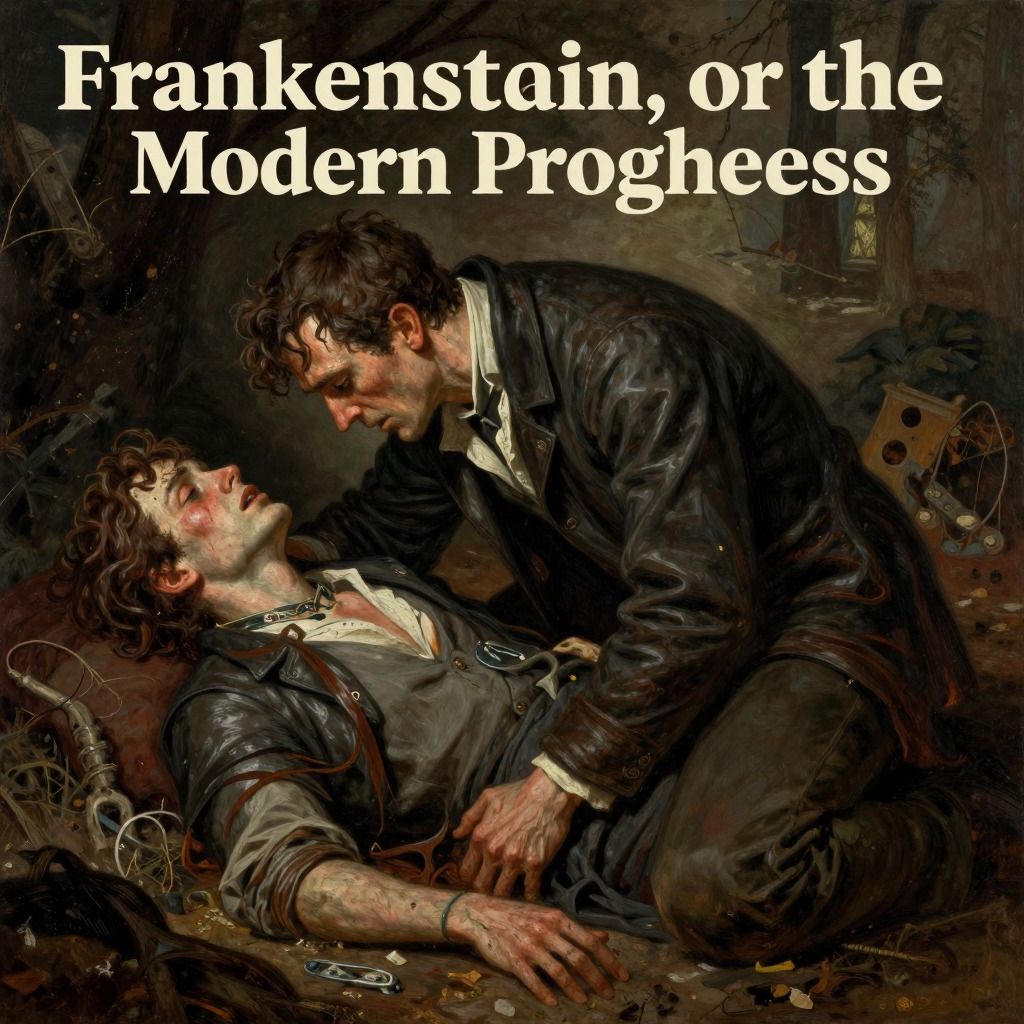
The moment the creature opens its dull yellow eye, Victor's dream of beneficent creation collapses into "breathless horror and disgust." The beauty of his ambition vanishes, replaced by a nightmare. That same night, his sleep is invaded by a dream in which he embraces Elizabeth only to see her features transform into the corpse of his dead mother, with grave-worms crawling in the folds of her shroud. This dream, a fusion of his creative act and his deepest loss, is the first symptom of a guilt that will never leave him. When he awakens to find the monster standing over his bed, he flees, and the creature's departure does not bring relief but the beginning of a nervous fever. During his months of illness, he raves incessantly about the monster, and his words, though initially dismissed as delirium, reveal the truth that his conscious mind cannot yet fully articulate: he has loosed a horror upon the world. The guilt is already so profound that it manifests as physical collapse, a pattern that will repeat itself with each new catastrophe.
The Weight of William's and Justine's Deaths
Victor's guilt deepens immeasurably when he realizes that his creation has murdered his younger brother, William. Standing in the storm at Plainpalais, he sees the monster's gigantic form and knows instantly that "HE was the murderer!" Yet he cannot speak. He knows that any confession of his own role would be dismissed as madness, and that pursuit of the creature is futile. This silence becomes a second wound. When Justine Moritz is accused of the murder, Victor is torn: he knows she is innocent, but he cannot reveal the truth without condemning himself as a madman. He watches her trial in "living torture," feeling that he is the cause of two deaths—William's and Justine's—and that he is the "true murderer." In the prison, as Justine comforts Elizabeth, Victor feels "the never-dying worm alive in my bosom, which allowed of no hope or consolation." He describes himself as bearing "a hell within me which nothing could extinguish." The guilt is not merely intellectual; it is a physical, burning presence that separates him from all human comfort. He later tells his father, "Justine, poor unhappy Justine, was as innocent as I, and she suffered the same charge; she died for it; and I am the cause of this—I murdered her." This direct self-accusation, though his father dismisses it as delirium, is the core of Victor's truth: he is the author of the evil, even if his hands never touched the victims.
The Destruction of Henry Clerval and Elizabeth
The murder of Henry Clerval, Victor's dearest friend, brings a new and even more unbearable layer of guilt. When Victor sees Clerval's lifeless body in the Irish magistrate's office, he throws himself upon it and cries out, "Have my murderous machinations deprived you also, my dearest Henry, of life? Two I have already destroyed; other victims await their destiny." He immediately falls into a violent fever, during which he raves that he is the murderer of William, Justine, and Clerval. The guilt now has a name and a list. Later, after Elizabeth is murdered on their wedding night, Victor's guilt reaches its absolute peak. He has lost everyone: his brother, his friend, his wife, and soon his father. He tells Walton that he is "the assassin of those most innocent victims; they died by my machinations." He does not claim to have held the knife, but he insists that his actions—the creation of the monster, the refusal to create a companion, the broken promises—are the direct cause of every death. The guilt is not a feeling of failure but a conviction of criminal responsibility.
The Guilt That Drives Revenge and Pursuit
Victor's guilt does not paralyze him; it transforms into an engine of revenge. After Elizabeth's death and his father's subsequent collapse, Victor swears an oath over their graves to pursue the monster until one of them perishes. He tells Walton that "revenge alone endowed me with strength and composure; it moulded my feelings and allowed me to be calculating and calm." The guilt and the revenge become inseparable: he must destroy the creature not only to avenge his family but to atone for his own sin of creation. Yet even in this pursuit, the guilt remains. He describes his life as a "pilgrimage" of suffering, and he admits that during sleep alone he finds joy, because in dreams he sees his lost loved ones alive. The guilt is so deep that it has become the very structure of his existence; he cannot imagine a life without it. On his deathbed, he tells Walton that he feels "justified in desiring the death of my adversary" and that his refusal to create a female companion was right, because his duties to humanity outweighed his duty to the creature. But even this final justification is haunted by the knowledge that he has failed in his self-appointed task of destruction. His last words to Walton are a warning: "Seek happiness in tranquillity and avoid ambition." The guilt has taught him, too late, that the pursuit of knowledge without moral restraint leads only to ruin.
The Inescapable Nature of Victor's Guilt
Victor's guilt is unique in that it is both fully acknowledged and utterly unrelievable. He never denies his responsibility; he repeatedly calls himself the murderer, the cause, the author of the evil. Yet he cannot confess publicly, because the truth is too monstrous to be believed. This double bind—knowing the truth and being unable to tell it—intensifies his torment. He is isolated not only by his actions but by the very nature of his secret. The guilt is not a temporary state but a permanent condition, one that follows him across continents and into the Arctic ice. It is the fire that keeps him alive during his pursuit and the weight that makes him wish for death. In the end, Victor's guilt is the tragic core of his character: a brilliant man who, in seeking to become a creator, becomes a destroyer, and who must live with the full, agonizing knowledge of what he has done.