Frankenstein's journey to England
Frankenstein, or the Modern PrometheusVictor Frankenstein's journey to England, undertaken in the late autumn of 17—, is a pivotal expedition that he conceives as a necessary step to fulfill his promise to create a female companion for the monster, but which instead becomes a descent into deeper isolation, horror, and tragedy as he travels through the Rhine, the Netherlands, and England, ultimately leading to the destruction of the female creature and the murder of his closest friend.
Purpose and Departure
Victor's decision to travel to England is driven by the need to consult English philosophers whose discoveries are material to his success in creating a female being. He finds the idea of working in his father's house, in familiar intercourse with those he loves, insurmountably repugnant, fearing that a thousand fearful accidents might disclose his tale. He therefore expresses a wish to visit England, concealing the true reasons, and his father, Alphonse Frankenstein, pleased to see his son capable of taking pleasure in such a journey, readily complies. The duration of the absence is left to Victor's choice, with a few months or at most a year contemplated. Alphonse, in concert with Elizabeth Lavenza, arranges for Henry Clerval to join Victor at Strasbourg, a precaution that interferes with the solitude Victor covets for his task but which he ultimately rejoices in, hoping Henry might stand between him and the intrusion of his foe. It is understood that Victor's union with Elizabeth will take place immediately upon his return. Victor leaves Geneva in the latter end of September, throwing himself into the carriage hardly knowing whither he is going, his only conscious thought being to order his chemical instruments packed to accompany him.
The Rhine Voyage and Contrast with Clerval
At Strasbourg, Victor waits two days for Clerval. The contrast between them is immense: Clerval is alive to every new scene, joyful at the setting and rising sun, while Victor is occupied by gloomy thoughts, haunted by a curse that shuts up every avenue to enjoyment. They agree to descend the Rhine in a boat from Strasbourg to Rotterdam, whence they take shipping for London. The voyage takes them past many willowy islands and beautiful towns, including a stay at Mannheim and arrival at Mainz on the fifth day. The course of the Rhine below Mainz becomes more picturesque, with ruined castles on precipices, dark woods, and flourishing vineyards. They travel at the time of the vintage and hear the song of the labourers. Even Victor, depressed in mind, finds himself pleased, lying at the bottom of the boat and gazing on the cloudless blue sky, drinking in a tranquillity long a stranger to him. Clerval, by contrast, feels transported to fairy-land, declaring the banks of the Rhine more charming than the majestic mountains of Switzerland. Victor, recording Clerval's words with affection, describes him as a being formed in the "very poetry of nature," whose wild and enthusiastic imagination is chastened by the sensibility of his heart. Beyond Cologne they descend to the plains of Holland, where the wind is contrary and the stream too gentle to aid them, so they post the remainder of the way to Rotterdam, proceeding by sea to England. On a clear morning in the latter days of December, Victor first sees the white cliffs of Britain. The banks of the Thames present a new scene, flat but fertile, and they pass Tilbury Fort, Gravesend, Woolwich, and Greenwich, places Victor has heard of even in his own country. At length they see the numerous steeples of London, with St. Paul's towering above all.
Life in London and the Journey North
London becomes their point of rest for several months. Victor is principally occupied with obtaining the information necessary for the completion of his promise, quickly availing himself of letters of introduction to the most distinguished natural philosophers. Company is irksome to him; he sees an insurmountable barrier placed between him and his fellow men, sealed with the blood of William and Justine. In Clerval, however, he sees the image of his former self, inquisitive and anxious to gain experience. Clerval's design is to visit India, believing his knowledge of its languages and society can assist European colonization and trade, and in Britain alone can he further this plan. Victor begins to collect the materials necessary for his new creation, a task that feels like the torture of single drops of water continually falling on the head. After some months in London, they receive a letter from a person in Scotland, formerly a visitor at Geneva, who invites them to Perth. Clerval eagerly accepts, and Victor, though he abhors society, wishes to view mountains and streams again. They determine to commence their journey north at the expiration of another month, in February, intending to visit Windsor, Oxford, Matlock, and the Cumberland lakes, resolving to arrive at the completion of this tour about the end of July. Victor packs up his chemical instruments and materials, resolving to finish his labours in some obscure nook in the northern highlands of Scotland. They quit London on the 27th of March, spending a few days at Windsor, then proceeding to Oxford, where Victor's enjoyment is embittered by memory and anticipation. He feels himself a blasted tree, a miserable spectacle of wrecked humanity. They pass a considerable period at Oxford, then proceed to Matlock, whose scenery resembles Switzerland but on a lower scale. The name Chamounix, when pronounced by Henry, makes Victor tremble, and he hastens to quit Matlock. From Derby, journeying northwards, they pass two months in Cumberland and Westmorland, where Victor almost fancies himself among the Swiss mountains. Here they make acquaintances who almost contrive to cheat him into happiness. The period of their appointment with their Scotch friend approaches, and Victor, who has neglected his promise, fears the effects of the daemon's disappointment, worrying that the fiend might remain in Switzerland and wreak vengeance on his relatives. He waits for letters with feverish impatience, hardly daring to read them. Sometimes he thinks the fiend follows him and might expedite his remissness by murdering his companion, so he will not quit Henry for a moment, following him as his shadow. They visit Edinburgh, but Victor is impatient to arrive at the termination of his journey. After a week, they pass through Coupar, St. Andrew's, and along the banks of the Tay to Perth, where their friend expects them. Victor, in no mood for society, tells Clerval he wishes to make the tour of Scotland alone, asking to be left to peace and solitude for a month or two. Henry wishes to dissuade him but, seeing him bent on the plan, ceases to remonstrate, entreating Victor to write often.
The Orkney Retreat and the Destruction of the Female Creature
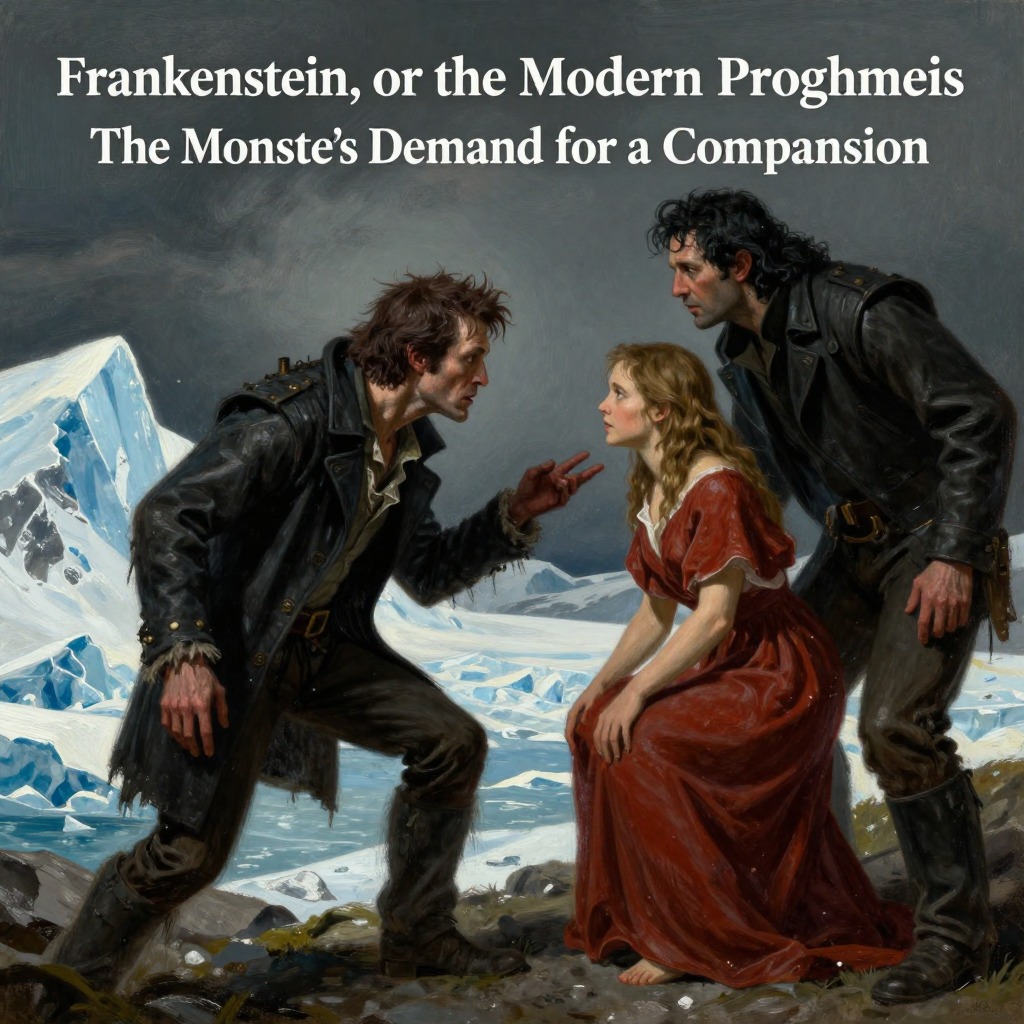
Having parted from Clerval, Victor determines to visit some remote spot of Scotland and finish his work in solitude. He traverses the northern highlands and fixes on one of the remotest of the Orkney Islands as the scene of his labours. The island is hardly more than a rock, its high sides continually beaten upon by the waves, the soil barren, affording pasture for only a few miserable cows and oatmeal for its five inhabitants, whose gaunt and scraggy limbs give tokens of their miserable fare. On the whole island there are but three miserable huts, and one, vacant when Victor arrives, he hires. It contains but two rooms, exhibiting all the squalidness of the most miserable penury, with the thatch fallen in, the walls unplastered, and the door off its hinges. Victor orders it repaired, buys some furniture, and takes possession. In this retreat he devotes the morning to labour; in the evening, when the weather permits, he walks on the stony beach to listen to the waves. As he proceeds in his labour, it becomes every day more horrible and irksome. Sometimes he cannot prevail on himself to enter his laboratory for several days; at other times he toils day and night. Unlike his first experiment, when an enthusiastic frenzy blinded him to the horror of his employment, he now goes to it in cold blood, his heart often sickening at the work of his hands. One evening, as he sits in his laboratory, a train of reflection leads him to consider the effects of what he is doing. He thinks that the female might become ten thousand times more malignant than her mate, that they might hate each other, or that she might turn with disgust from him to the superior beauty of man. Even if they leave Europe, one of the first results of their sympathies would be children, and a race of devils might be propagated upon the earth. He shudders to think that future ages might curse him as their pest. Looking up, he sees by the light of the moon the daemon at the casement, a ghastly grin wrinkling his lips. Trembling with passion, Victor tears to pieces the thing on which he is engaged. The wretch, seeing this, withdraws with a howl of devilish despair and revenge. Victor locks the door and makes a solemn vow never to resume his labours. The monster later appears in Victor's room, accusing him of breaking his promise and threatening that he will be with him on his wedding-night. Victor, after a period of despair and a dangerous voyage in a skiff that drives him to the Irish coast, lands near a town where he is immediately seized and charged with the murder of a gentleman found strangled the previous night. He is led before the magistrate, Mr. Kirwin, and when the body is revealed, Victor sees the lifeless form of Henry Clerval. He throws himself on the body, exclaiming that his murderous machinations have deprived him of his dearest friend. A fever succeeds, and Victor lies for two months on the point of death, raving that he is the murderer of William, Justine, and Clerval. He is eventually freed from the criminal charge when it is proved he was on the Orkney Islands at the hour the body was found, and he returns to Geneva with his father, the journey to England having ended in the loss of his closest friend and the deepening of his own damnation.