Isolation
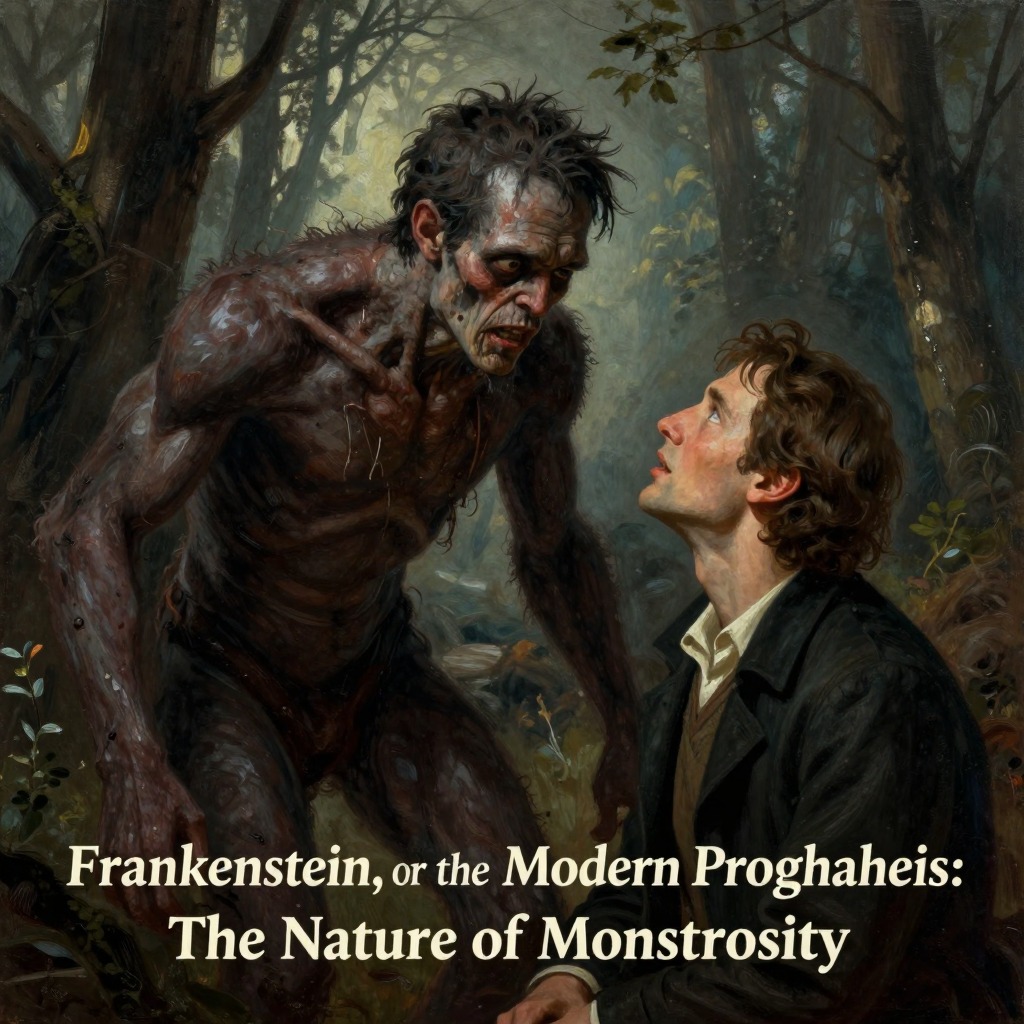
Frankenstein, or the Modern PrometheusIsolation is the central thematic force in Mary Shelley's Frankenstein, driving the actions and suffering of both Victor Frankenstein and his creature. It is not merely a condition but a cause: the creature's rejection by humanity transforms him from a benevolent being into a vengeful monster, while Victor's self-imposed solitude during his scientific work severs him from family and moral responsibility, leading to catastrophic consequences. The novel systematically explores how isolation—whether chosen or enforced—corrupts, destroys, and ultimately defines the tragic trajectories of its two central figures.
The Creature's Forced Isolation and Its Consequences
The creature's isolation is absolute and begins at the moment of his awakening. Victor, horrified by his creation, immediately abandons him, and the creature is left to wander alone, without any guide or companion. He describes his earliest memories as a "poor, helpless, miserable wretch" who "knew, and could distinguish, nothing" but pain, and he sat down and wept. This initial solitude is compounded by every subsequent human encounter. When he approaches a village, the inhabitants attack him with stones; when he saves a young girl from drowning, her companion shoots him. The creature's desperate need for connection is most poignantly expressed in his plea to Victor: "I am alone and miserable; man will not associate with me." He recognizes that his deformity makes him an outcast, and he laments, "I was benevolent and good; misery made me a fiend." The De Lacey family, whom he observes from his hovel, becomes his only link to humanity, but when they too reject him, the last thread is broken. He declares, "My protectors had departed and had broken the only link that held me to the world. For the first time the feelings of revenge and hatred filled my bosom." This enforced isolation is the direct cause of his turn to violence; he murders William, frames Justine, and vows to destroy all that Victor loves. The creature's isolation is not a choice but a sentence, and it is the engine of his villainy.
Victor's Self-Imposed Solitude and Its Moral Cost
Victor's isolation is initially a product of his obsessive ambition. During the two years he spends creating the monster, he withdraws from all human contact, neglecting his family and friends. He describes his state as one where he "seemed to have lost all soul or sensation but for this one pursuit." He collects bones from charnel-houses and works in a solitary chamber, his "workshop of filthy creation," separated from the rest of the house. This self-imposed solitude is a moral failure; he admits that his study "had a tendency to weaken your affections and to destroy your taste for those simple pleasures." After the creature's awakening, Victor's isolation becomes a prison of guilt and fear. He is haunted by the monster's form, and his nervous fever leaves him "alone" in his suffering, unable to confide in anyone. He describes his state as one where "solitude was my only consolation — deep, dark, deathlike solitude." Even when surrounded by his family, he is isolated by his secret. He cannot share the truth, for he fears being thought mad, and this silence deepens his torment. His isolation is both a cause and a consequence of his tragedy; it enables his initial transgression and then becomes the punishment for it.
The Shared Isolation of Creator and Creature
The novel repeatedly emphasizes the parallel isolation of Victor and the monster. Both are cut off from the bonds of human sympathy. The creature, in his final speech to Walton, declares, "I am alone," and contrasts his state with that of Satan, who "had his companions, fellow devils, to admire and encourage him." Victor, in his final days, tells Walton that he has lost everything and cannot begin life anew. Both characters are defined by their solitude. The creature's plea for a female companion is a direct attempt to escape his isolation: "My companion must be of the same species and have the same defects." Victor's refusal to create this companion, while morally complex, is driven by the fear of unleashing further evil, but it also condemns the creature to eternal solitude. This shared condition creates a tragic symmetry. The creature, after Victor's death, speaks of his own impending suicide, saying, "I shall die. I shall no longer feel the agonies which now consume me or be the prey of feelings unsatisfied, yet unquenched." His final act is to remove himself from a world that has offered him only rejection. Victor, too, dies alone, his quest for revenge unfulfilled. The novel suggests that isolation is not merely a personal misfortune but a fundamental flaw in the human condition, one that can corrupt even the most benevolent intentions.
Thematic Significance: Isolation as a Catalyst for Destruction
Isolation in Frankenstein is not a passive state but an active, destructive force. It is the mechanism through which ambition becomes tyranny, and innocence becomes malice. The creature's isolation is the direct cause of his crimes; he explicitly states, "I am malicious because I am miserable." Victor's isolation is the condition that allows his unchecked ambition to flourish, and it later becomes the source of his paralyzing guilt. The novel's structure, with its nested narratives, also mirrors this theme. Each narrator—Walton, Victor, the creature—speaks from a position of profound isolation. Walton, at the beginning, laments his lack of a friend, and Victor's story serves as a warning against the dangers of pursuing knowledge without human connection. The novel ultimately argues that the pursuit of any goal, however noble, that severs one from the bonds of family, friendship, and community is a path to ruin. The creature's final words, "Farewell," as he is borne away on the ice raft, underscore the novel's bleak conclusion: isolation is the inescapable condition of those who transgress the natural limits of human connection.