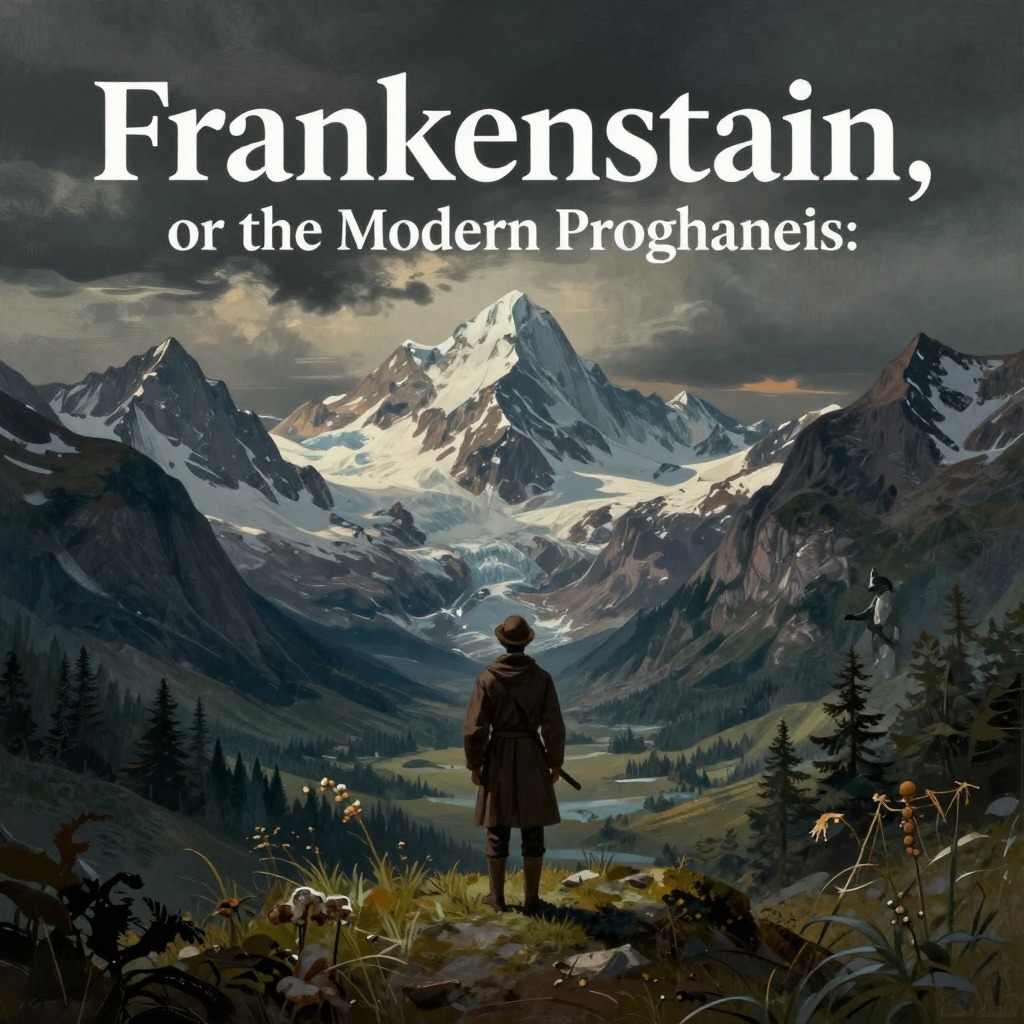
The Sublime
Frankenstein, or the Modern PrometheusThe Sublime, as depicted in Mary Shelley's Frankenstein, is not merely a scenic backdrop but a dynamic force that shapes the narrative's emotional and philosophical landscape. Drawing on the aesthetic theories of Edmund Burke, the sublime in the novel is an experience of overwhelming power and vastness—whether of mountains, storms, or icy wastes—that provokes a mixture of terror and delight, dwarfing human concerns while also offering a fleeting, perilous transcendence. For Victor Frankenstein, the sublime landscapes of the Alps and the Arctic become both a refuge from his guilt and a mirror of his own monstrous ambition, while for the creature, the same icy peaks represent the only home where his hideous form is not met with horror. The novel consistently uses sublime natural phenomena to mark moments of crisis, revelation, and profound psychological change, establishing nature as an active, often judgmental presence in the human drama.
The Sublime as Consolation and Confrontation
Victor Frankenstein repeatedly seeks the sublime as a balm for his tormented soul. After the deaths of William and Justine, he flees to the valley of Chamounix, hoping that "the magnificence, the eternity of such scenes" will help him forget his "ephemeral, because human, sorrows." The immense mountains and precipices, the sound of the river raging among the rocks, and the dashing of waterfalls speak of "a power mighty as Omnipotence," allowing him to cease fearing any lesser being. He finds that these "sublime and magnificent scenes" afford him "the greatest consolation," elevating him from "all littleness of feeling" and subduing his grief, even if they cannot remove it. At the summit of Montanvert, gazing at the "sea of ice" and the "awful majesty" of Mont Blanc, his sorrowful heart swells with "something like joy," and he addresses the "wandering spirits" of the dead. Yet this consolation is always temporary; the sublime also forces a confrontation with his own insignificance and the consequences of his overreaching ambition. The very glaciers that offer him peace are also the stage for his most harrowing encounter with the creature, where the "terrifically desolate" landscape mirrors the desolation within his own soul.
The Sublime and the Monster: A Shared Realm
The creature, too, finds a paradoxical home in the sublime landscape. After being rejected by the De Lacey family, he declares that "the desert mountains and dreary glaciers are my refuge" and that the "caves of ice" are his only dwelling, one which man does not grudge him. The bleak skies, he says, are "kinder" to him than human beings. For the creature, the sublime is not a source of aesthetic pleasure but a realm of exile that matches his own monstrous isolation. Yet it is also a place of power; he can bound over the crevices of the glacier with "superhuman speed," a being whose faculties are suited to this inhuman environment. The sublime landscape thus becomes the only territory where the creature can exist without immediate persecution, a frozen kingdom that both reflects his misery and grants him a terrible, untouchable freedom.
The Sublime as a Prelude to Horror
Shelley often juxtaposes the sublime beauty of nature with the most profound horror, using the former to amplify the latter. The night Victor completes his creation is marked by a "dreary night of November" with rain pattering "dismally against the panes," a gothic inversion of the sublime's uplifting power. More strikingly, when Victor returns to Geneva after William's murder, he witnesses a violent thunderstorm over the lake, with lightning playing on the summit of Mont Blanc. He exclaims, "William, dear angel! this is thy funeral, this thy dirge!" In the very next moment, a flash of lightning reveals the "gigantic stature" and "deformity" of the creature, confirming him as the murderer. The sublime storm, which had elevated Victor's spirits, instantly becomes the backdrop for a revelation of ultimate horror. This pattern recurs throughout the novel: the sublime prepares the soul for a profound experience, but that experience is as likely to be one of terror and damnation as of consolation and elevation.
The Sublime and the Limits of Human Ambition
The novel's frame narrative, set in the Arctic's "land of mist and snow," extends the sublime to the very limits of human endurance. Robert Walton's ship is surrounded by "vast and irregular plains of ice," and the crew faces the constant threat of being crushed. This polar sublime is the ultimate testing ground for human ambition. Victor, in his final pursuit of the creature, traverses "immense deserts" of ice, enduring cold, hunger, and despair. The sublime here is no longer a source of temporary joy but a relentless, punishing force that mirrors the destructive consequences of his own hubris. Walton's decision to turn back, against his own burning desire for glory, represents a recognition of the sublime's warning: that some ambitions, however noble in appearance, lead only to ruin. Victor's final advice to Walton—"Seek happiness in tranquillity and avoid ambition"—is a direct repudiation of the Promethean striving that the sublime had once seemed to justify. The novel thus uses the sublime not only as a setting but as a moral and philosophical argument, demonstrating that the awe-inspiring power of nature can both elevate and destroy, and that the true test of a human being lies in how they respond to its overwhelming presence.