Walton's decision to return south
Frankenstein, or the Modern PrometheusWalton's decision to return south is the pivotal moment in the frame narrative when the captain of the Arctic expedition, faced with a mutiny by his sailors and the death of his friend Victor Frankenstein, abandons his lifelong dream of polar discovery and turns his ship back toward England. The decision represents the defeat of the very ambition that opened the novel and that Frankenstein's own story was meant to warn against, making it the structural and moral conclusion of the entire work.
The Sailors' Demand and the Mutiny
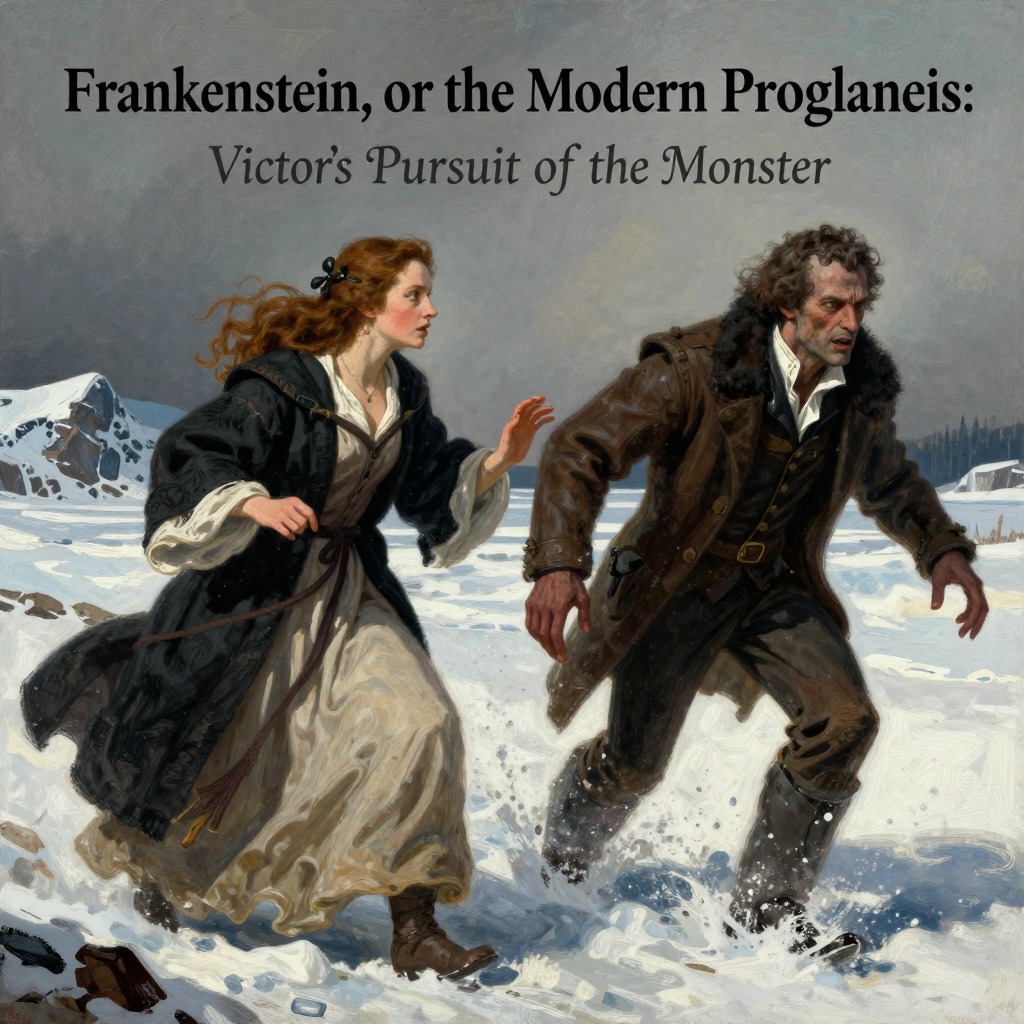
By early September, Walton's vessel had been trapped for days by immense mountains of ice, with the cold proving excessive and several crew members already dead. On the morning of September 5, half a dozen sailors, chosen as a deputation by the rest, demanded admission to the captain's cabin. Their leader told Walton that they feared that even if the ice should dissipate and open a free passage, he would be rash enough to continue the voyage and lead them into fresh dangers. They insisted that he give a solemn promise that if the vessel were freed, he would instantly direct his course southwards. Walton was troubled by the speech; he had not despaired, nor had he conceived the idea of returning if set free. Yet he hesitated, uncertain whether he could in justice or even in possibility refuse the demand.
Frankenstein's Last Intervention
Victor Frankenstein, who had been lying in his cabin in a state of extreme exhaustion, roused himself at this critical moment. His eyes sparkled and his cheeks flushed with momentary vigor as he turned to the men. He asked them why they had called this a glorious expedition — not because the way was smooth and placid as a southern sea, but because it was full of dangers and terror, because at every new incident their fortitude was to be called forth and their courage exhibited. He told them they were to be hailed as benefactors of their species, their names adored as belonging to brave men who encountered death for honor and the benefit of mankind. Now, at the first mighty trial of their courage, they shrank away, content to be handed down as men who had not strength enough to endure cold and peril. "Be men, or be more than men," he cried. "Be steady to your purposes and firm as a rock." He spoke with a voice so modulated to the different feelings expressed in his speech, with an eye so full of lofty design and heroism, that the men were moved. They looked at one another and were unable to reply. Walton told them to retire and consider what had been said, but he added that he would not lead them farther north if they strenuously desired the contrary. The men retired, and Frankenstein immediately sank back into languor, almost deprived of life.
The Decision and Its Consequences
Despite Frankenstein's eloquence, the sailors' resolve held. On September 7, Walton recorded that the die was cast: he had consented to return if they were not destroyed. "Thus are my hopes blasted by cowardice and indecision," he wrote; "I come back ignorant and disappointed." On September 9, the ice began to move, and by the 11th the passage toward the south became perfectly free. When the sailors saw this and realized their return to England was apparently assured, a shout of tumultuous joy broke from them, loud and long-continued. Frankenstein, who had been dozing, awoke and asked the cause of the tumult. When Walton told him the men were shouting because they would soon return to England, Frankenstein asked, "Do you, then, really return?" Walton confirmed that he could not withstand their demands. Frankenstein replied that Walton might give up his purpose, but his own was assigned to him by heaven and he dared not. He attempted to spring from the bed but fell back and fainted. It was his last effort; he died shortly afterward, on September 12.
Thematic Significance
Walton's decision to return south completes the novel's cautionary arc. In his first letter, Walton had declared that he would sacrifice his fortune, his existence, and his every hope to the furtherance of his enterprise, and that one man's life or death was a small price to pay for the knowledge he sought. Frankenstein's entire story — the creation of the monster, the murders of William, Justine, Clerval, and Elizabeth, and Frankenstein's own death — was meant to demonstrate the catastrophic consequences of that very philosophy. By choosing the lives of his crew over his own glory, Walton implicitly heeds Frankenstein's dying advice: "Seek happiness in tranquillity and avoid ambition, even if it be only the apparently innocent one of distinguishing yourself in science and discoveries." The decision also fulfills the structural pattern of the hero's journey inverted: where Frankenstein refused to turn back and was destroyed, Walton does turn back, and lives — though he returns disappointed, his hopes of utility and glory lost, and his friend dead.