
The Meaning of Protection
Gang Up: A Bikerland NovelThis flow examines protection as both a real community need and a justification used by leaders to control people and resources.
increasing Bearing strength in each event
 decreasing
Bearing strength in each eventdecreasingTemple’s Walls
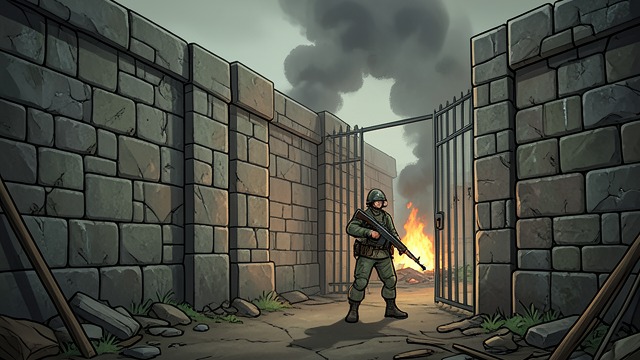
Shelter in a Dangerous World
Physical security
Temple’s walls and reinforced structures offer refuge from raiders and the radiation-scarred wastes. The Compound provides greater security than the makeshift homes beyond it.
Protection with an owner
The Family controls access to the town’s strongest defenses and presents itself as the source of order. Residents receive safety through an institution that also demands taxes and obedience.
The setting makes protection a genuine need, not a hollow excuse. That reality complicates every challenge to the Family’s rule: resisting control may also mean risking the shelter it provides.
Tax for Safety

Security as Exchange
A public demand
Case tells local patrons that they must pay if they want protection. The Family’s authority depends on the money collected from the people living under its rule.
Private appropriation
Troy takes coins for himself, revealing how easily a protection system can be redirected toward a leader’s personal gain. Case’s objection is both an ethical dispute and a challenge to Troy’s authority.
The episode asks whether protection remains legitimate when the people collecting its price cannot agree on its purpose. Security and extraction share the same institutional machinery.
Women Protected by Witnesses

Safety Through Supervision
An escort rule
Women are discouraged from walking alone because a witness may be needed if one is taken. The rule attempts to answer real danger in a society where violence is common.
Limited freedom
Robin and Abigail can travel together, but the protection depends on keeping women’s movements visible and documented. The rule therefore safeguards and constrains them at once.
The story’s social order repeatedly makes security conditional. A protective measure can reduce one risk while reinforcing the assumption that women cannot move safely without supervision.
A Community in the Fire
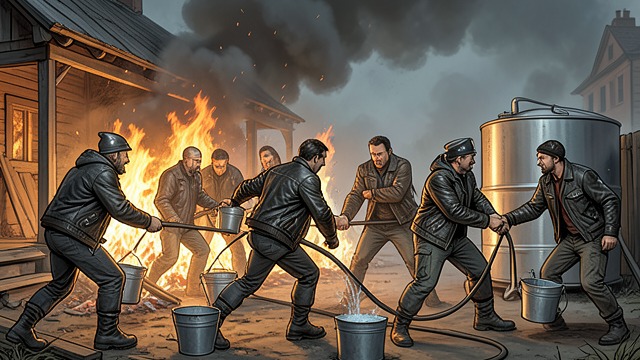
Protection Beyond the Walls
Case chooses residents
When fires threaten Temple, Case organizes people to save homes and prevent further spread. He refuses Troy’s view that the town beyond the Compound is expendable.
Brall joins the effort
Brall and his men help fight the blaze, temporarily acting as protectors of the same residents their gang has threatened. Their labor challenges the image of the Cauldron as only a conquering force.
The fire makes protection an action that can cross factional lines. It also clarifies the moral difference between defending an institution and defending the people who depend on it.
Protection Through Partnership
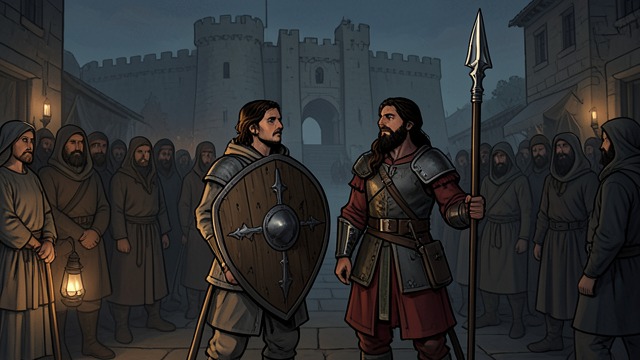
Security Shared
Complementary roles
The Family remains responsible for Temple while the Cauldron supports trade routes and outside security. Their combined strengths answer different dangers facing the settlement.
A conditional promise
The arrangement protects the community by making both groups dependent on stability. It does not remove the possibility of future conflict, but it gives each side a reason to preserve cooperation.
Protection changes from a claim held by one gang to a shared obligation. The town’s safety becomes more resilient precisely because authority is no longer concentrated in a single faction.
during the opening description of the settlement
during the collection at The Smoking Gun
during Robin and Abigail’s walk
on the night of the Compound bombing
after the Temple Accord is signed
