Brall’s Attempt to Claim Abigail
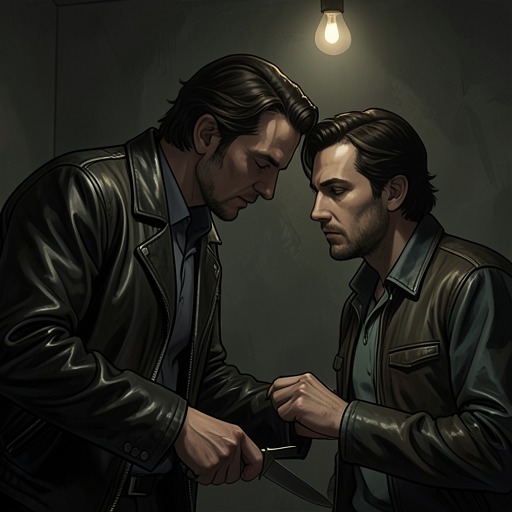
Gang Up: A Bikerland NovelBrall’s Attempt to Claim Abigail brings a political bargain into direct collision with Abigail’s refusal to be possessed. After Titus’s death, Brall approaches her in a shop and presses a claim he has made openly for some time: she should join his gang, a condition he frames as a path to peace. Abigail counters that claim with a knife and a threat, turning a negotiation over her future into a dangerous face-to-face standoff.
Background and Stakes
Brall’s interest in Abigail predates the confrontation. He had made no secret of wanting her, and Titus knew of that desire before his death. In Temple, Brall had offered terms of the sort used in open business negotiations, but with a personal condition attached: Abigail would have to be indoctrinated into his gang. The language of negotiation gives his pursuit a public, political shape, while its central demand remains control over Abigail.
The encounter occurs after Titus is dead, a change Brall immediately invokes. He tells Abigail that her father’s decisions had kept her from him and presents those decisions as wrong. His proposed alternative is that she become his, with peace and the avoidance of bloodshed as the promised return. That promise carries a threat beneath its conciliatory surface: Abigail has reason to think acceptance could prevent a war that might destroy her clan, but Brall does not offer a limited or temporary arrangement. His desired possession is, in his own terms, lasting.
The bargain also meets a world in which women’s access and status are already governed by gang rules. In the Family, warriors’ needs and the distribution of women form part of the order overseen by its leadership, while Sandra, as Matron, has final say over whether a woman may marry into the group. Brall’s demand is not a break from that system so much as a competing claim within it. Abigail is being treated as the object through which rival powers might secure allegiance or avert conflict.
The Shop Confrontation
Brall enters the shop with no apparent interest in browsing. Abigail understands that he has come for her, not for any of the goods. When he tells her Titus is dead, she answers that she already knows. Brall then recasts his pursuit as both correction and settlement: Titus had wrongly kept her away, he says, and becoming his would spare bloodshed. Abigail challenges that explanation rather than accepting peace as a sufficient justification for his claim.
The balance of power shifts when Brall closes the distance and pushes Abigail against the wall. His physical force silences the shopkeeper, whose protest ends when Brall turns toward him. Brall makes his desire explicit and handles Abigail roughly, while she experiences the pull of a response she has been conditioned to feel. The scene refuses to equate that bodily reaction with consent. Abigail’s attraction to being wanted exists alongside her resistance to Brall’s claim, and neither erases the other.
Her decisive counter is a knife Titus had given her long before: a hard-steel, crescent-shaped blade kept at her waist. Abigail presses it into Brall’s crotch. His eyes widen, and he releases her. The knife changes the encounter’s terms in an instant. Brall had used his size and proximity to make the claim feel inevitable; the blade makes the risk of continuing equally immediate.
Refusal and Withdrawal
Abigail warns Brall that another approach could leave him permanently injured. He threatens to kill her if she acts, and she answers that the knife has already drawn blood from someone before, challenging him to decide whether he can risk her using it. The exchange is not a victory that removes danger: Abigail is frightened, and Brall remains powerful enough to threaten her life. But the threat does not make her yield. Her weapon gives her refusal a force Brall cannot simply talk away.
Brall eventually backs off. He says he is leaving for now, while making clear that he knows where to find her and believes she may change her mind. His departure therefore ends the immediate assault without settling the larger struggle. The encounter leaves his claim active as a future possibility, but it also establishes that Abigail has opposed it openly and made its cost visible to him.
After Brall withdraws, Abigail’s fear remains entangled with desire. She is shaken by his attention and by her own physical response, yet her attachment to Case is decisive: she wants Case, not Brall. She wants to be desired and admired, but only at Case’s side. The distinction exposes the limit of Brall’s reasoning. Being wanted is not the same as choosing the person who wants her, and a promise of peace cannot make those choices interchangeable. Abigail leaves the confrontation wanting to find Case and work through what has happened with him.
Significance
The encounter stages a conflict between two kinds of power. Brall offers a political settlement in the language of ownership, while Abigail’s response turns a gift from Titus into a practical means of resisting that settlement. The knife matters not merely as a symbol of her father’s protection: placed against Brall, it alters what he can do in the moment and forces him to retreat.
Abigail’s refusal is complicated rather than emotionally uncomplicated. She feels fear and arousal at once, and she recognizes the appeal of the intensity Brall offers. Yet she does not treat those sensations as permission for him to decide her future. The scene’s central tension lies in the gap between desire as a bodily response and consent as a choice. Brall tries to close that gap by making possession sound like peace; Abigail’s blade, and her stated allegiance to Case, keep the distinction open.