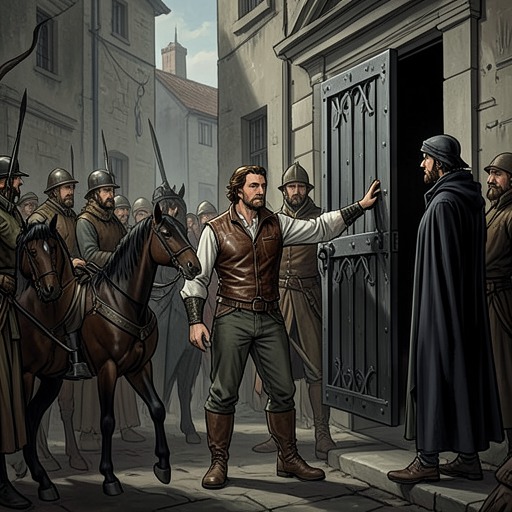
Case–Troy power struggle
Gang Up: A Bikerland NovelCase–Troy power struggle is the Family’s crisis of succession after Titus’s death: two men with claims to authority, backed by divided loyalties, collide over who controls the Family and what that control is for. Their rivalry moves from tense negotiations and disputes over resources to physical violence, while the danger posed by the Cauldron and the people of Temple tests the difference between their approaches to leadership.
Succession and divided loyalties
Troy had served as Titus’s second-in-command and earned loyalty through his duty to the Family. Case and Troy nevertheless stood on opposing sides of the question of how the Family should be run. The division was visible among the men, who now belonged either to Case or to Troy; it was not a private disagreement that could be concealed from the people expected to follow them. With Titus dead, the authority he had held had become the object of a contest that threatened the continuity of his work.
The strains appear even in the atmosphere of the Mud Pit. Case hears younger men boasting about Brall and the Cauldron, and nearly all of them are his men. When he enters, the talk falls to a more subdued rumble. He buys a round for everyone, turning a display of generosity into a public gesture in a room where allegiance is already divided. The gesture does not settle the succession, but it shows Case exercising influence through the Family’s followers while the rival camps remain present.
The conflict also unfolds against an uneasy peace with the Cauldron. At this point, no blood has been shed between the two sides, not even in bar fights, and Brall’s men are described as disciplined. Case and Troy are therefore contesting leadership under pressure from an external threat as well as from one another. Their failure to consolidate power risks undoing what Titus built, while a fracture inside the Family could leave it less able to withstand the Cauldron.
Authority, money, and violence
Their dispute becomes concrete when the two men collect money from nearly everyone in a tavern and head back toward the Compound. In an alley, Troy stops to open the bag and begins taking large portions of the coins for himself. When challenged, he gives his claim in blunt terms: “Funds go to the Family. We’re running the Family. Funds go to me.” The repeated movement from the Family to himself makes the dispute more than an argument over bookkeeping. Troy treats his role in running the Family as grounds to personally control its funds.
Case tells him to put the money back. Troy refuses, and the disagreement turns physical: Case punches him twice, the two grapple in the dirt, and the bag falls, scattering gold into a small mud puddle. The money that had been gathered from the tavern is left on the ground between them as their fight becomes public and immediate. Case’s own thoughts turn toward the possibility that Troy killed their father, though the passage presents this as suspicion rather than proof. His impulse to strangle Troy shows how the struggle over leadership is entangled with grief and suspicion about Titus’s death.
Kinship and political bargaining
The rivalry is also shaped by the Family’s rules for sex, descent, and marriage. Troy is Robin’s brother, and Titus had protected her from Troy’s desire to invoke the Right of Clan against her. That rule permits a clan that believes its bloodline is threatened to use a stepfather or stepbrother to continue it through pregnancy; marriage between members of the same family, including step-siblings, is forbidden. Robin has heard estimates that the Long War removed as much as ninety-five percent of the population, a catastrophe that gives the rule its stated demographic rationale without making its coercion any less stark. With Titus dead, the protection he had given Robin is gone, and Troy’s claim to Family authority carries intimate consequences as well as political ones.
Case’s proposed arrangement involving Sandra brings this system directly into the succession contest. He tells Troy that Troy is to mate Sandra after a year has passed. The delay is tied to mourning: Sandra must be seen to observe it, or the Family’s men may suspect what happened to Titus. Case says he knows Troy is clean, but the proposed pairing still binds succession politics to regulated reproduction and to appearances surrounding the dead leader. Troy’s response is to challenge the delay, making plain that even a negotiated arrangement is contested between them.
The larger settlement later described for Temple preserves this political use of marriage and sexual access. The Cauldron may marry into the Family and receives special preference for newly matured Family girls. That arrangement does not by itself establish how Case and Troy’s personal rivalry ends, but it shows the kind of order their struggle takes place within: authority is exercised not only through command and money, but also through the allocation of kinship ties and access to women.
Competing ideas of leadership
When Abigail’s capture by the Cauldron is reported, Troy immediately asks whether she underwent Indoctrination. His question locates the news within the Family’s political conflict with the Cauldron: the rival group has not merely taken Abigail but has made her one of its own. The exchange does not settle how either man responds beyond that moment, but it makes clear that leadership is being tested by events beyond the succession itself.
The sharpest contrast comes during the fire in Temple. As the town burns, Case gathers men into a chain of helpers and prepares to go through the gates. Troy stops him by placing his hands on Case’s shoulders. Case says, “We’ve got to help these people, Troy. It’s our duty.” Troy answers that there is no duty but survival and invokes Titus’s teaching. Case counters that his father’s lessons are precisely why he is helping, then accuses Troy of having learned how to stir up a war. Their disagreement brings the underlying struggle into focus: both appeal to Titus, but they use his legacy to justify opposing definitions of responsibility.
The later description of the arrangement at Temple offers a measure of political reorganization without erasing that difference. The Family retains control of Temple and responsibility for its security, while the Cauldron is assigned trade-route work and can be called on if the settlement faces hostilities. The Family’s riders continue to seek new territory and materials, while the Cauldron receives regular work and access to supplies and lodgings. The arrangement is summed up as “A little bit chaos, a little bit order.” Against this outcome, Case and Troy’s rivalry reads as a struggle over what the Family’s power should protect and how it should be exercised: the contested legacy of Titus is not simply the right to rule, but the purpose that rule serves.