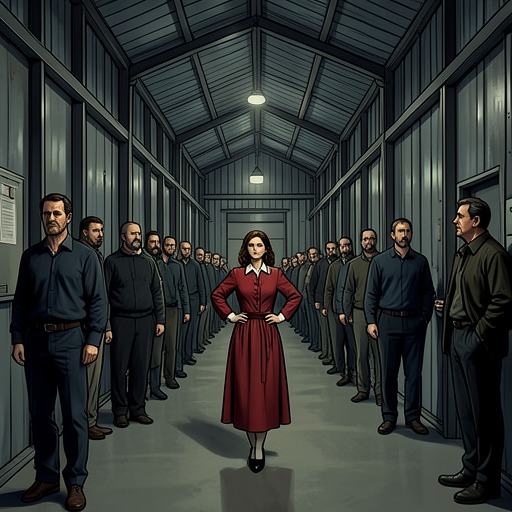
Cauldron Camp
Gang Up: A Bikerland NovelCauldron Camp is Brall’s fortified headquarters outside Temple and the material center of the Cauldron’s military power. More than a collection of tents, it is a deliberately organized war settlement: defensible, armed, supplied, and disciplined. Its position near Temple turns the camp into both a staging ground for invasion and a rival seat of authority, while its routines reveal how the Cauldron converts a precarious population into an army capable of contesting the Family’s control of land, taxes, bodies, and water.
Fortification and Physical Setting
Cauldron Camp stands in the shantytown outside Temple, an area that resembles the town in poverty but lacks Temple’s walls and its solid stone-and-steel buildings. Its structures are made from spare sheet metal, abandoned automobile bodies, and boards laid over mud. The setting gives the camp the appearance of a settlement assembled from the wreckage of the postwar world, yet Brall’s headquarters imposes a distinct military order upon that improvisation. His headquarters is a large tent bordered by overturned tanks and a long trench functioning as a moat. The trench is filled with broken glass and gears, making approach dangerous even before an attacker reaches the tent. Inside are beds, carpeting, polished wood, a small liquor cabinet, and a heavy table covered with maps and navigational instruments—objects made especially valuable by the collapse of regular communication. A rack holds guns, a wickedly bladed axe, and a yellow-painted crowbar. A small fire is kept just below a smolder, while women outside tend a larger fire and carry coals inside to keep the tent warm. The headquarters therefore combines domestic comfort, command infrastructure, and overt violence in one enclosed space.
Military Organization and Discipline
Near Brall’s tent, an old gym serves as the Cauldron’s training ground. Its roof is mostly gone, leaving only a strip of shade, and the surviving wooden floorboards cling to the edges of dirt that has been dug out across most of the room. The ruined gym is consequently both a remnant of an earlier civic world and a practical drill yard for the new one. Brall’s men train with knives, clubs, chains, and whatever other weapons they choose, spreading out so that their movements do not injure one another. The early exercises consist of repeated attacks in different directions, including upward, downward, sideways, and backward movements. Brall’s soldiers already know how to fight; the purpose of these drills is to make them respond to his voice and to the commands of his sergeants. Later sessions teach attack positions, ranks, mock battles, and tactics. Training thus turns individual violence into coordinated force. Brall understands that a hungry, undisciplined man is dangerous to his own leader, whereas a disciplined man with an empty belly can still be held together by the promise that food is coming if he follows orders a little longer. The scale of the camp makes this discipline necessary. More than seventy-five soldiers follow Brall, and roughly one hundred additional people—described as whores, merchants, life-partners, or other dependents—travel with them. Nearly two hundred mouths require food, protection, and organization. The camp’s military routine is therefore also a system of population management: weapons, labor, food, obedience, and movement must be coordinated or the settlement will collapse under its own disorder.
Strategic Position Outside Temple
The camp lies only a few hundred yards from Temple’s walls, with Brall’s soldiers positioned on both sides of the road leading into the fertile town. This placement gives Cauldron Camp immediate strategic pressure over Temple’s entrances and makes the settlement a visible alternative to Family authority. The Family’s power is sustained through raids, land, loot, women taken for trade, and taxes imposed on Temple’s inhabitants; Cauldron Camp answers that protected and taxed order with a mobile military community organized around Brall’s command. The camp also functions as a networked base rather than an isolated encampment. Carthage moves through its shanty tents and the tall spiraling piles of wood used for signal fires. The Sooner crew, a group of hard soldiers from Oklahoma whom Brall trusts as shock troops, acknowledges Carthage as he passes. Their presence shows that the camp’s strength depends not only on local followers but also on dependable external fighters and signaling systems. With these troops, Brall expects to be ready for war within days.
War, Water, and the Camp’s Expansion
Cauldron Camp is the launch point for the campaign against the Family and for the broader struggle over Temple. When Brall’s forces attack the spring near dusk, the camp’s organization becomes offensive power. The spring is heavily guarded, but the declining sun blinds the Family defenders and allows Brall to retain the element of surprise. The fight is short and bloody: Brall loses two men, the Family loses five, and the remaining defenders surrender and are chained. Brall considers selling them back or using them as hostages in negotiations, while withholding some degree of clemency because he wants to rule the people whose settlement he is conquering rather than strip them of every protector. The captured spring is more than a battlefield objective. It rises from a cave deep in the rocks, and its clean water has escaped the radiation affecting the surrounding land. Once the fighting ends, Brall personally surveys the rooms and recognizes that possession of this source gives the Cauldron a major advantage. The Family controls other sources, but none is so close or readily available. Without steady water, the Family will weaken. Cauldron Camp’s military geography is therefore inseparable from resource control: the camp can threaten Temple because it can mobilize men, and it can sustain that threat because it seeks command of the water that keeps the population alive. The same campaign reveals the camp’s coercive underside. Robin is found locked in the back of the cave with her hands tied behind her back. Her discovery connects Cauldron Camp’s military expansion to the struggle over individual bodily control that defines the conflict between Brall, the Family, and the women caught between them. The camp is presented as a place where the language of protection, possession, captivity, and political rule repeatedly overlaps.
Political Rival and Battlefield Headquarters
Cauldron Camp stands opposite the Family’s enclosed spaces: Temple’s walls, the Family Compound, and the bunker reserved for the Family and its most closely regarded Kin. The contrast is not simply architectural. The Family uses walls, guards, taxes, and controlled access to separate protected insiders from the broader population, while Brall’s camp uses trenches, tanks, weapons, signal fires, and military discipline to establish a competing order beyond those walls. Both systems convert insecurity into authority, but they do so through different forms of enclosure and command. The camp remains active as the war escalates. After further conflict, Case and Brall agree to terms forbidding sneak attacks and requiring an open battle outside town. The next morning, the two forces gather beyond the walls with roaring bikes and men carrying hatchets, planks, spikes, knives, chains, shotguns, and spears. The Family outnumbers the Cauldron by roughly half again its size, making Cauldron Camp the base of a force that is smaller but organized enough to accept a direct test of arms. Its significance lies in this transformation: what begins as a tent surrounded by wreckage becomes the headquarters of a disciplined rival power, capable of challenging the Family’s taxes, territory, military supremacy, and claim to govern Temple.