Cauldron's Capture of the Spring and Rescue of Robin
Gang Up: A Bikerland NovelCauldron's Capture of the Spring and Rescue of Robin is the moment when Brall's campaign acquires both a material prize and an intimate human stake. By taking the Family's uncontaminated water source, Brall gains the means to weaken the settlement and the position from which he hopes to rule it; by finding Robin imprisoned in the cave, he is forced to confront how closely his political ambition is entangled with his desire for her. The event therefore shifts the value of the spring from strategic resource to contested symbol of power, while changing Robin's immediate condition from captivity to dependence on the man who conquered the place.
Causes and Strategic Stakes
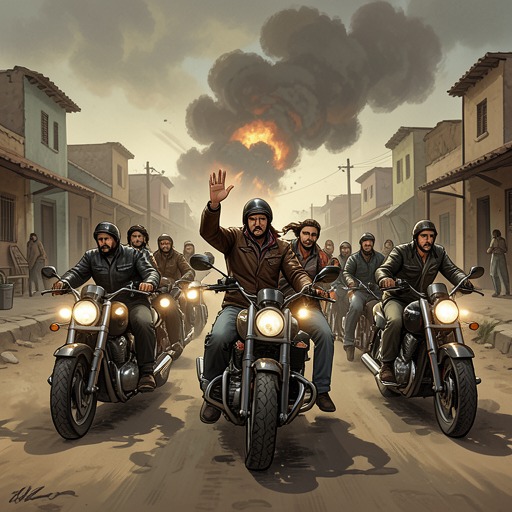
They attacked the spring near dusk, when the Family's heavily guarded position was compromised by the falling sun. The light was in the defenders' eyes, and Brall possessed the element of surprise. The advantage was tactical rather than accidental: Cauldron struck at a moment when the Family's weapons and numbers could not be used as effectively, turning a fortified water source into a vulnerable target.
The spring mattered because it emerged from a cave deep in the rocks and supplied clean water untouched by the radiation covering the surrounding land. The Family possessed other sources, but none was as close or as readily available. Brall understood that control of this particular source would exert pressure without requiring the immediate destruction of the town. Without steady, regular water, the Family would weaken, making the spring a weapon of attrition as much as a prize of conquest.
The Battle and Brall's Terms
The fighting was short and bloody. Brall lost two men, while the Family lost five; the remaining defenders surrendered, and Brall ordered them put in chains. Their captivity was not treated as a purely punitive measure. He could sell them back or use them as hostages in negotiations for peace, preserving a political use for the men whose position he had just defeated.
That decision reveals the limits Brall placed on conquest. He wanted to rule the people rather than remove all of their men from them, because total devastation would leave him with subjects who had every reason to resist and no social structure through which to govern. His clemency was therefore practical as well as humane: the captives embodied future bargaining power, while restraint helped preserve the population Brall intended to control.
After the fighting, Brall personally surveyed the rooms in the cave, walking through the territory he now considered his own. Blood pools, emptied shotgun shells, and bullet cases marked the passage from battle to possession. The cool air and the enclosed trickle of water contrasted with the heat outside, making the cave feel at once like a refuge and the sealed interior of a conquered domain. The spring's material value was immediate, but the cave also became the setting for a discovery that altered the meaning of the victory.
Robin's Discovery and Release
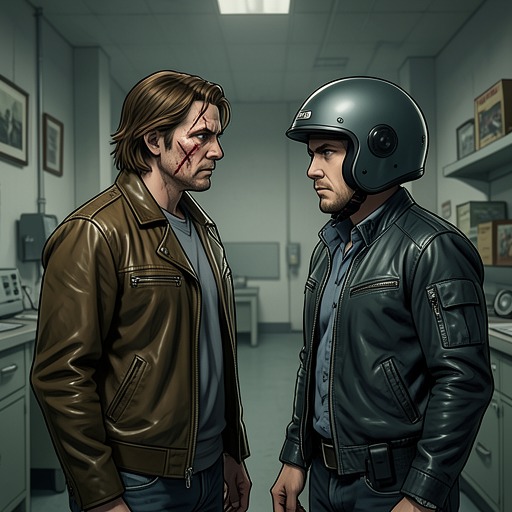
A troubled moan drew Brall farther into the cave toward a light. In a back corner he found Robin locked away with her hands tied behind her back. The discovery provoked an immediate physical and emotional reaction: he worried that she might have been hurt, frightened by the fighting, shot, or killed, and imagined taking her against his massive body to reassure her. His anger that his men had failed to tell him she was there subsided as he deliberately tried to become calm and rational, recognizing that she was frightened and alone.
Brall freed Robin by undoing the metal restraints. She had been unable to break them herself, but he could do so easily, tossing the bindings aside. The gesture is simple, yet it marks a sharp reversal in the scene's power structure. Robin enters the encounter as a prisoner whose movement has been physically controlled; she leaves the immediate confinement because Brall's strength removes the mechanism that held her. Her freedom, however, does not become independent security. It is delivered through the conqueror who now controls the spring and the surrounding territory.
Robin told Brall that Troy had wanted her and had kept her in the most heavily guarded area available. Her question about whether Brall had come for her exposes the emotional uncertainty beneath the rescue. She needed confirmation that their feelings were real and that she had not invented the relationship in response to her captivity. Brall recognized that need because he shared it, but he answered by naming the water and the town as his objectives rather than admitting that he wanted her as well. His silence about that desire creates the event's central gap between action and declaration: he has found and freed Robin, yet refuses to make love the stated reason for the campaign.
Possession, Violation, and Intimacy
Robin interpreted the attempt to take her as an effort to claim her. Brall asked whether they had succeeded, and she answered that they had taken her and that she had had sex with every man brought to her. The exchange places sexual coercion inside the same language of ownership that governs the battle for the spring. Troy's imprisonment, the Family's guarded territory, Brall's chains, and Robin's fear of being claimed all belong to a social world where bodies and resources are treated as things that powerful groups can seize.
At the same time, the scene does not leave Robin's relationship with Brall at the level of military possession. Once the fighting has ended, the cave isolates the two of them from the men and noise outside. The battlefield's violence gives way to a private encounter in which Robin seeks validation and Brall suppresses the words that would reveal how urgently he wants her. Their reunion thus carries two incompatible movements: Brall's public project is to own and govern territory, while his private attachment makes Robin's condition impossible for him to treat as merely another consequence of war.
The sexual encounter that follows culminates with both of them reaching orgasm, after which Brall remains physically joined to Robin while lying over her. She kisses him and welcomes the sensation of his weight dominating her experience. These details frame intimacy through the same bodily asymmetry that has defined the rescue, but they also present mutual participation and emotional attachment within that unequal structure. The scene does not erase the violence that preceded it; instead, it places pleasure, dependence, and domination directly beside the scars of captivity.
Consequences and Narrative Significance
The immediate consequence is Cauldron's control of the spring and the surrender of its Family defenders. Brall now holds a resource capable of weakening the Family over time, prisoners who can be exchanged or used to negotiate, and a fortified cave that he has inspected as part of his new domain. The capture is therefore a practical foundation for the continuing war, not merely a successful raid.
The rescue produces a second consequence that is less stable. Robin is no longer locked in Troy's guarded area, but her release does not settle whom she belongs to or whether Brall's love can survive the fact of what was done to her. Her disappointed response to Brall's refusal to say he came for her shows that physical rescue cannot by itself repair emotional insecurity. The event changes captivity into a difficult form of freedom, in which Robin must interpret Brall's actions against his guarded words.
For Brall, the victory ends in an assertion of private attachment. After acknowledging that there is still a war to fight and much work to do, he simply enjoys the woman beside him and regards her as his woman and his love. That ending compresses the event's governing contradiction into one image: outside the cave, water, chains, casualties, and political calculation define the new order; inside it, Brall treats the rescued Robin as the intimate reward and emotional center of conquest. The spring gives him power over the Family, but Robin gives the victory its personal meaning—and makes that power inseparable from the possessive, wounded love through which he understands her.