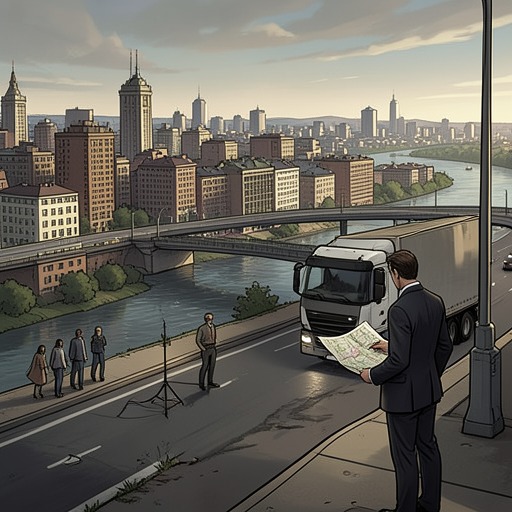
Dallas
Gang Up: A Bikerland NovelDallas is the nearest major urban reference point in the wasteland surrounding Temple: a metropolis that survived the Long War, though with its size and population drastically reduced. The city remains important less as a directly visited setting than as a distant standard of law, commerce, and organized society against which Temple’s violent Family regime is measured. Its name also marks the geographic and economic horizon toward which the Cauldron’s disciplined military organization is eventually redirected.
A Surviving Postwar City
Dallas is described as a bustling metropolis that still exists after the Long War, but only in diminished form. Traders arriving in Temple bring reports from the East and North of large, protected supercities that escaped the war relatively untouched; Dallas is not presented as one of those fully shielded enclaves. Instead, it belongs to the damaged world beyond Temple, a surviving city in a landscape where only five or six comparable towns are known to the people who live there.
The distance between Dallas and Temple is therefore not merely geographical. Temple occupies the hot badlands of what was once Texas, in a region where the Long War did not spread directly but where postwar scarcity, demographic collapse, and armed territorial rule define everyday life. Dallas represents a larger and more established urban possibility within that same fractured world, while Temple remains a small, exposed settlement whose social order has been rebuilt around force.
Law and Order Against Family Rule
Abigail has never been to Dallas, but she knows what distinguishes it from Temple: Dallas has law and order. Temple has the Family. The contrast reduces the political structure of each place to a pair of stark principles. In Dallas, authority is imagined as an external civic system; in Temple, the Family itself decides what the law means and who receives its protection.
That difference is reinforced by Temple’s economic arrangement. The Family claims to serve the whole town, but earns its income through raids on surrounding territories, taking land, loot, and women for trade. Family members receive first choice, the Kin receive the next preference, and ordinary residents receive the benefits of protection only if they pay taxes. Dallas consequently functions as an implied alternative to a society in which protection is inseparable from tribute and military domination, even though the text does not describe its institutions in detail.
The city’s symbolic force also enters the way Temple’s women present themselves. Clothing made in Dallas is treated as a luxury and a sign of distinction: Abigail wears a tight shirt expertly made there, along with carefully maintained boots and jeans. The garment carries the prestige of an outside commercial center into a settlement governed by raiders, displaying how Dallas supplies not only an imagined civic contrast but also goods that distinguish status within Temple’s hierarchy.
Trade Routes and the Cauldron Settlement
Dallas becomes materially important when Brall and the Cauldron negotiate their place in Temple’s future. Under the settlement, Brall’s forces will control the trade routes between Temple and Dallas, as well as routes to any other city or town Temple manages to contact. The arrangement transforms Dallas from a distant point of comparison into one endpoint of a practical economic network.
This responsibility suits the Cauldron’s organization. Brall commands more than seventy-five soldiers, with roughly another hundred people attached to them as workers, partners, merchants, or dependents. He trains the group through drills, ranks, mock battles, and tactical study because nearly two hundred mouths require discipline as urgently as they require food. The agreement gives this mobile force regular work and a settled base: no more wandering through the wastes or spending months and years without a home. Dallas-bound trade therefore becomes part of the process by which the Cauldron changes from a roaming armed group into a regulated power connected to Temple’s economy.
The settlement also promises mutual security. The Cauldron will remain available if Temple faces hostilities, while receiving access to the Compound’s supplies and lodgings when present in the town. Drink, women, and sleep are free, while other provisions must be paid for. The Family retains control of Temple’s internal security and keeps its riders responsible for searching the wastes, raiding abandoned towns and cities for materials, and representing Temple to the outside world. Dallas thus stands at the intersection of commerce, military protection, and territorial expansion rather than functioning as a neutral destination.
Narrative Significance
Dallas is chiefly a contrastive and connective location. It is never given the same immediate physical presence as Temple, the Compound, or the spring, but its absence is meaningful: Abigail has not seen the city, and the reader encounters it through accounts, trade, and manufactured goods. The city’s reality is distant enough to remain partly imagined, yet concrete enough to shape decisions and social distinctions.
Its most important narrative function is to expose Temple’s instability. Temple’s hills and cemetery may provide natural defenses, and the Family may claim authority over every resident, but neither fact makes the settlement equivalent to a lawful city. Dallas supplies the vocabulary by which that gap can be recognized. Later, when the Cauldron receives responsibility for the routes linking the two places, the alliance gives Temple access to a broader world while also binding that world to the same armed systems of protection, taxation, and territorial control that govern life inside the town.