Family Rule of Temple
Gang Up: A Bikerland NovelFamily Rule of Temple is the system through which the Family governs Temple: it makes the law, controls protection and taxation, and claims the first share of the wealth taken from the surrounding wastes. The order presents the Family as serving the whole town, but its benefits are unequal and its authority is enforced by force. Conflict with the Cauldron and a struggle over leadership expose the limits of that rule; the eventual settlement redistributes some responsibilities without transferring control of Temple itself.
Authority and the Shape of the Town
Temple has no separate legal authority above the Family. In Abigail’s understanding, the Family supplies both order and law, with the latter defined by whatever the Family decides. Its governing power is visible in the town’s uneven landscape: broken-concrete streets and makeshift buildings lie beyond the Family’s fortified Compound, while the Cauldron holds sway in the shantytown outside Temple’s eastern walls. The Compound’s concrete buildings, reinforced with steel and layered with lead, offer a protected space against the radiation outside. Authority is therefore territorial as well as political: the Family rules the town, while its walls and guarded spaces mark who can enter its most secure center.
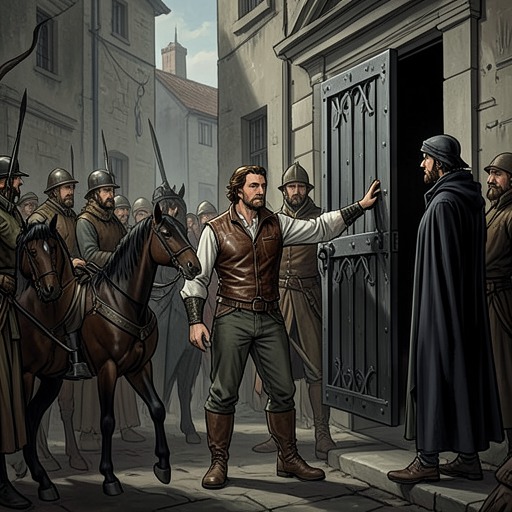
The boundaries around the Compound are actively policed. A cleared strip about thirty feet wide surrounds its walls, and guards remain on duty to warn people away. If a caravan or wagon blocks the space, the Family confiscates it within minutes. During a crowd’s demand to enter, guards threatened to open fire and told those gathered to return to their homes, promising that anyone admitted would be notified. The incident shows that access to safety is controlled by the Family, not treated as a general right of Temple’s residents. Even people known personally to the guards, such as Robin, pass through because they are recognized as belonging inside.
Protection, Taxation, and Extraction
The Family describes itself as serving all of Temple, and its economy combines protection with raiding. Its riders take land, loot, and women from surrounding territories for trade. Family members receive first choice of the proceeds; favored people known as Kin come next; ordinary residents may live in Temple, but only those who pay taxes receive the full benefits of protection under Family rule. Protection is thus both a public claim and a conditional service: residence is permitted broadly, while security is stratified by payment and status.
The Mud Pit makes that hierarchy visible in everyday commerce. It is open to almost anyone with money, and traders spend there on the Family’s sex workers and moonshine. Yet a visitor who is neither Family nor a reliable source of income risks being present at all; death is common, and fights more common still. The bar can serve as a public meeting place, but it does not suspend the coercive terms of the town. Money buys access, not equal standing or safety.
Social Order and Control of Kinship
The Family’s authority also reaches into intimate life. In the account of the Right of Clan, marriage between members of the same family is forbidden, including between stepsiblings, because the population devastated by the Long War must be rebuilt without marrying within the same bloodline. The rule nevertheless permits a threatened clan to invoke a reproductive exception: a stepfather may take a stepdaughter, or a stepbrother a stepsister, solely to produce a pregnancy, not a marriage. The distinction makes reproduction a matter of clan power even where marriage is prohibited.
Robin’s circumstances show the personal danger built into that rule. Titus had protected her from Troy’s desire to invoke the Right of Clan against her; after Titus’s death, she feared that protection was gone. Troy had repeatedly told her of his wish to impregnate her. Later, he asserted that Robin would be under his care alone, rather than Case’s or the Cauldron’s. Case’s own directive that Troy mate Sandra after a year of mourning further shows reproductive arrangements being treated as matters a leader could assign. These episodes place women’s bodies within the same political order that allocates territory, security, and resources.
Contested Leadership and the Cauldron
The Family’s rule is not internally unified. After Titus’s death, loyalty divides between Case and Troy, who had served as Titus’s second-in-command. Both are associated with the Family’s future, but they disagree over how it should be run, and the uneasy peace with the Cauldron makes that contest urgent. At this stage, neither side has shed blood in the conflict, including in bar fights; the peace depends in part on the discipline of Brall’s people. The town’s small size also makes the absence of witnesses to Titus’s street killing suspect: in Temple, no witnesses can mean that those who knew what happened were paid off, loyal, or dead.
The Cauldron is a rival power with an organized following, not simply an external threat. Brall trains more than seventy-five soldiers, with around a hundred additional people attached to them as sex workers, merchants, life-partners, or other dependents. He emphasizes discipline, including drills, formations, attack positions, and mock battles, as a way to keep a large, difficult-to-feed group under command. The Family’s unease with this force sits beside its own dependence on armed riders and coercive protection. When the Cauldron attacks the spring near dusk, surprise helps it overcome a heavily guarded position. Brall loses two men and the Family five; the survivors surrender and are chained, available for ransom or as hostages in pursuit of peace. The capture turns a dispute over influence into direct leverage over the Family’s resources and security.
Settlement and the Persistence of Family Rule
The conflict eventually produces a negotiated division of work rather than a complete transfer of power. Under the settlement, Brall and the Cauldron take responsibility for trade routes between Temple and Dallas and for routes to other places Temple may contact. They are also to respond if Temple faces hostilities. In return, they gain access to the Compound’s supplies and lodging while in Temple, with drink, women, and sleep provided freely and other things paid for. The arrangement offers Brall’s disciplined force regular work and a settled home instead of continued wandering in the wastes.
The Family retains Temple’s security and control of the town. Its riders continue to search the wastes, raid ruins, and bring back materials for fabrication and production; they also keep first claim on incoming loot and remain Temple’s public face to the outside world. The agreement therefore modifies how the Family exercises power, incorporating the Cauldron into trade and defense, but leaves the central structure of Family Rule of Temple intact. Its order survives not by eliminating a rival force, but by making that force part of the system while reserving government of the town to the Family.