Family's Compound
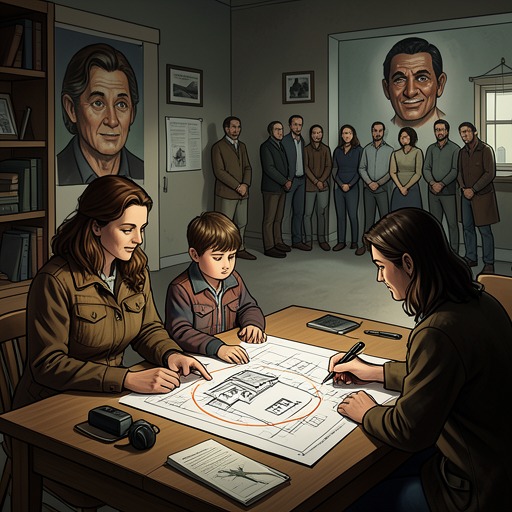
Gang Up: A Bikerland NovelFamily's Compound is the fortified center of the Family's authority in Temple and one of the book's clearest images of postwar rule. Its concrete walls protect survivors from radiation, but they also enclose a hierarchy in which money, membership, military loyalty, and control over bodies determine access. Across the story, the Compound changes from a symbol of inherited security into a contested space of coercion, sabotage, escape, accusation, and uneasy reconciliation.
Fortification and Social Order
Family's Compound consists of squat concrete buildings reinforced with steel and layered with lead, making it a refuge from the radiation that continues to ooze through the world left by the Long War. Its construction expresses the Family's central political claim: survival depends on enclosure, armed strength, and obedience. The Compound is not merely a residence but a protected jurisdiction, distinct from the fragile boards, clay, and tents that make up much of Temple beyond its walls.
That distinction produces a sharply policed boundary between insiders and outsiders. The Family keeps cleared ground around the walls, posts warnings, and maintains guards to prevent caravans or wagons from obstructing the perimeter. When a crowd gathers outside demanding admission, the guards threaten to open fire and instruct the people to return home, promising that anyone admitted will be notified. The Compound therefore operates as an exceptional space in which the Family decides who may approach, who may enter, and whose safety is worth preserving.
The Mud Pit and the Economics of Belonging
The Mud Pit, the bar inside the Compound, is open to almost anyone who can pay. Traders spend their money there on the Family's prostitutes and moonshine, creating a commercial relationship between the protected enclave and the wider wasteland. Yet hospitality is conditional. People who are not Family, or who fail to provide the Family with regular money, risk death simply by remaining present, while fights are even more common. The bar thus turns the Compound's security into an economic privilege rather than a universal right.
This arrangement also reveals how the Family's power is sustained. Outsiders may buy temporary access to pleasure and trade, but they do not acquire belonging. Veterans and older riders exchange stories in the bar while younger men boast about Brall and the Cauldron, and the division between Case's men and Troy's followers is already audible within this supposedly unified headquarters. The Mud Pit is consequently both a social commons and a pressure chamber in which factional loyalty, masculine prestige, and the threat of violence continually circulate.
Ritual, Power, and Possession
The Compound's authority is repeatedly reinforced through collective display. Titus's death brings engines roaring through the cemetery as the old King is mourned and a successor prepared for coronation. The funeral belongs to the Family's political order, and the surrounding culture treats the Family's warrior circle as the people who matter. The Compound stands behind that order as its material foundation: the place from which authority, protection, and claims over Temple are administered.
Its rituals also make bodies into signs of allegiance and ownership. During a Cauldron gathering, Abigail is surrounded by six men and several Cauldron Girls while Brall's arrival creates the expectation that the ceremony will begin. Her presence links the Family to the rival group through a public sexual spectacle, showing that the Compound's political boundaries can be crossed even when its social rules remain violently unequal. Later, Abigail and Robin kiss before watching men gather around them, with Case and Brall approaching together to assert the first claim. The Compound's world converts intimacy into public ceremony, and ceremony into a negotiated arrangement among male powers.
Sabotage, Captivity, and Escape
The Compound becomes a direct battlefield when an enormous explosion erupts from its southern side. The blast strikes the wall, creates a tower of flame, and sends heat and wind through the night; Case immediately fears for those still inside the garage. The damage is later identified as part of Troy's sabotage, leaving the long garage burned and making the wreckage a visible reminder that the Family's greatest danger comes from betrayal within its own structure.
The same enclosed system is used to control Robin. Troy declares that she will be under his care rather than Case's or the Cauldron's, insisting that she belong to him alone. Her refusal exposes the gap between the Compound's language of protection and the coercive possession practiced by its leaders. After leaving the Family following its supposedly permanent indoctrination, Robin returns through a secret sewer route known only to a few members of the Family. The route runs beneath Temple, requiring her to walk above and at times through sewage before emerging inside the walls. She expects Troy's guards to shoot her because she possesses knowledge that could condemn him, and she finds the burned garage on the other side of the wall. Her reentry turns the Compound's hidden infrastructure against the authority that claimed to control her.
Crisis, Judgment, and Reordered Community
As the conflict intensifies, the Compound's walls no longer guarantee stability. The crowd outside, the internal division between Case and Troy, and Troy's destruction of the garage all show a regime losing control of the boundary it built to preserve itself. The question posed at Carthage's grave—what Brall wants—extends beyond a personal demand: it points toward the struggle over whether Temple's future will remain governed by the Family's inherited order.
The crisis reaches the open battlefield when the terms of war are set and the opposing forces agree to meet outside town rather than continue through sneak attacks and slow attrition. Sandra then steps before the gathered men and townspeople to denounce Troy publicly, interrupting his attempt to command the scene. The Compound's political center is displaced by a public judgment that includes people previously kept outside its walls. In this movement from guarded enclosure to collective accusation, the location's meaning changes: it remains a fortress, but no longer an unquestioned source of legitimacy.
Family's Compound ultimately embodies the contradiction at the center of the Family. It is genuinely necessary protection in a radioactive wasteland, yet its security depends on exclusion, armed force, sexual hierarchy, and the power to define other people as property or threats. Its walls shelter the Family while concentrating the consequences of its rule. Fire, captivity, secret passage, and public denunciation all reveal that the strongest enclosure in Temple is also the place where inherited authority becomes most vulnerable.