Family-Cauldron War
Gang Up: A Bikerland NovelThe Family-Cauldron War is the central armed conflict between Case’s Family and Brall’s Cauldron, a struggle that transforms Temple’s existing order before ending in negotiated co-rule rather than annihilation. It grows from competing systems of protection, tribute, military discipline, and territorial ambition, but its immediate trigger is Troy’s betrayal: while preparing the Family for war with Brall, he admits that he caused explosions at the grain tower and the long garage and takes pleasure in the violence. The war therefore begins as both an external confrontation and an internal seizure of power, with the survival of Temple tied to the question of who can command its men, resources, and future.
Causes and Political Background
The conflict is rooted in the Family’s established position in Temple. The Family claims to serve the whole town, financing itself through raids on surrounding territories and taking land, loot, and women for trade. Family members receive first choice, favored dependents known as the Kin come next, and ordinary residents receive the benefits of protection only if they pay taxes. Anyone may live in Temple in principle, but the protection system is explicitly unequal: taxation determines who receives its real advantages. This makes the Family both a governing institution and a predatory military economy, so a challenge from the Cauldron threatens more than territory. It threatens the distribution of protection, wealth, bodies, and authority on which Family rule rests.
The Cauldron is dangerous because Brall has turned a wandering armed population into a disciplined force. More than seventy-five soldiers follow him, accompanied by another hundred people who depend on that force as workers, merchants, partners, or hangers-on. Nearly two hundred mouths require food, but Brall treats discipline as the condition that makes such a population governable. Training begins with repeated movements designed to make the men obey his voice and the voices of his sergeants, then advances to attack positions, formations, mock battles, and tactics. His logic is practical and severe: a fed man whose mind is full of chaos is dangerous, while a hungry but disciplined man can still be persuaded to follow a leader a little longer. The Cauldron thus enters the war as an organized military society rather than a loose band of raiders.
Troy converts this structural tension into open war. He tells Robin that the conflict with Brall is now full-scale and that Case must be angry with Brall after the incidents at the grain tower and the long garage. When Robin asks whether Troy caused those attacks, he refuses a direct confession, but his pleasure and her certainty reveal the truth. He also boasts that Troy’s men suffered no deaths in the explosions, suggesting that the sabotage was calculated to create crisis without sacrificing his own immediate supporters. His objective is not merely to defeat the Cauldron. He expects Case to join him, believes numbers will decide the struggle, and imagines that Brall’s death will clear the way for further destruction inside the Family.
Escalation and the Struggle for Resources
Case responds to the war according to his deepest operational instinct: there must always be a next action. He organizes men and prepares an attack because forward movement feels preferable to uncertainty, even when the chosen action may be wrong. Yet the war exposes the limits of action without political clarity. While Temple’s ruins still smoke, Case paces alone in his room, positioned above ground so he can reach the danger quickly, unable to convert his urgency into a settled plan. The physical image of the charred hotel and intermittent flames places the conflict inside a town already damaged by violence; war does not begin on untouched ground but feeds on an existing landscape of collapse.
Brall’s attack on the spring changes the balance more decisively than the sabotage. He strikes near dusk, when the heavily armed Family guards have the descending sun in their eyes and the Cauldron possesses the advantage of surprise. The engagement is short and bloody. Brall loses two men, while the Family loses five; the remaining defenders surrender and are placed in chains. Brall keeps open the possibility of selling them back or trading them for peace, and he shows a measured clemency because he intends to rule the people whose water source he has taken. The victory is therefore military, but it is also an act of prospective governance: prisoners become bargaining resources, and restraint becomes a method of making conquest sustainable.
The spring’s value is material and strategic. Its stream rises from a cave deep in the rocks, clean and untouched by the radiation that scars the surrounding land. Although the Family controls other sources, none is as close or as readily available. Brall understands that steady water is essential to the Family’s strength; without it, the population will weaken. After the fighting, he surveys the rooms as the new owner, walking through blood, spent shells, and bullet cases while the enclosed water continues to trickle in the darkness. The scene compresses the war’s central logic into one captured resource: military power depends on control of food, water, movement, and the people who can be compelled to defend them.
The captured spring also reveals that the war is not only a contest between leaders. It reaches into the vulnerable spaces behind their armies. In the back of the cave, Brall discovers Robin tied up with her hands behind her back. Her presence turns his victory into an immediate personal crisis: the conquered site contains someone he loves, and the strategic prize becomes inseparable from the obligation to rescue her. The war’s public geography—walls, roads, water, and territory—therefore opens onto private captivity and personal allegiance.
Open Battle and the Collapse of Troy’s Position
By the following morning, the terms of the war are changed. Case and Troy agree to abandon sneak attacks and the slow consumption of one side by the other in favor of an open battle outside Temple. Case’s written plan is total: wipe Brall out and end the conflict permanently. Troy welcomes the prospect of a melee, treating the promised confrontation as the kind of direct violence he enjoys. The agreement gives the war a formal shape, but it also exposes the difference between Case’s desire for decisive political settlement and Troy’s appetite for combat itself.
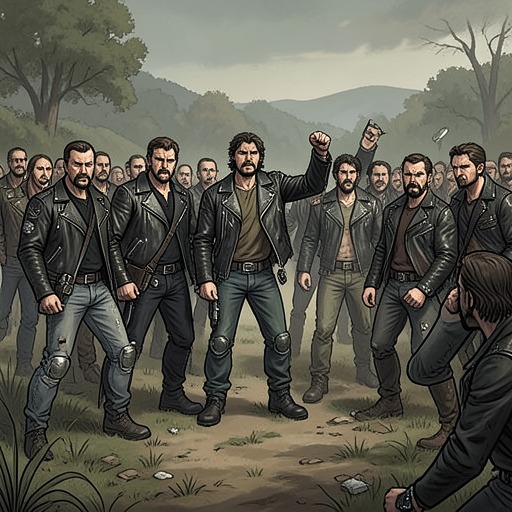
The battlefield is arranged as a spectacle of mobilized force. Rows of motorcycles roar outside the walls, while men carry hatchets, planks, spikes, knives, chains, shotguns, and spears. The Family appears to outnumber the Cauldron by roughly half again its strength. Both sides wait for the leaders’ orders, and the pause before movement makes the confrontation feel nearly ceremonial: victory has not yet been decided, but each army has already displayed the resources it can gather. Case watches Troy carefully and sees Brall dressed for the fight with leather over his broad body, a thick pipe in one hand and a gun in the other. Neither leader fully trusts the other’s promise, so both prepare for the possibility that the agreed battle will become betrayal.
The decisive reversal comes when Troy is publicly accused and turns against Sandra, the matron and widow of the Family’s leader. Case wants to beat him to death, but Troy’s paid retinue initially moves to protect him. Troy calls for both Sandra and Case to be killed, yet his words no longer command the crowd. The accusation of murder is grave; attempting to attack the Family’s matron is worse, because it places Troy against the symbolic and familial center of the community. Disapproval rolls through the assembly. His warriors gradually peel away and merge with Case’s force, leaving only his most faithful followers around him, while Brall’s soldiers prevent the remaining group from escaping. Troy, once protected by numbers and patronage, is surrounded by the very forces he believed he could control.
This collapse prevents the planned open battle from becoming the war’s final massacre. The Family’s numerical superiority and the Cauldron’s battlefield position are rendered secondary when Troy loses legitimacy. His command depends on paid loyalty, whereas Case and Brall can now claim the crowd’s recognition. The war’s value structure shifts from military strength to political credibility: Troy still possesses weapons and a personal guard, but he no longer possesses the authority to make his orders meaningful.
From War to Accord
After Troy’s isolation, Case and Brall shake hands, and the crowd cheers. Case proposes that they discuss how to run Temple, admitting that they may accomplish more together. Brall accepts the possibility. Their exchange converts the immediate enemy into a potential governing partner, and Robin and Abigail approach hand in hand as this new alignment takes visible form. The war ends not because the underlying differences disappear, but because the two leaders recognize that the town’s survival requires the combination of Family resources and Cauldron discipline.
The later settlement gives that recognition an institutional form. Brall and the Cauldron receive responsibility for the trade routes between Temple and Dallas and for routes to any other towns Temple can reach. They remain on call if Temple faces hostilities, placing the Cauldron’s regimented force in regular protective service rather than leaving it to wander through the wastes. In return, Cauldron members receive access to the Family Compound’s supplies and lodgings when they are in Temple; drink, women, and sleep are free, while other provisions must be paid for. The agreement also allows Cauldron members to marry into the Family and grants them special preference for newly matured Family girls, extending the alliance into kinship and reproduction as well as military cooperation.
The Family retains control of Temple itself. Its riders continue to secure the town, search the wastes, raid the ruins of former towns and cities, and gather scrap and materials for production. They receive the first haul of loot and remain Temple’s public face to the outside world. The settlement therefore divides the functions of power rather than replacing one regime with another: Brall supplies organized force, trade protection, and external defense, while the Family preserves internal sovereignty, raiding rights, extraction, and civic representation. The proposed joint rule reflects this same logic. Case earlier advances a council arrangement in which every council member has a vote and each has a veto, preventing either side from simply stepping on the other’s authority. The war’s ending thus turns battlefield parity and mutual dependence into a system of shared control.
Historical and Narrative Significance
The Family-Cauldron War demonstrates how violence in Temple produces political consolidation. The Family begins with a tax-backed protection order and a hierarchy of access; the Cauldron arrives as a disciplined, mobile military population; Troy weaponizes sabotage and family division; Brall captures the spring; and the final settlement assigns each group a specialized role in a broader territorial system. War expands the reach of both organizations, but it also teaches them that resources cannot be secured by force alone. Water requires administration, trade routes require protection, prisoners can become bargaining instruments, and a town cannot be governed indefinitely by a leader whose own crowd rejects him.
The conflict also contrasts two kinds of command. Troy seeks victory through secrecy, explosions, personal retainers, and the manipulation of Case’s anger. Brall builds obedience through training and accepts temporary clemency when conquest must become rule. Case begins by valuing immediate action and a final military solution, but he ends by proposing cooperation. The war’s decisive lesson is not that force is unnecessary; every later arrangement depends on armed capacity. Rather, force becomes durable only when converted into discipline, legitimacy, resources, and institutions.
Its ending preserves the instability that made the war possible. The Family and the Cauldron do not merge into a single undifferentiated community, and the settlement retains unequal access to women, supplies, loot, and authority. Yet the former enemies now possess complementary strengths: the Family has Temple’s established name and internal control, while the Cauldron has soldiers capable of guarding routes and answering external threats. The war consequently closes as a foundation for Temple’s new dual order, with the promise of joint rule standing beside the unresolved coercion that made such an order necessary.