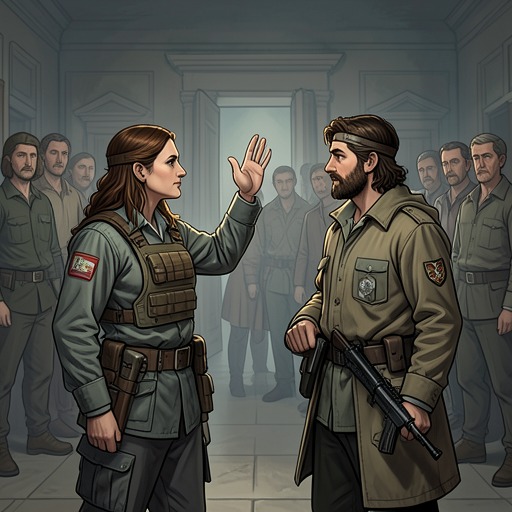
Post-Long War Wasteland
Gang Up: A Bikerland NovelThe Post-Long War Wasteland is not simply a landscape of ruins but the material condition governing life in and around Temple: radiation and environmental danger constrain settlement, while food, water, trade, and armed protection determine who holds power. Its damage is both spectacular, in storms carrying wreckage across the land, and cumulative, in the scarcity and insecurity that organize ordinary life.
Geography and the War’s Aftermath
Abigail understands the present through the history her father taught her. The Long War did not make civilization vanish all at once; it frayed and burned, leaving fragments that no longer belonged to a coherent former whole. That image describes a world where remnants of the old order persist, but do not restore it. People inhabit what remains rather than returning to what was lost.
Temple lies in the hot badlands of what was once Texas, in a region Abigail understands as one where the Long War did not spread in the same way as elsewhere. It is one of only five or six towns known to its inhabitants. Traders sometimes arrive with reports of large, protected supercities to the East and North, relatively untouched by the war. Such places form a distant contrast, not a practical refuge: Abigail has never been to the nearest city, Dallas, where she has heard that law and order still prevail.
Temple has its own answer to the absence of an outside authority. There, the Family is the order, and what counts as law is whatever the Family decides. The contrast between Dallas and Temple makes the wasteland more than a setting: it is a political landscape in which protection and justice depend on who controls a settlement.
Environmental Danger and Scarcity
The wastes impose themselves on the body. Brall’s journeys pass through storms of grit and steel, with winds strong enough to lift wreckage from extinct cities. The air around those dead cities carries the smell of bodies left by the war and not yet fully exposed to the elements. After a day’s ride, dust and grime coat Brall so heavily that the outlines remain on his skin when he removes his clothes. The description makes environmental damage an accumulating condition, not a single catastrophe confined to the past.
Water is one of the clearest measures of that scarcity. The stream at the spring comes from a cave deep in the rocks; its water is clean and untouched by radiation. The Family has other sources, but none as close or readily available. Brall recognizes that without a steady supply, the Family will weaken. When his forces take the spring, they gain more than a defended site: they acquire a resource whose regular availability can alter the balance of power.
Food is equally bound to discipline and survival. Brall’s force includes more than seventy-five soldiers and another hundred people attached to them as partners, merchants, or other dependants. Feeding nearly two hundred mouths requires organization. Brall trains his men not only in formations and mock battles, but in following orders; his experience on famine-prone journeys has taught him that hunger and disorder are dangerous together. In this world, military discipline is also a way to keep a group intact while supplies are uncertain.
Social Order and the Distribution of Protection
The Family’s authority rests on an exchange of resources and security. It serves Temple, but earns income by raiding surrounding territories and taking land, loot, and women for trade. Family members receive first choice, followed by those favored by the Family, known as the Kin; ordinary residents may live in Temple if they pay taxes. The stated rule that anyone may live there does not mean that everyone receives the same protection. The full benefits of the Family’s protection are reserved for taxpayers.
This hierarchy shows how survival resources become political privileges. The Family does not merely defend a population from danger; its control over protection, raiding, and the distribution of spoils establishes ranks within that population. Those outside the favored groups remain subject to the order while receiving fewer of its benefits.
The postwar imbalance between men and women also shapes the society Abigail describes. Her account says that after the war, when many men were fighting, only women judged beautiful, sexually desirable, and willing to submit were left. It presents women’s survival as bound to men’s preferences and to a system that treats their bodies as resources. This social arrangement is part of the wasteland’s political reality, not a separate consequence from its struggles over land, food, and security.
Conflict, Resources, and Political Change
The wasteland’s settlements are connected by trade as well as violence. Temple’s fertile ground is unusual in a land with little fertile ground left: it supports farming and commerce, making it valuable to the Family and attractive to Brall for drugs, guns, and trade. Its importance is therefore not only local. Whoever controls Temple can influence the movement of goods and the security of routes through the region.
The Family’s own arrangements reflect the pressure to preserve cohesion. After Titus’s death, Case proposes joint rule in which council members would each vote and hold a veto. Titus had already established a council of veteran riders and Sandra, and had let it be known that he wanted Robin to join it in the future. The proposal responds to a political danger made sharper by the wasteland: a divided authority can threaten the organization on which collective security depends.
The conflict over the spring turns environmental dependence into open warfare. Brall’s attack succeeds at dusk, when the defenders have the sun in their eyes and he has surprise. His losses are two men against five Family defenders; the remaining defenders surrender and are chained. Brall considers keeping some clemency because he wants to rule the people he has conquered, rather than strip them of all their men. Control of a scarce resource thus brings both immediate force and a problem of governing those who depend on it.
The later terms of war reject slow encroachment and surprise attacks in favor of an open battle outside town. The eventual arrangement gives Brall and the Cauldron responsibility for trade routes between Temple and Dallas and for responding to hostilities against Temple. In return, the Cauldron receives access to the Compound’s supplies and lodging when stationed there, while the Family retains Temple’s security and control and continues to seek territory and materials beyond it. The agreement does not erase scarcity or the political hierarchies it produced. It reorganizes armed power around trade, protection, and access to supplies, showing how the wasteland’s conditions persist even when its factions make peace.