Radiation-Scarred World
Gang Up: A Bikerland NovelThe Radiation-Scarred World is not merely the wreckage left after the Long War; it is a continuing pressure on bodies, settlements, and political life. In the hot badlands around Temple, radiation makes secure shelter and safely grown food privileges, while fertile land and water become strategic assets. The war’s violence is overlaid by a slower danger: an environment so damaged that ordinary life depends on controlling the places and supplies that remain usable.
A damaged landscape
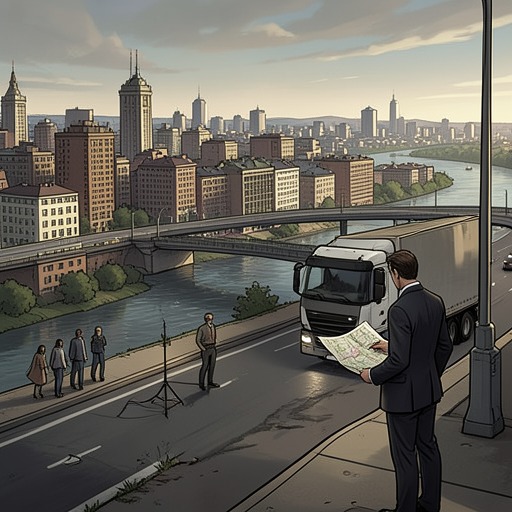
The Long War left a world that did not simply vanish. Civilization remained in fragments, but its connections had frayed and burned, like a fabric damaged by fire. Temple stands in the hot badlands of what was once Texas, in a region where the war did not spread in the same way as it did elsewhere, yet where its aftermath still defines daily life. Traders bring stories of large, shielded supercities in the East and North, comparatively untouched by the war. The nearest such city known to Temple’s residents is Dallas, a place associated with law and order that Abigail has never visited. Temple has no comparable separation from the damaged land around it: its order is enforced by the Family.
The settlements themselves make the unevenness of survival visible. Temple is one of only five or six towns its inhabitants know about. Its streets are patched with broken concrete, gravel, and black pitch; outside the few sturdy buildings, boards, clay, and tents make up structures designed to break. On the eastern edge, beyond the town walls, the Cauldron holds sway in the shantytown. Several hills ring Temple and form part of its natural defenses, while the town’s fertile ground is exceptional in a region where little land can be farmed. That fertility supports commerce as well as agriculture, making Temple valuable to those who can command its routes and resources.
Shelter, food, and bodily exposure
Radiation is registered through practical precautions rather than through a single disaster. The Family’s Compound consists of squat concrete buildings reinforced with steel and layered with lead, a barrier against radiation outside. Sandra, the Family leader’s wife, stays indoors as much as possible and eats only nearby crops grown under safe conditions. That way of living is expensive, but her position gives her access to it. Her skin has not yet developed many of the wrinkles associated with years of radiation exposure, a visible contrast that links bodily appearance to both environmental damage and unequal protection.
The danger also gives the landscape a persistent, oppressive presence. The old Family leader is described as struggling through each breath and movement in a haze of radiation and terror. His decline is personal, but the description places it within the same environment that makes safe food and fortified shelter essential. The cemetery outside Temple has grown crowded; the Family often does not report the deaths of people outside its warrior circle. In this setting, exposure and mortality reach beyond the protected household, while recognition and care remain distributed according to status.
Scarcity made political
Temple’s institutions turn environmental vulnerability into political authority. The Family claims to serve the town through protection, but its income comes from raiding surrounding territory and taking land, loot, and women for trade. Family members receive first choice, then the favored Kin, and then ordinary residents, provided they pay taxes. Anyone may live in Temple, but only taxpayers receive the full benefits of the Family’s protection. Security is therefore both a response to a dangerous world and a means of sorting people into unequal degrees of safety.
That system depends on controlling material resources. The Family’s territory is described as nearly the size of the Texas Panhandle, and its reach over several towns rests on decisions about where to attack, trade, fortify, or retreat. Its stores and provisions also sustain a large population: Brall commands more than seventy-five soldiers, with roughly a hundred additional people attached to them as partners, merchants, or dependents. His insistence on discipline reflects the difficulty of keeping such a group fed and organized during journeys through famine-prone wastes. The damaged environment does not dictate one form of rule, but it makes food, armed protection, and organized movement powerful instruments of rule.
Resource conflict and adaptation
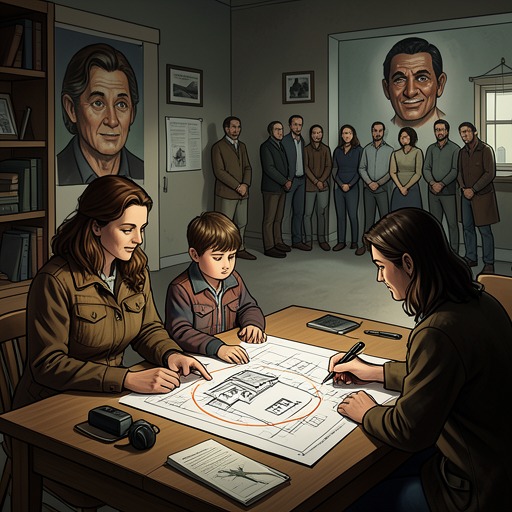
Control of usable resources becomes a direct military objective. During the attack on the Family’s Compound, Case identifies the grain tower and a garage as targets and recognizes the strategy behind the damage: the attacker is trying to starve the Family out. The grain store is thus more than infrastructure; it is a point where environmental scarcity can be converted into immediate political and military pressure.
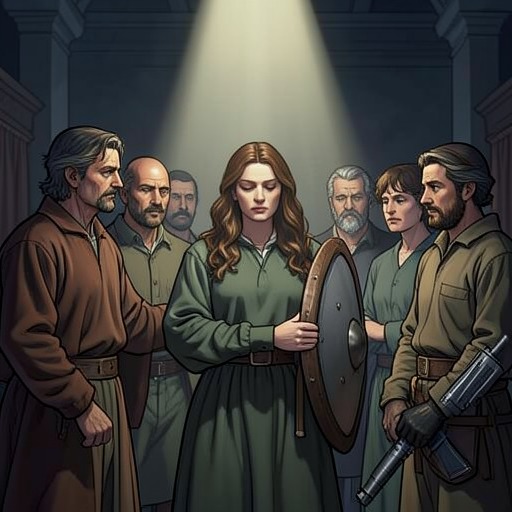
Water is equally consequential. Brall’s forces attack the spring near dusk, taking advantage of the light against the defenders. The short battle leaves two of Brall’s men dead and five Family men dead; the survivors surrender and are chained, to be held for possible sale or used as hostages in negotiations. Brall intends to rule the people he has conquered and therefore shows some clemency, recognizing that removing all their men would damage the population he seeks to govern. The spring’s importance is measured not only in the force used to take it, but in the choices its capture imposes on the victor.
The settlement that follows also shows adaptation rather than escape from environmental risk. Under the agreement, Brall and the Cauldron take responsibility for trade routes between Temple and Dallas and for routes to any other towns or cities Temple can contact. The Cauldron will answer calls for help if Temple faces hostilities; in return, its disciplined troops receive regular work, a place to live, and access to supplies and lodgings in the Family’s Compound while in Temple. The arrangement replaces wandering through the wastes with a more settled role, but it does so by reorganizing who controls movement, protection, and access to provisions.
The world as an ongoing force
The Radiation-Scarred World shapes the story through cumulative pressure rather than a single catastrophe. Its heat, radiation, patchy fertility, and limited secure settlements frame the dangers characters take for granted; reinforced walls and carefully produced crops offer protection, but only unevenly. Food stores and springs become targets because their loss can threaten a community without defeating it in open battle. Even the contrast with Dallas emphasizes the point: law and order are imagined as features of a shielded city, while in Temple those functions are concentrated in the Family’s authority.
This environment is therefore both setting and political condition. Its damage narrows the options available to inhabitants, while the groups that control land, food, water, trade, and armed protection turn those constraints into power. Temple’s fertility offers an opening for farming and commerce, but it also draws competing rulers toward the town. In the aftermath of the Long War, survival does not mean leaving conflict behind; it means organizing life around the scarce pockets of safety that remain.