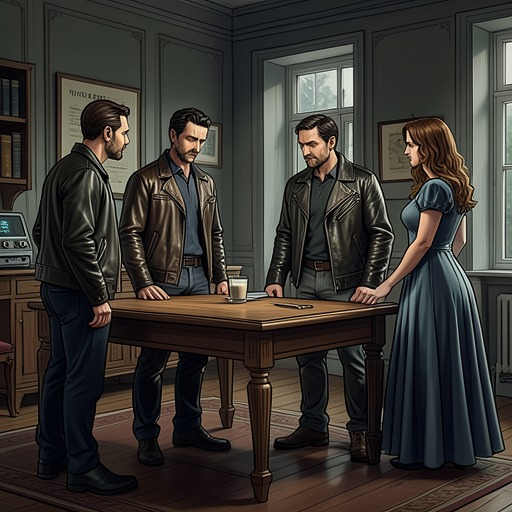
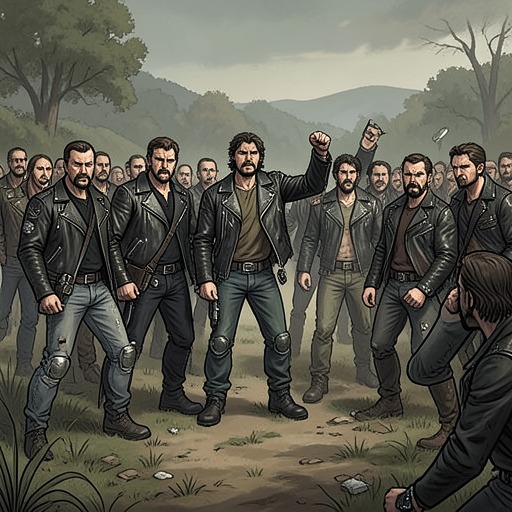
The long garage
Gang Up: A Bikerland NovelThe long garage is a major working structure inside the Family’s Compound whose destruction becomes one of the clearest material signs that Troy is attacking his own people while preparing a wider conflict. What begins as a damaged facility is consequently transformed into a strategic and political object: its loss threatens the Family’s supplies, exposes the reach of the saboteur, and later serves as physical evidence against Troy.
Place in the Family’s Defensive System
The long garage belongs to the Compound’s larger network of defended resources. Titus had organized the Family’s defenses with the expectation that the settlement might be attacked, and the men knew their assigned duties. The Compound was therefore not an unguarded home but a prepared military property, shaped by Titus’s experience of war and by the dangers of the wasteland. The long garage stood within that protected arrangement alongside the grain tower, making it part of the infrastructure whose survival sustained the Family’s ability to resist enemies.
The structure also reflects the precarious conditions of Temple. The town exists in a world damaged by the Long War, where fertile land and usable supplies are scarce, and where the Family controls local order. In such a setting, a garage is more than a building for vehicles or equipment: it is a working component of the settlement’s economic and defensive life. Damage to it carries consequences beyond the immediate wreckage because every useful facility matters in a society already living with the pressure of scarcity, radiation, and violence.
Troy’s Sabotage
During the conflict, explosions strike the south side of the Compound. Case identifies the grain tower and the first garage as the likely targets and immediately understands the purpose of the attack: the saboteur wants to starve the Family out. The guard detail at the site consisted of five riders, establishing that the attack was directed against a defended position rather than an abandoned or insignificant structure. The long garage is thus linked directly to the Family’s ability to preserve food, equipment, movement, and military endurance.
Troy later admits enough to make the truth unmistakable without offering a straightforward confession. He tells Robin that any number of acts could or could not have been his, but his pleasure and grin reveal his responsibility to her. Robin also recognizes that none of Troy’s men died in the attacks, a detail suggesting deliberate control rather than indiscriminate violence. The destruction of the long garage was an act of calculated sabotage: Troy damaged Family property, preserved his own forces, and used the resulting anger against Brall to consolidate support for war.
Evidence of Betrayal
The long garage becomes politically important because it helps Troy turn suspicion outward. He explains to Robin that the explosions have made Case angry with Brall and that a full war with Brall’s Cauldron now appears justified. The attack therefore performs two functions at once. Materially, it weakens the Compound; rhetorically, it creates a crisis that Troy can blame on an external enemy. He counts on the Family interpreting the damage as part of Brall’s aggression, while he privately treats it as an advantage that will bring Case and the Family’s numbers behind him.
This deception is especially cruel because the attack is directed against the very defenses Titus established. Only days after Titus’s death, the Compound’s preparations remain largely intact, but Troy exploits those defenses from within. The long garage consequently marks the difference between an outside assault and an internal betrayal: the Family has prepared to withstand enemies at its walls, yet its own structure is made vulnerable by someone who understands the settlement’s organization and can manipulate its response.
Ruin and Return
After Robin escapes Troy’s custody, she returns to the Compound through the sewer route at night. She emerges inside the walls opposite the place where the long garage had been struck and burned. The wreckage is still visible, and she shakes her head at it, recognizing that the ruined structure represents another charge Troy will have to answer for. Its burned remains give physical form to the hidden conspiracy she carries back into the Family’s territory.
The return also changes the garage’s narrative function. Earlier, it is a target whose destruction threatens the Family’s survival and helps provoke war. Later, it becomes a landmark of testimony: Robin uses the damaged site to orient herself as she moves through the Compound, then plans to find Abigail and reveal Troy’s scheme. Because Robin grew up there and knows the Compound’s interior better than anyone, the ruined long garage becomes part of the geography through which concealed knowledge moves toward exposure.
Narrative Significance
The long garage embodies the book’s connection between infrastructure and power. Troy’s sabotage does not merely destroy property; it attacks the material systems that make communal order possible, then converts that damage into a pretext for violence against Brall’s Cauldron. The garage’s destruction shows how quickly a protected home can become a battlefield when authority is unstable after Titus’s death.
Its burned remains also resist Troy’s attempt to control the story. He can deny the explosions in words, but he cannot erase the wreckage. The structure therefore functions as a silent witness to the conspiracy, linking the practical costs of war with the moral fact of betrayal. By the time Robin sees it on her return, the long garage is no longer transparent background machinery. Its damage has made the Compound’s vulnerability visible, and its ruin helps turn Robin’s private knowledge into evidence capable of challenging Troy’s power.