Titus
Gang Up: A Bikerland NovelTitus is the former leader of the Family, a political and military anchor whose death transforms the already fragile order of Temple into open rivalry, suspicion, and war. Though he appears only through his absence, his decisions, protections, and institutional legacy shape nearly every major conflict that follows. His murder is first an unresolved wound, then a concealed political fact, and finally the revelation that turns Case against Troy.
Identity and Authority
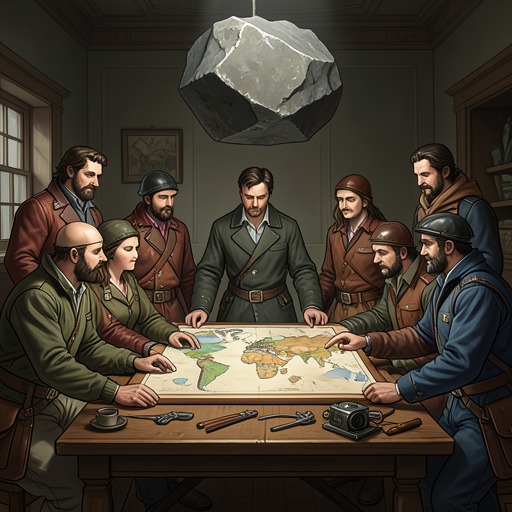
Titus governed the Family’s broad regional power through practical decisions about attack, trade, fortification, and retreat. The Family’s territory extended across a region nearly the size of the Texas Panhandle, and its strength depended on his ability to make clear choices across that scattered domain. His leadership was therefore more than ceremonial: it was the organizing intelligence that allowed several towns, warriors, supplies, and competing loyalties to function as one political structure.
His authority also had a social and domestic dimension. Sandra managed food, deliveries, and the distribution of women among the warriors, but Titus made the overall decisions within which that system operated. The distinction between them reveals the Family’s division of power: Titus directed strategy and collective survival, while Sandra administered the daily machinery that sustained the warriors. Together, their household represented the Family’s governing center, although Titus remained the figure associated with its public strength and final direction.
Protection and Restraint
Titus was a counterweight to Brall and the Cauldron. Brall recalls him as an unusually crafty opponent who always seemed to have several additional plans ready for every move. Their conflict had been extensive, but Titus had kept Brall at bay, preventing the Cauldron leader from claiming Temple outright. Titus’s success was not presented as a single victory; it was a continuing act of containment that preserved an uneasy peace.
That peace was precarious because the Family and the Cauldron had already become rival powers with competing interests in Temple’s fertile land and commerce. Yet, at the time of Titus’s death, neither side had shed blood in direct conflict, not even in bar fights. Brall’s disciplined men and Titus’s political control kept the hostility below the threshold of war. Once Titus disappeared, the restraint he embodied disappeared with him, leaving Case, Troy, and Brall to contest the same unstable ground.
Titus also protected Robin from Troy. Robin was subject to the Family’s patriarchal system and knew that Troy wanted to invoke the right of clan against her, a practice intended to preserve a threatened bloodline by forcing a stepbrother and stepsister into reproduction without marriage. Titus’s protection had blocked Troy’s claim for years. His death therefore removed not only the Family’s senior authority but also Robin’s personal safeguard, making his murder immediately consequential in her life.
Death and Funeral
Titus died shortly before the funeral gathering on the hill outside Temple. The narrative describes him as an old man whose strength had kept the Family together, despite a body worn down by heat, radiation, fear, and the labor of surviving in the wasteland. His death is described as a murder rather than a natural ending, but the killer is initially unknown. Case wants to devote all his resources to discovering who was responsible, yet he believes the fragile social fabric of Temple requires immediate attention and cannot survive a leadership vacuum.
The cemetery itself carries Titus’s institutional imprint. He had begun it on a hill among the natural defenses surrounding Temple, when it occupied only a small portion of the ground. By the time he was buried there, the graves were overcrowded, and the Family often ignored the deaths of outsiders who did not belong to its warrior circle. The cemetery thus embodies both Titus’s attempt to establish order and the Family’s exclusionary hierarchy: he founded a lasting place for communal memory, but the community recognized some dead more fully than others.
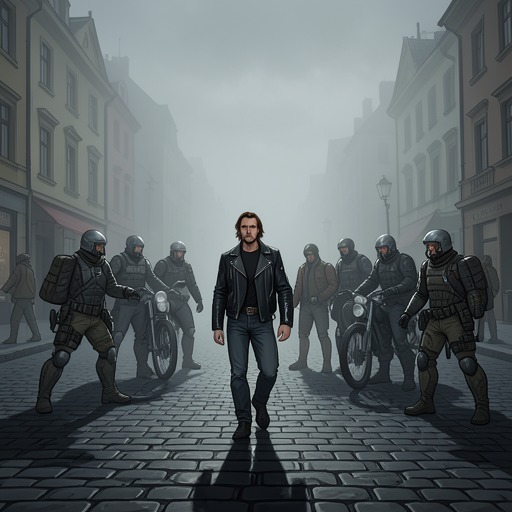
His grave receives a granite tombstone rather than the limestone used for many nearby graves. Case is pleased with the arrangement even while grieving, a detail that gives the funeral a concrete mark of rank and respect. Around the grave, the Family’s warriors rev their motorcycles for five or ten minutes, their engines drowning out conversation before they return to the Family’s Compound. The ceremony moves directly from mourning toward the customary cycle of drinking, sex, and renewed expeditions into the wastes, as if collective ritual can force the Family to continue operating despite the loss of its central figure.
The Succession Crisis
Titus’s death arrives at the worst possible political moment for Case. Case believes that, given another two years, he could have consolidated the Family, dealt with Brall and the Cauldron, quietly removed Troy, and married Abigail in the same week as Titus’s death. Instead, the succession question becomes immediate. Case and Troy each command loyal men, and both understand that failure to consolidate power will undo Titus’s work.
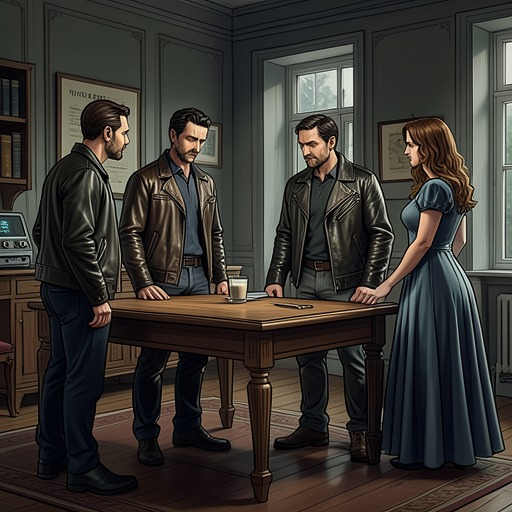
The conflict between them is not merely a personal quarrel. Troy had served as Titus’s second-in-command and had earned substantial loyalty through his service, while Case inherits the expectations attached to Titus’s position. At the Mud Pit, the two men sit at opposite ends of the bar, each blaming the other for Titus’s shooting in the open street. The absence of witnesses deepens the suspicion: in a town as small as Temple, no witnesses suggests that people were bribed, loyal to the killer, or dead.
Titus’s death also changes Brall’s calculation. With the old Family leader gone, Brall sees Temple as open to permanent seizure. The town’s fertility makes it valuable in a landscape where fertile land is scarce, while its commerce offers opportunities for drugs, guns, and trade. Abigail, Titus’s daughter, becomes part of Brall’s political objective because she has rejected him for years and because claiming her would symbolize the collapse of Titus’s resistance. The dead leader thus remains present as the obstacle Brall has finally outlived.
Revelation and Narrative Role
The decisive reversal comes when Troy admits to Robin that he killed Titus. The revelation closes the mystery that had poisoned the Family’s leadership and confirms that the succession crisis was built on concealed betrayal. Troy then speaks of full war against Brall and links the coming conflict to attacks on the grain tower and the garage, prompting Robin to ask whether those acts were also his. His confession reframes the apparent struggle with the Cauldron: Troy has been using external danger to strengthen his own position inside the Family.
Sandra later brings the accusation before the community. She states that Troy killed Carthage to escalate the conflict with the Cauldron, then destroyed the grain tower and part of the Compound when Case did not immediately respond. But she identifies Titus’s murder as Troy’s worst offense, emphasizing that the victim was her husband and the Family’s shared leader. Five witnesses stand behind her, while the crowd divides between those already convinced and those demanding proof.
Titus therefore functions as the absent center of the plot. His leadership had converted scattered power into a fragile order; his protection had restrained Brall and shielded Robin; his death removes both safeguards at once. The eventual exposure of his killer produces recognition, rage, and the demand for punishment, but it cannot restore the structure Titus maintained. His granite marker and the roar of the motorcycles preserve his memory, while the wars and betrayals after his burial demonstrate how dependent Temple had become on one man’s authority.