Troy's Public Accusation and Execution
Gang Up: A Bikerland NovelTroy's Public Accusation and Execution marks the moment when Troy's private violence becomes a public political fact and his remaining authority disintegrates. The scene begins as a planned open battle between the Family and the Cauldron, but Sandra interrupts the clash to accuse Troy before the assembled forces. Her testimony transforms the conflict from a contest over territory and power into a judgment on murder, treachery, and the legitimacy of Troy's rule.
From War Council to Public Reckoning
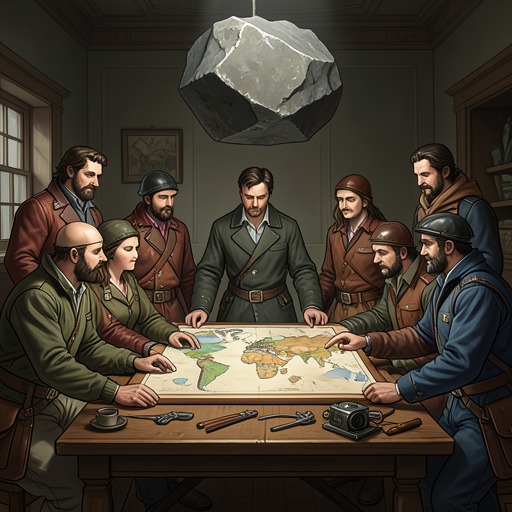
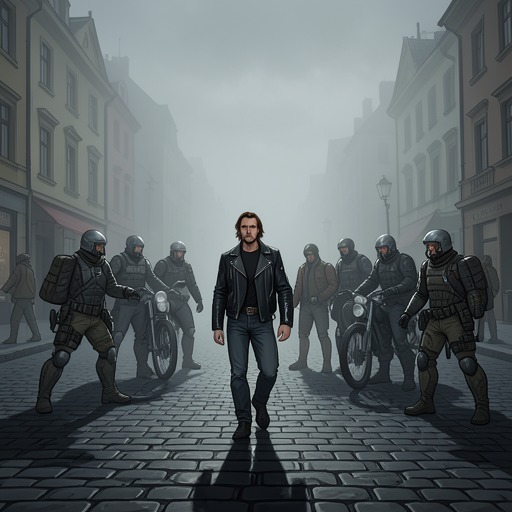
By the morning of the battle, the terms had been deliberately made open and final. Case and Troy had agreed to abandon sneak attacks and slow attrition, planning instead to destroy Brall outside Temple's walls. The Family arrived with roughly half again as many fighters as the Cauldron, their bikes roaring while men carried hatchets, planks, spikes, knives, chains, shotguns, and spears. Troy prepared to address his troops, but the intended battle was suspended when Sandra walked before the assembled crowd with five townspeople behind her. Her intervention changed the scene's governing question: the issue was no longer simply which force would win, but whether Troy could continue to command anyone after the crimes attributed to him were spoken aloud.
Sandra's Accusation and the Witnesses
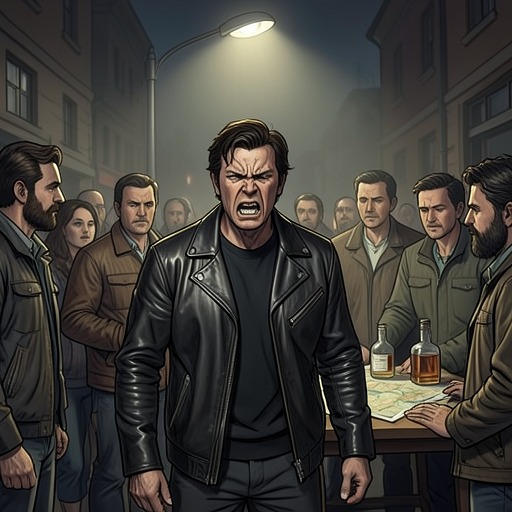
Sandra stated her charge without disguise, identifying Troy as a persistent threat rather than a merely ambitious rival. She told the crowd that he had killed Titus by running him down and shooting him in the head, and linked that crime to the killing of Carthage, which she presented as already established knowledge. Her accusation gained force from the five townspeople standing behind her, especially Gadson, the town baker. He had previously received special protection and payments from Troy, yet now testified against the man who had benefited him. Sandra framed that reversal as evidence that Troy's conduct had exceeded even the limits tolerated by those dependent on his patronage: Gadson was seeking justice, not advantage. The testimony therefore made Troy's alleged murders a collective matter, witnessed by people who claimed no interest in deciding who would rule Temple.
Troy's Failed Counterattack
The accusation produced an immediate shift in the crowd. Some people demanded proof, but others already believed Troy responsible for Titus's death, and the public testimony gave that suspicion a concrete form. Even members of Troy's own force began separating from him, showing that his authority depended less on loyalty than on fear, payment, and the expectation of continued protection. The turning point came when Troy abandoned argument and lunged at Sandra with his knife. She sidestepped the attack and knocked him into the dust, after which he charged again and Case struck him down. Case then kicked away Troy's knife and beat him repeatedly, driven by the knowledge that Troy had murdered his father. The violence exposed Troy's claim to command as self-serving: when he called for the killing of Sandra and the supposed traitors, his order no longer carried weight.
The Collapse of Troy's Authority
The crowd's alignment against Troy completed the political reversal begun by Sandra's accusation. His warriors did not remain a unified force: one after another, many withdrew and merged with Case's supporters, while only a small circle of personally loyal followers stayed around him. Brall's soldiers, acting according to the arrangement made for the confrontation, closed off every route of escape, leaving Troy and his remaining men surrounded. Troy responded by insisting that the people around him would have achieved nothing without him, but the claim revealed how completely his power had narrowed into wounded self-justification. Case could have ordered an immediate killing, yet the danger of provoking another battle led him to offer Troy a conditional escape: leave Temple, take his poison elsewhere, and live. The offer temporarily changed the scene from execution to expulsion, but Troy's apparent acceptance did not signal surrender. He spat on the ground, rejected the assembled community, and began to walk away while Brall's men opened a path for him.
The Execution and Its Immediate Meaning
Troy’s attempted departure becomes the final reversal of the scene. After Case offers to let him leave Temple alive, Troy turns back and charges with the long knife, directing his violence at the man whose accusation and assault have already stripped him of authority. Brall intervenes instantly, striking Troy over the head with the pipe he carries. The blow kills Troy at once, ending not only the immediate threat to Case but also the possibility that the surrounded faction might force a renewed battle. Brall’s intervention gives the execution a distinctly political shape: the Cauldron, which had entered the confrontation as Family’s enemy, prevents the Family’s internal conflict from becoming another costly melee. The watching crowd responds with a cheer drawn from both Family and Cauldron, treating the death as a shared victory and confirming that Troy’s power has vanished even before his body is removed. Case can only look at the corpse, shake his head, and acknowledge that Brall has saved him.
Political Consequences Beyond the Killing
Troy's execution resolves more than a personal vendetta. It removes the figure whose violence had threatened to turn the Family–Cauldron conflict into an uncontrolled struggle for Temple itself, while Brall's intervention prevents Case's assault from developing into a renewed melee. The crowd's cheer, shared by the Family and the Cauldron, marks the death as a collective political settlement rather than a private act of revenge. Troy's authority had rested on force, patronage, and the ability to make others depend on him; once witnesses spoke, his followers deserted, and his last attack failed, those supports disappeared together. The event therefore clears the way for a different arrangement of power: the Family retains control of Temple and its security, while the Cauldron can assume disciplined responsibility for the trade routes linking Temple with Dallas and other settlements. In that aftermath, the execution becomes the violent hinge between civil conflict and negotiated order, converting Brall from enemy commander into a partner whose troops can provide regular protection instead of continuing to wander through the wastes.