
The Town Watches Its Rulers
Gang Up: A Bikerland NovelThis flow follows the role of Temple’s citizens as witnesses, taxpayers, and an audience whose choices help determine who can govern.
increasing Bearing strength in each event
 decreasing
Bearing strength in each eventdecreasingResidents at the Funeral
Public Ritual, Private Uncertainty
A collective gathering
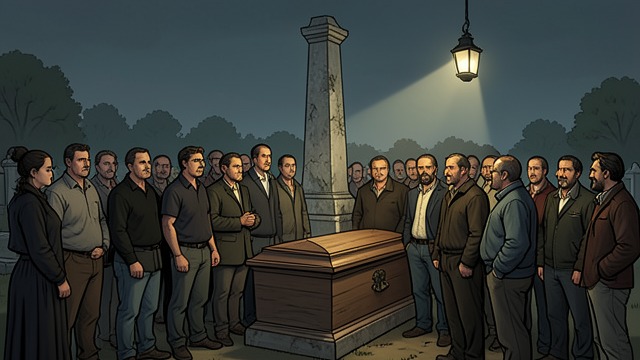
Family members, Kin, and citizens assemble at Temple Cemetery for Titus’s burial. Their presence gives the funeral the appearance of communal continuity.
An unsettled audience
The mourners do not yet know whether Case or Troy will lead them, or what Brall’s presence means for Temple’s future. The ceremony cannot answer the questions the crowd carries.
The citizens’ attendance gives the leadership contest a public dimension. Authority in Temple depends not only on force but also on how the community reads its rulers.
The Taxed Community
Paying for Protection
A routine demand
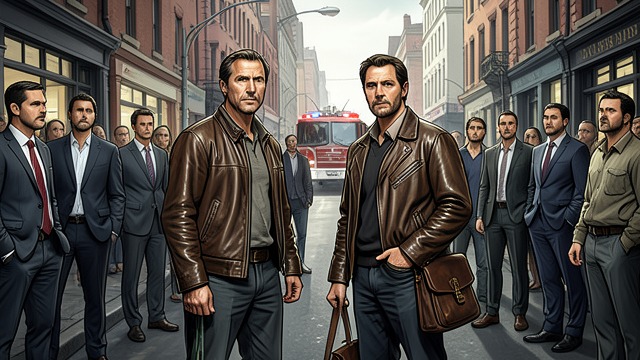
Case and Troy collect taxes from local traders and residents, explaining that the Family maintains security. The collection demonstrates how ordinary commerce depends on the gang’s authority.
A visible breach
Troy’s taking of part of the funds is witnessed by Case, and their fight spills into public view. Residents can see that the rulers who demand compliance do not agree on the rules themselves.
The tavern community is more than background. Its money sustains power, and its observation of leadership conduct can influence whether that power remains credible.
Citizens Face the Flames

Protection Put to a Test
A public emergency
Explosions and spreading fire endanger buildings beyond the Family’s walls. Case calls residents to organize water and move people away from danger.
Competing ideas of duty
Troy argues that the Compound should be protected first and the rest of Temple treated as expendable. Case insists that residents depend on the Family for safety.
The emergency tests the justification for the Family’s rule. Its authority depends on whether it acts for the community when protection is costly.
Witnesses Step Forward
Citizens Give Evidence
Testimony against Troy
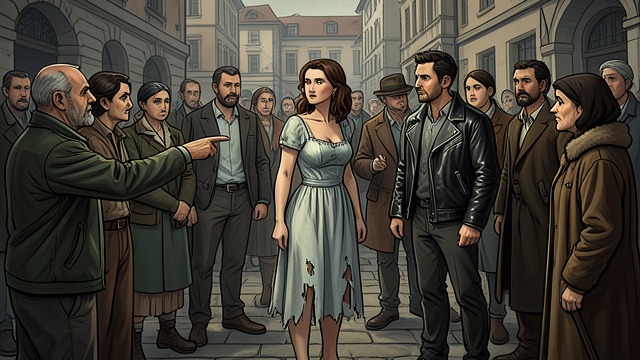
Sandra presents townspeople who say they witnessed Troy kill Titus. Their testimony carries weight because they are not presented as leaders with a direct claim to command.
A public response
The crowd demands proof and then reacts to the evidence. Troy’s followers begin to separate from him as the community’s account of the crisis changes.
The witnesses show that ordinary residents can influence a struggle normally dominated by armed leaders. Their willingness to speak helps turn private suspicion into an act of public judgment.
A Community Accepts Peace
The Crowd Welcomes a Deal
Leaders report the agreement
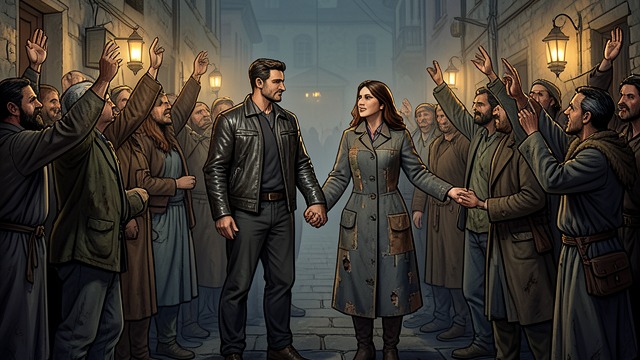
Case and Brall announce their accord to waiting warriors and residents. Cheers follow as both factions recognize that the immediate threat of fighting has receded.
Hope with conditions
The settlement promises security and trade, but its success depends on the groups honoring their responsibilities. The citizens gain a chance at stability rather than a guarantee against future conflict.
Temple’s people end the story as an audience to a new order they helped make possible by paying, witnessing, and responding. Peace becomes a public commitment as well as a leaders’ contract.
during Titus’s burial
during the collection at The Smoking Gun
on the night the Compound burns
at the open gathering before the final battle
after Case and Brall sign the accord
