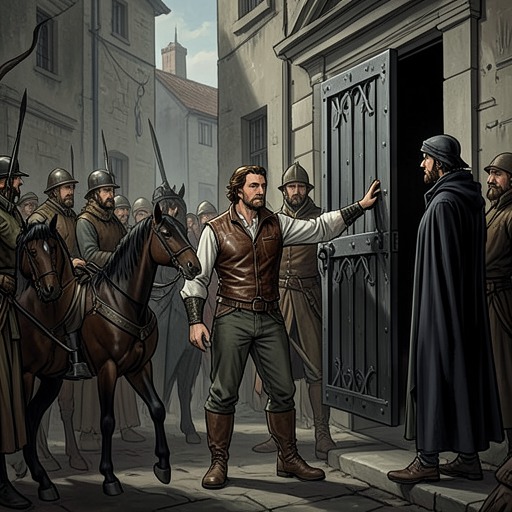
Case–Sandra political alliance
Gang Up: A Bikerland NovelCase and Sandra’s political alliance takes shape in the vacuum left by Titus’s death: Case needs a workable government for a Family divided between him and Troy, while Sandra already holds practical power and a place in the leadership structure Titus built. Their partnership is therefore less a bond of uncomplicated trust than a negotiation over authority, suspicion, and the survival of the Family as war approaches.
A partnership formed under suspicion
At the Mud Pit, Troy and Sandra occupy opposite ends of the bar, each blaming the other for Titus’s killing in the open street. The absence of witnesses intensifies rather than settles the question: in a town as small as Temple, Case recognizes that anyone who knew what happened must have been paid off, loyal to someone, or dead. The accusations carry immediate political weight. One theory is that Troy killed Titus to seize power; another is that Sandra arranged the murder to put her favored stepson in charge.
Case rejects both explanations as distasteful, but rejecting the theories does not resolve the antagonism between Troy and Sandra. He knows they are not the allies he would choose, yet he also knows that the Family cannot afford to leave its leadership divided with a war against Brall looming. His alliance with Sandra begins in that gap between personal suspicion and political necessity: their cooperation is needed before the truth about Titus’s death has been established.
Sandra’s existing authority
Sandra is not simply Case’s stepmother or a figure attached to Titus’s memory. Under Titus, she ensured that warriors were fed and supplies delivered, and she helped distribute women among them. Titus handled the Family’s larger strategic decisions—where to attack, trade, fortify, or retreat—across a region nearly as large as the Texas Panhandle. Sandra’s work sustained the machinery through which those decisions could be carried out. Her authority is therefore rooted in administration and provision as well as her connection to the former leader.
Titus had also established a council of veteran riders and women. Sandra was its sole woman member, and Titus had let it be known that he wanted Robin to join in the future. That detail makes the council more than a new title Case can use to legitimate his own rule: it is an institution with a history under Titus and a possible future beyond the men competing for control. Sandra enters Case’s proposed arrangement with experience and an established seat, not as a political novice whom he can simply absorb into his faction.
Joint rule as a settlement
Case proposes joint rule: each council member would have a vote, and each would hold a veto. The arrangement is designed to keep leaders from overriding one another, turning the danger of rivalry into a formal system of shared restraint. It also reflects the immediate problem Case faces. He needs to consolidate power, but a settlement that merely declares him in charge would not address Troy’s resistance or Sandra’s independent standing.
Sandra’s participation matters because the proposed structure draws on Titus’s council while trying to prevent the Family’s leadership from splintering after him. Case does not present joint rule as proof that the accusations and resentments have vanished. Instead, the votes and vetoes offer a practical means of governing while disagreement remains. The alliance is institutional before it is intimate: it rests on shared participation in a council and on the mutual limits its members accept.
Kinship and the terms of power
Case’s proposal also places Sandra within a larger system in which family ties and political authority are closely entangled. He tells Troy that, after a year, Troy is to mate Sandra; the delay is justified as a period of mourning, so that the men will not draw conclusions about Titus’s death. The proposal treats Sandra’s future in explicitly political and reproductive terms. It is not evidence of a personal agreement between Case and Sandra, and the distinction matters: Case is attempting to manage Troy and the Family’s suspicions by assigning a future relationship, while Sandra’s own wishes are not stated in the evidence of the proposal.
That plan belongs to a society shaped by demographic collapse after the Long War. The Right of Clan can be invoked when a small lineage feels threatened, allowing certain step-relations to conceive children, while marriage between members of the same family—including step-siblings—is forbidden. The rule’s distinction between marriage and reproduction helps explain why Case can frame Troy’s future with Sandra as a political arrangement rather than a conventional marriage. It also exposes the limits of the authority represented by Case and Sandra’s alliance: even when they negotiate how the Family will be governed, women’s sexuality and reproduction are treated as matters the leadership can organize.
Continuing distrust and political consequence
Their partnership does not eliminate the difference between Case’s approach and Sandra’s. Later, while confined with Robin, Case recalls Sandra insisting that he must not forget his father’s death. He understands that she remains focused on the unresolved killing, but calls it a mystery and says that he prefers absolutes. Sandra appears to have a plan and to be moving toward trouble, though Case cannot yet discern what she intends or stop her. The episode reveals a limit in his political understanding: he can propose rules for shared government, but he cannot thereby direct Sandra’s actions or make her adopt his preferred way of confronting the past.
The eventual political settlement with the Cauldron gives their cooperation a wider context. The Cauldron may marry into the Family and receive special preference for newly matured Family girls, while the Family retains Temple’s security and control and its riders continue to search the wastes for territory and resources. This arrangement preserves the Family’s authority while giving the Cauldron a place in the new order. It echoes the practical logic of Case and Sandra’s alliance: stability is built through negotiated participation and managed access, not through the disappearance of competing interests. Their political partnership is consequently best understood as a necessary, guarded form of shared rule—one that can help hold the Family together without settling either the mystery of Titus’s death or the conflicts embedded in the system it preserves.