Family–Cauldron Truce Alliance
Gang Up: A Bikerland NovelThe Family–Cauldron Truce Alliance converts a war between rival groups into a practical arrangement for governing Temple and dealing with threats beyond it. Its decisive turn comes after Brall kills Troy and Case acknowledges that Brall has saved him: the two leaders shake hands, then negotiate a written agreement that gives each group work and authority the other cannot easily replace. The settlement ends the cycle of attacks by making cooperation a condition of both groups’ survival.
From battlefield reversal to negotiation
The agreement follows an effort to bring the war into the open. Case’s plan, developed with Troy, was to wipe out Brall; the stated terms instead required the factions to stop relying on sneak attacks and meet in open battle outside town. Before the fighting could proceed as Troy intended, Sandra stepped before the assembled men with five Temple townspeople behind her. She openly denounced Troy, identifying him as a longstanding danger in front of his own fighters as well as the Family and Cauldron forces. Her intervention changed the public meaning of the confrontation: the dispute was no longer only a contest between armed leaders, but a judgment of Troy’s place in Temple.
The decisive personal reversal came when Brall struck Troy dead. The crowd of Family and Cauldron members cheered, but Case’s response was not another challenge. He looked at Troy’s body, told Brall that he had saved him, and shook his hand. Brall accepted the recognition without turning it into a boast. Case then proposed that they discuss how to run the town and what they could accomplish together. That exchange makes the alliance possible: the former opponents recognize an immediate shared interest before attempting to settle the larger political one.
The written settlement and division of responsibilities
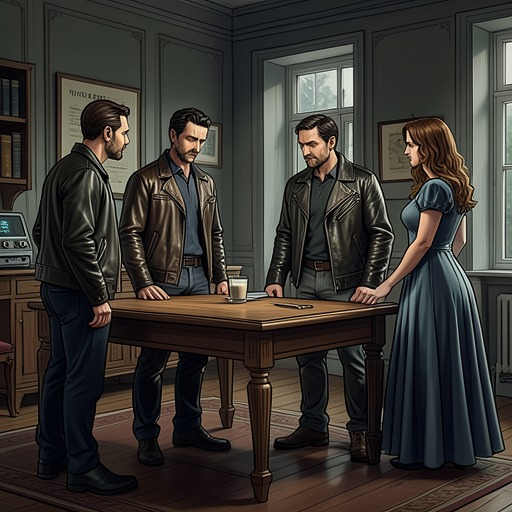
The handshake becomes a formal contract in the following chapter. Case writes that the deal is made; Brall examines the paper, signs it, and calls it a good agreement. Its terms distribute tasks according to the groups’ different capacities. Brall and the Cauldron are responsible for trade routes between Temple and Dallas, as well as routes to any other towns or cities Temple manages to contact. If Temple faces hostilities, the Cauldron is to be available to help defend it. The arrangement gives Brall’s disciplined troops regular work and a place to live, instead of continued wandering in the wastes without a settled home.
When the Cauldron is in Temple, its members receive access to supplies and lodging at the Compound. Drink, women, and sleep are free; other goods and services must be paid for. The contract also permits Cauldron members to marry into the Family, with special preference in the allocation of newly matured Family girls. These terms make the settlement more than a military truce: they incorporate the Cauldron into Temple’s social and economic order while preserving the Family’s position within it.
The Family, in turn, retains Temple’s security and control of the town. Its riders are assigned to seek out territory in the wastes and raid the ruins of former towns and cities for scrap and materials needed for fabrication and production. They receive the first share of recovered loot and serve as Temple’s public face to the outside world. The agreement therefore does not dissolve either group into the other. It gives them distinct responsibilities and preserves the Family’s authority over Temple while granting the Cauldron a defined role in the wider network of trade and defense.
Interdependence as the basis of peace
The contract is designed to make victory by either side damaging to the victor. The Family cannot simply eliminate the Cauldron and still expect to maintain the standard of living supported by secure trade routes. Nor can the Cauldron destroy the Family and safely govern the town or establish the connections needed to keep money flowing. Each group holds resources and capabilities the other needs. Peace is thus secured not by assuming that old rivalries have vanished, but by making the costs of renewed conflict clear and immediate.
The arrangement is summarized as “A little bit chaos, a little bit order.” The phrase describes both the distribution of power and the contrast between the groups’ work: the Family keeps internal security and conducts raids, while the Cauldron provides disciplined protection and manages trade routes. Their separate functions are intended to produce a workable shared order without requiring either faction to surrender its identity. The bargain also ties Temple’s prosperity to connections with settlements beyond the town, rather than to force alone.
Public ratification and the alliance’s significance
After the signing, Case and Brall return to The Mud Pit, where warriors and soldiers have waited outside the conference room. Drinking had been suspended so that no intoxicated member could disrupt the negotiations. Brall announces that they have a deal; Case confirms it and declares that drinks are on the house. Cheers rise for both leaders and both groups, turning the written contract into a public commitment. Robin moves close to Brall, while Abigail takes hold of Case’s arm, visually placing the couples alongside the new political partnership.
The ending does not promise that Temple will be free of danger. It stresses that threats remain in the wasteland, but that the Family and Cauldron will face them together. The alliance’s significance lies in joining a personal reconciliation to an institutional settlement: Brall’s intervention saves Case, their handshake opens negotiations, and the contract gives cooperation a durable economic and military structure. The peace is therefore neither simple forgiveness nor an unqualified merger. It is a negotiated balance, held together by shared responsibilities and by the knowledge that neither group can safely thrive alone.