Temple’s Dual-Gang Social Order
Gang Up: A Bikerland NovelTemple’s Dual-Gang Social Order is the settlement that places Temple under the shared influence of the Family and the Cauldron without making their roles identical. The Family retains control of the town, while the Cauldron gains regular work, a home base, and responsibility for trade routes and outside defense. The arrangement turns former enemies into necessary partners, but its stability rests on the same hierarchy and unequal treatment that shaped Temple before the alliance.
Temple Before the Settlement
Temple’s order grew from the violence and scarcity left by the Long War. At Titus’s funeral, the crowded cemetery outside town showed how the Family’s priorities had shaped the community: the graves had expanded beyond their original space, yet the Family often did not record the deaths of people outside its warrior circle. The Family’s claim to rule was therefore not simply protection; it also defined whose lives counted.
The Family said it served all of Temple, but its economy was built on raiding surrounding territory for land, loot, and women. Family members received first choice, followed by favored associates known as the Kin, and then other residents, provided they paid taxes. Anyone could live in Temple, but only taxpayers received the full benefits of the Family’s protection. The distinction between living inside the town and being protected by its rulers made membership and payment conditions of security.
This hierarchy operated in a postwar society where women were treated as a scarce resource and their survival was described in terms of male preference and compliance. The Family’s raids included taking women for trade, and the final settlement likewise offers the Cauldron access to women as part of its compensation. The political order changes its distribution of power without rejecting the underlying assumption that women’s bodies can be allocated by gangs.
War, Force, and the Need for Discipline
The Family’s rule depended on organized violence, while the Cauldron brought a different kind of military capacity. Brall had more than seventy-five soldiers under his command and about a hundred people attached to them as partners, merchants, sex workers, or other dependents. Feeding nearly two hundred people required discipline as well as supplies, so Brall trained his followers to respond to orders and operate as a force rather than a loose crowd. That organization made the Cauldron valuable not only as an army but as a body capable of sustained, coordinated work.
The struggle over the spring made the balance of force concrete. Brall’s troops attacked near dusk, using the fading light to their advantage against a heavily guarded position. The fight was brief but bloody: the Cauldron lost two men and the Family lost five before the remaining defenders surrendered. Brall chained the prisoners, intending either to sell them back or use them as hostages in negotiations. Yet he also wanted to rule the people he had conquered and recognized that taking all their men away would not win their gratitude. Military victory created leverage, but governing required restraint.
The Family’s control of its own boundaries could be forceful in a different way. When a crowd gathered outside the Compound seeking entry, its guards ordered the people home and threatened to fire if they did not disperse. The Family enforced a cleared perimeter around the walls, confiscating caravans or wagons that obstructed it. Such control of access and space was part of the existing order; the eventual settlement would redistribute responsibilities without dissolving the Family’s authority over Temple.
The Division of Responsibilities
The agreement gives the Cauldron a defined economic and military role. It is to manage trade routes between Temple and Dallas, along with routes to other places Temple might contact, and to respond when Temple faces hostilities. Brall’s disciplined troops are thereby assigned regular duties in place of wandering through the wastes without a settled home. When the Cauldron is in Temple, its people may use the Compound’s supplies and lodgings; drink, women, and sleep are provided freely, while other goods must be paid for.
The Family, in turn, keeps Temple’s security in its own hands and retains control of the town. Its riders are to scout new territory and search abandoned settlements for scrap and materials needed for fabrication and production. The Family also claims the first share of recovered loot and remains Temple’s public face to the outside world. The arrangement thus divides labor rather than merging the two organizations: the Cauldron handles routes and stands ready for external defense, while the Family maintains local rule and leads territorial expansion.
The settlement extends beyond work and supplies. The Cauldron may marry into the Family and receives special preference for newly matured Family women. That provision offers a route into the Family’s social structure, but on terms set by the ruling groups and within the same gendered hierarchy evident in the town’s earlier economy. The deal provides the Cauldron with lodging, status, and access; it does not establish equal rights among Temple’s residents.
Mutual Dependence and Public Legitimacy
The arrangement is designed so neither gang can remove the other without damaging its own position. If the Family destroyed the Cauldron, it would lose the disciplined force supporting the trade routes that sustain Temple’s high standard of living. If the Cauldron destroyed the Family, it would inherit a town it could not safely govern and lose the connections needed to keep money flowing. Their partnership is therefore secured less by trust than by the cost of breaking it.
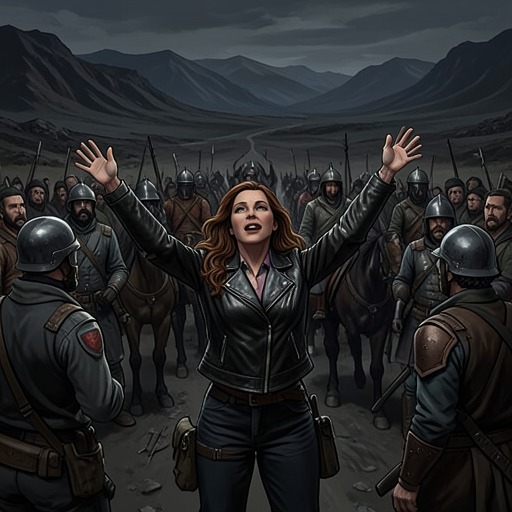
The agreement also emerges against a question of who can speak for Temple. In the confrontation with Troy, Sandra steps in front of the assembled men and townspeople, halting his speech so that she can publicly accuse him. Five townspeople stand behind her, and the crowd quiets to hear her. The episode shows that the town’s population is not merely a silent audience to gang politics: its presence can lend force to a public challenge. The new settlement, however, remains an agreement between the Family and the Cauldron, not a transfer of authority to the townspeople.
Its public image is likewise shaped by collective performance. At the peace ceremony, Abigail and Robin kiss before the gathered men, who watch and cheer; the men wait for the women to give their signal before approaching. Case and Brall claim the first place together. The scene makes reconciliation visible and binds the rival leaders to the ceremony, while also displaying how public approval and women’s participation are incorporated into a system still organized around male power.
What the New Order Preserves
The settlement is summarized by its governing balance: a little chaos alongside a little order. The Family keeps the authority and outward identity it has built in Temple; the Cauldron contributes disciplined troops and the capacity to secure commerce beyond the town. Their functions are complementary, their resources interdependent, and their peace practical rather than unconditional.
The arrangement changes who shares power, but not the foundations of Temple’s social hierarchy. Protection remains tied to the Family’s rule, resources and opportunities are distributed according to status, and the deal assigns women a place in the exchange between organizations. The result is a new coalition capable of sustaining Temple and reaching beyond it, formed not by the disappearance of coercion but by its coordination between two gangs.