The Smoking Gun
Gang Up: A Bikerland NovelThe Smoking Gun is Farner’s tavern, located outside the Compound and open to visitors entering Temple. More than a drinking house, it is a public threshold between the Family’s protected territory and the wider settlement: farmers, traders, and other men gather there, while Family representatives arrive to collect the money that sustains their rule. Its ordinary bustle gives the Family’s protection racket a civic appearance, but the tavern also exposes the corruption beneath that arrangement when Troy diverts the collected funds for himself.
Setting and Social Function
The tavern is usually full toward the end of the day, after farmers have returned from their fields and traders have finished their business. Men sit at tables playing cards or rolling dice, while others drink and exchange stories. This mixture of labor, commerce, gambling, and conversation makes The Smoking Gun one of the few clearly public spaces in the surrounding postwar society. It is not confined to Family members or residents of the Compound; anyone who makes the journey into Temple may enter.
That openness gives the tavern a special political importance. The Family’s authority reaches into a place that is technically outside the Compound, and the tavern’s ordinary hospitality becomes the setting for an imposed financial relationship. The patrons are not merely customers enjoying a drink. They are also subjects expected to contribute to the Family’s fund in exchange for continued protection.
The Family’s Collection Rounds
Before Titus died, Case and Troy made a weekly trip to The Smoking Gun together. Titus had originally used the errand to bring them into closer cooperation and to teach Case how the work was done. Their division of labor was consistent: Troy supplied the physical intimidation, while Case handled the speaking. The routine therefore combined a public announcement with the implicit threat of force behind it.
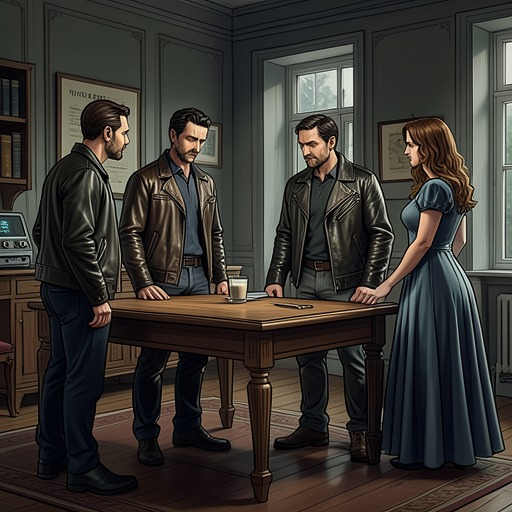
When the tavern crowd had gathered, Case struck a table and demanded attention. He announced that it was time for donations to the Family, then explained the transaction in direct, practical terms: the Family kept the people safe and protected, and those who wanted that protection had to keep the fund going. The patrons answered with groans because the demand was understood as a tax, not a voluntary gift. The scene shows how the Family translates organized violence into a language of public service, making extortion sound like an administrative duty.
The collection is also embedded in a broader system in which money is not the only resource controlled by the Family. When Hanley, a barber and dentist, says that he has no money that week, he offers to send his daughter Evelina instead. Case and Troy exchange a glance, and Troy merely shrugs. The response demonstrates that the tavern’s financial collection is connected to the society’s treatment of women as assets whose availability can settle a father’s obligations. The monetary demand and the sexualized social order reinforce one another rather than operating as separate forms of power.
Troy’s Embezzlement
After roughly ten minutes, Case and Troy have collected money from nearly everyone in the tavern. They leave with the bag and begin walking back toward the Compound, apparently having completed the Family’s routine business. The decisive reversal occurs in an alleyway near the tavern, where Troy stops, opens the bag, removes large portions of the coins, and stuffs them into his pockets.
Case asks what he is doing. Troy answers that the funds are supposed to go to the Family, then immediately claims that because he and Case are running the Family, the funds belong to him. The logic is revealing: Troy does not deny the collection’s official purpose; he converts institutional authority into personal entitlement. The public performance at The Smoking Gun has produced a private opportunity for theft, and the same power that extracts resources from the tavern’s patrons enables Troy to appropriate them before they reach the Compound.
This moment also marks a change in the meaning of the weekly errand. Under Titus, the visit had helped bind Case and Troy together and had served as practical instruction for Case. After Titus’s death, the established routine remains, but its moral center has eroded. The tavern continues to look like a stable institution, while its collection system becomes evidence of factional ambition and internal decay.
Threshold of Family Power
The Smoking Gun stands in contrast to the increasingly closed spaces associated with the Family. The tavern is accessible to outsiders, yet the obligations imposed there are determined by a power concentrated inside the Compound and its protected bunker. The public house is therefore a threshold: people can enter it freely, but once the Family’s representatives arrive, freedom is narrowed by the expectation of payment, obedience, or submission to the social rules the Family enforces.
That contrast becomes sharper as the larger conflict develops. Crowds later gather outside the Compound seeking entry, only to be driven away by guards who threaten to open fire. The Compound’s walls are surrounded by cleared ground, posted warnings, armed sentries, and a policy of immediate confiscation when a caravan or wagon obstructs the perimeter. Against that fortified exclusion, The Smoking Gun remains a place where the outside population can still be seen and addressed. Its apparent openness does not mean equality; it is the outward-facing room of a system whose real decisions are made behind walls.
Narrative Significance
The tavern gives the story a concrete stage on which the postwar order can be observed without the abstraction of political debate. Cards, dice, drinks, farming, and trade create the surface of communal life, while Case’s demand for donations exposes the coercive structure underneath. Hanley’s offer of Evelina widens that structure from taxation to bodily and familial vulnerability, and Troy’s theft reveals how quickly collective authority can become private appetite.
The Smoking Gun is consequently both a social crossroads and a diagnostic space. At its tables, the Family presents itself as protector; on the walk back, Troy treats protection as a revenue stream for himself. The tavern’s importance lies in that movement from public order to concealed appropriation. It shows that the Family’s rule is maintained not only through guns and walls, but through repeated performances in everyday places where domination is made to resemble routine administration.