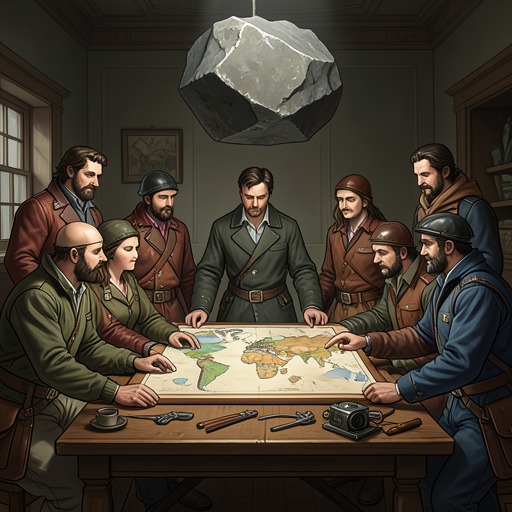
Troy
Gang Up: A Bikerland NovelTroy is Titus’s former second-in-command and one of the two men dividing the Family after Titus’s death. He has earned loyalty through duty, commands his own faction, and possesses the practical authority to challenge Case; yet his rivalry with Case becomes a conspiracy against the Family’s fragile order. By stealing its funds, exploiting Robin, arranging Titus’s murder, killing Carthage, and sabotaging the Family’s territory, Troy transforms a succession dispute into a war that ultimately destroys him.
Identity and Position
Troy enters the post-Titus crisis as a recognized power rather than an outsider. The men of the Family are divided between his followers and Case’s, while Troy’s previous position as Titus’s second-in-command gives him an established basis for influence. His loyalty is not merely presumed: he has earned substantial allegiance through his service to the Family. At the same time, his association with Robin, described as his sister and as perhaps the most beautiful girl in the wasteland, adds to the prominence of his household within Temple’s social and political structure.
The succession struggle is visible to everyone. Case and Troy both understand that they cannot remain indefinitely at odds without undoing Titus’s work, especially with an uneasy peace holding between the Family and the Cauldron. That peace depends on the absence of bloodshed between the two groups, even in bar fights, while Brall’s disciplined men remain a serious military threat. Troy therefore begins from a position in which consolidation and cooperation are necessary, but his ambition makes compromise increasingly unstable.
Rivalry with Case
Troy’s conflict with Case is first presented as a contest over how to run the Family. In the Mud Pit, Troy sits opposite Sandra, and both blame the other for Titus’s killing. The lack of witnesses makes the murder politically poisonous: in Temple, no witnesses suggest that everyone who knew the truth was paid off, loyal, or dead. Case rejects the competing suspicions that Troy killed Titus to seize power or that Sandra killed Titus to place her favored stepson in command, but he still recognizes that Troy and Sandra are not the allies he needs before the coming war with Brall.
Case attempts to impose agreement through a conference in which Troy sits at one end of the table and Sandra glares from the other. Troy initially dismisses the claim that there is a problem, gripping the rubber-lined table until it squeals and shifts beneath his hands. Case asks him to accept an arrangement that will let the rival factions work together against the Cauldron. Troy swallows a sharper response and nods, but the gesture is compliance rather than reconciliation. Case then orders Troy to mate Sandra after a year, allowing her a formal mourning period so that the Family will not speculate openly about Titus’s death. The proposed marriage is meant to bind the competing centers of authority; instead, it becomes part of Troy’s later plan to conceal his intentions.
Their older partnership had once been more functional. Before Titus died, Case and Troy traveled together weekly to The Smoking Gun, an errand Titus used to bring them together and to have Troy teach Case the ropes. Troy supplied the muscle while Case did the talking. After the succession, that complementary arrangement becomes a history of unequal access and mutual suspicion: both men command separate forces, and each interprets the other’s decisions as a threat to his share of power.
Greed and the Fracturing of Authority
Troy’s break with the Family’s collective interest becomes concrete during the return from The Smoking Gun. After the pair collect money from nearly everyone in the tavern, Troy stops in an alley, opens the bag, removes large portions of the coins, and stuffs them into his pockets. When challenged, he justifies the theft by collapsing the Family into himself: the funds belong to the Family, he says, and because he is running the Family, they belong to him. The act exposes the principle beneath his leadership. Public authority, in Troy’s hands, is treated as private entitlement.
His resentment is sharpened whenever information reaches Case’s faction before his own. Troy has his men, while Case has his, and the division will continue until the marriages are finalized. When Pontoon arrives after visiting the Mud Pit and tells Troy that the Cauldron has taken Abigail and made her their own through indoctrination, Troy reacts not first as a strategist but as a man furious at being excluded from news. He feels left apart and questions what his position is supposed to mean if Case receives information without him. The episode shows how his hunger for control is sustained by grievance: every sign of Case’s independent authority becomes evidence that Troy is being denied the power he believes he deserves.
Escalation into Violence
Troy converts his grievance over divided authority into a program of unilateral action. At the head of the Family convoy that ambushes Carthage, he rides with his gun already drawn, while two bikers strike the Cauldron lieutenant with chains and a pipe before Troy passes him and shoots him three times in the back. The killing is not a confused clash between rival forces; Troy leads the attack, and the seven riders withdraw together into the wastes, leaving Carthage dead or dying in the road. By shedding the first blood between the Family and the Cauldron, he destroys the fragile condition that had preserved their uneasy peace and makes open war far more likely.
Conspiracy, Coercion, and Sabotage
Troy’s violence extends beyond the battlefield into the Family’s own enclosure. When Case tries to pass through the gates during the fire that illuminates Temple like daylight, Troy stops him by the shoulders rather than joining the effort to organize a response. The interruption places Troy in opposition to the immediate defense of the community and foreshadows the later accusation that he helped destroy the Family’s territory. His treatment of Robin makes the same politics personal. He enters her room, grips a chair until the wood warps, and addresses her as a sister even after she rejects that identity. Later, his men Potter and Altan bring her to his office at gunpoint, where he uses sexualized intimidation and the presence of armed subordinates to reduce her freedom to obedience. The coercion is not incidental to his rule: he openly invokes the killers and looters around him as instruments for keeping people like Robin in line.
In the same confrontation, Troy reveals the strategy that had been concealed beneath his apparent willingness to marry Sandra. He says he intended to wait until matters settled, complete the marriage, and make it appear that he was giving the arrangement an honest chance. Afterward, he planned for either Case to suffer an accident or one of his own men to suffer one that could be blamed on Case. The proposed marriage therefore functions as political camouflage, while murder and manufactured blame form the mechanism by which Troy expects to remove his rival without immediately exposing himself. Robin understands from his disclosures that he may not allow her to leave alive, and his confession confirms that he was responsible for Titus’s death.
Troy also admits that the conflict with Brall has been deliberately accelerated. He treats the coming full war with the Cauldron as acceptable and refers to Case’s anger over the incident at the grain tower and the garage. Later, Sandra publicly identifies the pattern before the Family and the townspeople: Troy acted alone in killing Carthage, and, when Case failed to respond at once, Troy destroyed the grain tower and part of the Compound to provoke a larger conflict with Brall. These acts convert private ambition into collective catastrophe. Troy does not merely compete for succession; he manufactures emergencies, then uses the emergencies to justify the authority he has already begun to seize.
Exposure and Death
Troy’s conspiracy finally becomes a public matter when Sandra steps before the assembled Family and Cauldron forces with five townspeople behind her. She speaks against him directly, calling him a snake and naming his independent actions as the cause of the escalation. Her denunciation reverses the political advantage Troy has built through secrecy: the accusation is no longer a suspicion exchanged between factions but a charge delivered in front of the men whose loyalty he needs. The presence of witnesses also answers the silence surrounding Titus’s death, replacing the town’s earlier atmosphere of paid-off, loyal, or dead observers with an organized public testimony.
Troy responds not with explanation or reconciliation but with an attack. As Case turns toward Sandra and asks whether she is all right, Troy rushes at him carrying a long, sick knife. Brall intervenes with extraordinary speed, striking Troy over the head with the pipe he is carrying. Troy dies instantly from the blow, and the crowd cheers, with members of both the Family and the Cauldron treating the moment as a shared spectacle. His end is therefore both political and physical: the man who tried to turn concealment, sabotage, and controlled violence into permanent power is killed in the open, before the rival communities whose war he helped create.
Troy’s trajectory gives the succession crisis its clearest pattern of escalation. He begins as a legitimate deputy with loyal men and a history of useful service, but interprets shared authority as dispossession. He steals communal funds, resists cooperation with Case, exploits the proposed marriage to Sandra as cover, coerces Robin, murders Titus and Carthage, and provokes attacks on the Family’s own stronghold. Each step narrows the possibility of settlement while widening the war he claims to manage. His death closes that sequence, but the public cheer cannot erase the damage his strategy has done: the Family’s internal division and the conflict with the Cauldron have already been fused into one crisis.
Narrative Role and Thematic Significance
Troy functions as the succession crisis’s internal antagonist: unlike an external enemy, he begins with legitimate standing inside the Family and understands its institutions, alliances, and military routines from within. His former role as Titus’s second-in-command, his command of a loyal faction, and his earlier partnership with Case make his betrayal more dangerous than a simple power grab by an outsider. He knows how authority is assembled, how information is withheld, how marriages can stabilize competing claims, and how violence can be disguised as retaliation. That knowledge lets him turn ordinary mechanisms of governance into instruments of conspiracy.
His defining contradiction is that he presents himself as a defender of the Family while repeatedly converting the Family’s resources and dangers into private leverage. The stolen coins become his because he identifies himself with the institution; the marriage to Sandra becomes cover because he understands its public symbolism; the murder of Carthage and the destruction at the grain tower and the Compound become provocations that he can later treat as evidence for stronger leadership. Troy’s language and conduct repeatedly collapse the distinction between serving the Family and possessing it. The result is not order but self-consuming authority: every attempt to consolidate power produces another fracture, another accusation, and another reason for war.
The character also gives the plot a discovery structure. Titus’s death begins as an unresolved political mystery, with Troy and Sandra each blaming the other and the absence of witnesses making every explanation suspect. The truth emerges through Troy’s own coercive disclosure to Robin rather than through a formal investigation. He reveals the plan to wait, marry Sandra, engineer an accident for Case, and manufacture reciprocal blame; Robin then recognizes that he killed Titus and understands that his openness may be a prelude to killing her as well. The revelation changes the meaning of earlier scenes retroactively. His resentment at being excluded from information, his refusal to cooperate fully with Case, and his willingness to treat communal money as personal property all become parts of a single pattern rather than isolated acts of arrogance.
Troy’s relationship to violence is similarly developmental. He first appears as the Family’s muscle beside Case’s talk, a practical enforcer within Titus’s arrangement. He then steals, threatens, coerces, organizes an ambush, and directs sabotage, moving from the enforcement of authority to the manufacture of crises. When he finally runs at Case with a knife, the gesture exposes the endpoint of that progression: negotiation, concealment, and proxy violence have failed, so he attacks openly. Brall’s intervention kills him instantly, and the cheer from both the Family and the Cauldron gives the death a grimly communal quality. Troy sought to rule through division, but his final defeat briefly produces a shared response across the factions.
Troy therefore embodies the danger of leadership without any durable distinction between personal grievance and public duty. He does not merely fail to reconcile competing loyalties; he feeds on their separation until the Family’s succession dispute becomes a war with the Cauldron and a threat to the community he claims to command. His death resolves his individual claim to power, but it does not restore what his actions have damaged. The narrative uses him to show how a fragile political order can be destroyed from inside when ambition treats every alliance as camouflage, every resource as property, and every crisis as an opportunity for control.