Troy’s Conspiracy and Betrayal
Gang Up: A Bikerland NovelTroy’s Conspiracy and Betrayal is the hidden engine behind the escalating conflict in Temple: Troy kills Titus, helps provoke a full war with Brall and the Cauldron, and plots to exploit Case’s response before having Case killed. The scheme depends on making manufactured violence look like the work of rivals. Its shape becomes clear when Troy, speaking to a captive Robin, reveals more than he intends—or more than he can safely allow her to repeat. What begins as political calculation thus becomes a struggle over who knows the truth, who can make it public, and whether the Family can recognize a traitor within its own ranks.
The Political Ground for Betrayal
The Family’s authority rests on a bargain that is protective but unequal. It claims to serve all of Temple, while financing itself through raids on surrounding territories and the taking of land, loot, and women for trade. Family members receive first choice, followed by favored dependents known as the Kin; ordinary residents come after them, and only those who pay taxes receive the full benefits of the Family’s protection. This hierarchy matters to Troy’s conspiracy because the destruction he engineers threatens both the Family’s security and its claim to govern Temple.
The Family’s control is visible at the Compound gates as well as in its economic order. When a crowd gathers outside demanding entrance, guards threaten to open fire and tell people to return to their homes, where they can be found if admission is granted. A cleared strip around the walls, posted warnings, and the rapid confiscation of caravans or wagons that obstruct the perimeter make the boundary a forcefully enforced one. Troy’s plot therefore unfolds within a system that links protection, taxation, and armed control—and in which a conflict can be made to look like a threat that calls for more force.
A Plan Built on Provocation
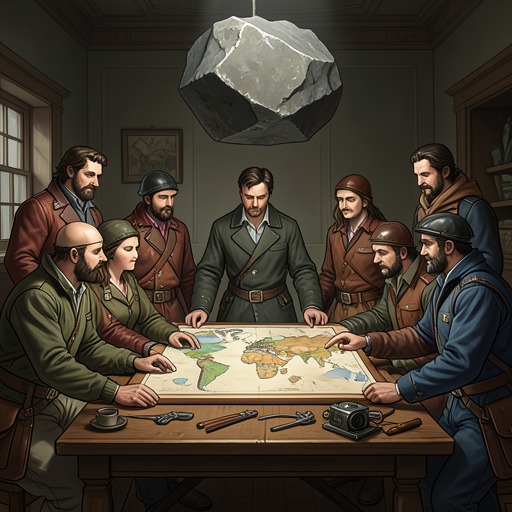
While Robin is restrained and surrounded by armed men, Troy describes the future he had intended to stage. He says he would have waited for matters to settle, married Sandra, and made it appear that he was giving the marriage an honest chance. Afterward, he would have arranged a crisis: Case might suffer an accident, or one of Troy’s own men might have one, with the blame placed on Case. The details show a plan not simply to oppose Case openly but to manufacture the appearance of events that would make opposition politically useful.
The scheme is double-edged. Troy tells Robin that a full war with Brall and the Cauldron is now unavoidable, and treats the conflict as an opportunity: after the incident at the grain tower and the garage, he expects Case to be angry with Brall and to join his side. Troy emphasizes numbers and the advantage of having Case with him. Yet in the same conversation he imagines Case dying after Brall has been killed, wagering that people will not scrutinize the death of a respected fighting man killed in the line of duty. The alliance he presents as necessary is therefore only temporary in his own design; Case is both a useful force in the coming war and a future target.
Robin asks whether Troy caused the attacks. He evades a direct answer, but his response leaves her convinced that he started the explosions. She recalls that none of his men died in them, and reads his manner as pleasure rather than guilt. The attack on the grain tower and the damage to the Compound are later identified publicly as part of Troy’s effort to incite conflict against Brall. Together, the selective casualties, the evasion, and the stated plan make sabotage legible as political staging rather than an accidental outbreak of violence.
Robin’s Discovery and the Murder of Titus
The conspiracy is exposed first to Robin, not to a public assembly. Troy’s insults and threats establish that she is in his power: he controls whether she may be harmed, and armed men stand around her. When he reveals his intentions, Robin realizes that he is telling her things she should not know. Her understanding immediately turns to the danger that follows from that knowledge: Troy may not mean to let her leave, or live long enough to expose him.
The central revelation is that Troy killed Titus. Robin’s recognition is gradual and physical in its force, as the truth settles coldly around her heart. This is more than another charge in a political dispute. Titus’s murder makes Troy’s scheming a betrayal of the Family’s own people, while his later sabotage and manipulation show how he uses that private crime to widen the public conflict. His talk of accidents and blame now has a darker meaning: he is not merely willing to exploit violence but has already used it to remove a member of the Family.
Public Accusation and the Wider Consequences
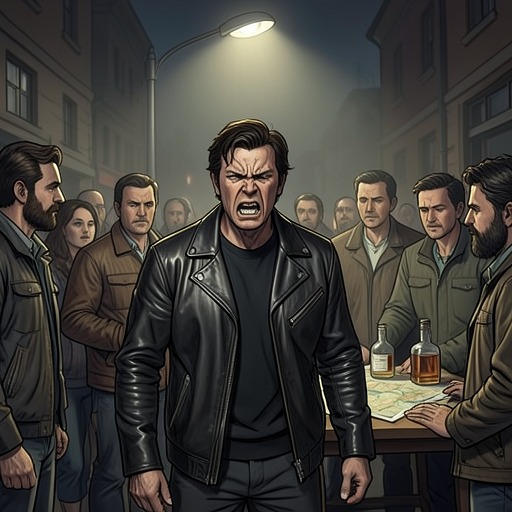
Troy’s secret becomes a public charge when Sandra steps forward before the assembled crowd and speaks against him. Five townspeople stand behind her. She accuses Troy of killing Carthage to escalate the conflict with the Cauldron, then of destroying the grain tower and part of the Compound to provoke action against Brall. The first accusation is presented as true beyond doubt; the second strikes the crowd as plausible because Troy is already known for deviousness. The response is not unanimous certainty: some people direct murderous insults at him, while others demand proof.
Sandra identifies Titus’s murder as the worst offense and names him as her own Titus and the crowd’s. She argues that the conflict cannot continue with a traitor among them. The accusation transforms Robin’s private discovery into a crisis of public legitimacy, even as the crowd’s demand for proof shows that exposure and conviction are not the same thing. Troy’s betrayal has injured the Family not only through deaths and destruction but by making its members confront the possibility that its war was deliberately engineered from within.
The war’s material consequences extend beyond the accusations. Brall attacks the spring near dusk, taking advantage of the light in the defenders’ eyes and the element of surprise. The short battle costs Brall two men and the Family five; the remaining defenders surrender and are chained, to be held for possible sale or exchange as hostages. Brall intends some clemency because he wants to rule the people he has conquered, not deprive them of all their men. In the later settlement, Brall and the Cauldron take responsibility for trade routes between Temple and Dallas and agree to answer calls for help if Temple faces hostilities. The Cauldron is promised supplies and lodging in the Compound, while the Family retains control of Temple and its security. Troy’s strategy of turning violence into leverage helps drive a conflict whose eventual settlement redistributes military duties and resources, even as the Family’s rule remains in place.