Troy's Murder of Titus and Sabotage
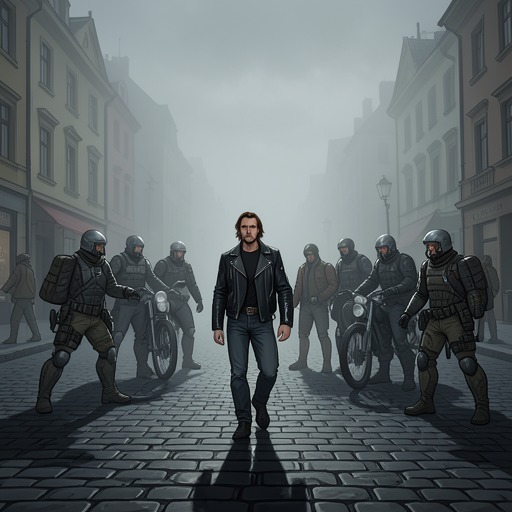
Gang Up: A Bikerland NovelTroy's Murder of Titus and Sabotage is the hidden campaign by which Troy tries to seize power inside the Family while forcing Temple into war with Brall and the Cauldron. He kills Titus, destroys the grain tower and part of the Compound, and attempts to make the resulting violence appear to justify retaliation against Brall. The event's decisive significance lies in its double betrayal: Troy attacks both the Family's political order and the fragile balance between Temple's competing powers, converting private ambition into public catastrophe.
Causes and Political Design
Troy's actions grow out of a succession struggle within the Family. While speaking to Robin in captivity, he explains that he had intended to wait until circumstances looked favorable, marry Sandra, and make the union appear sincere. After that, he planned for Case to suffer an accident, or for one of his own men to die in circumstances that would make Case appear responsible. The design was not a single impulsive crime but a staged transfer of power, built around marriage, manufactured suspicion, and the removal of a rival.
Abigail's presence complicated this plan. Troy describes Abigail as an agent of chaos because her actions threaten to disrupt the orderly appearance he wants to create around his proposed marriage and political ascent. His hostility toward her therefore belongs to the same scheme as his treatment of Case: both are obstacles to a controlled succession. Troy's language also reveals his confidence that violence, if properly directed, can be made to look like ordinary misfortune or the unavoidable result of conflict.
The broader political setting makes the sabotage especially destructive. The Family is organized to serve Temple through raids, the seizure of land and loot, and the collection of taxes from residents who depend on Family protection. Its members and favored Kin receive priority in distributing the wealth taken from surrounding territories. The grain tower and the Compound are therefore not merely physical targets; attacks on them threaten food, shelter, authority, and the visible machinery of Family rule. Troy strikes at the material foundations that allow the Family to present domination as protection.
Murder and Sabotage
Troy admits to Robin that he killed Titus, and her recognition of the truth arrives as a cold realization: he had been the one responsible. The confession is made while Robin is restrained, which places the revelation inside a scene of coercion and impending danger. Troy has already made clear that he may not allow her to leave alive, and his disclosure consequently functions both as a boast and as a threat. Robin understands that the knowledge itself may be enough to condemn her.
Titus's murder is paired with a series of explosions. Troy refuses to give Robin a clean verbal confession to every act, claiming that any number of things could or could not have been his doing, but his pleasure and confidence make the truth unmistakable to her. The attacks include the destruction of the grain tower and damage to the long garage, and later testimony identifies the destruction of the grain tower and part of the Compound as deliberate attempts to provoke action against Brall. The evasive wording does not conceal his responsibility from Robin; instead, it displays the pleasure he takes in making culpability visible without granting his enemy the comfort of a simple admission.
A crucial feature of the sabotage is its controlled risk. Robin recalls that none of Troy's men died in the attacks. This absence of casualties among his own followers suggests that the explosions were not uncontrolled violence but operations planned to damage Family infrastructure while preserving Troy's immediate strength. The destruction could then be presented as evidence of Cauldron aggression or as a reason to gather the Family behind Troy's military response.
Troy makes the intended political effect explicit when he tells Robin that the attacks have left Case angry with Brall. He treats the coming war as a matter of numbers, believing that Case will join him and that their combined forces will overwhelm Brall. In this calculation, sabotage is not an end in itself. It is a device for converting uncertainty into alignment: destroy important Family assets, blame or implicate the opposing faction, and use the resulting anger to place Case on Troy's side.
Discovery and Recognition
Robin is the first person shown to understand the full connection between Titus's death, the explosions, and Troy's plan. She realizes that Troy has revealed information he should have kept secret, unless he does not intend for her to leave or even to live. Her attempted declaration that she will expose him is met not by repentance but by further restraint, as Potter locks her arms behind her with handcuffs. The event thus turns knowledge into immediate peril: recognition does not free Robin, but places her under tighter control.
The truth later reaches Case through Sandra. She tells him plainly that Troy killed Titus and identifies Titus as both Case's father and her own husband. Sandra says that multiple witnesses place Troy at the scene. Her accusation transforms the murder from a private suspicion into a political charge supported by testimony, and Case's response is immediate rage. The revelation breaks through his previous political hesitation and leads him to decide that Troy must be killed.
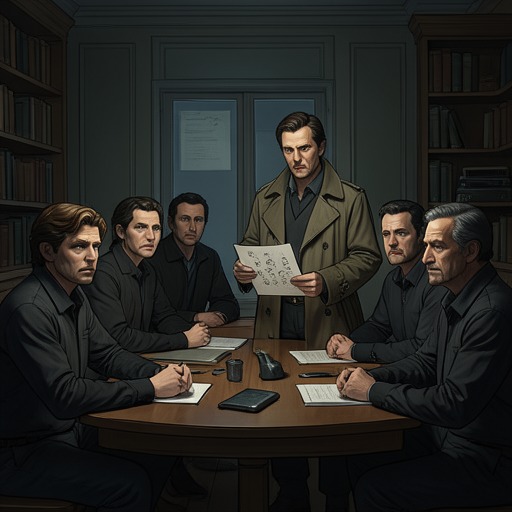
Sandra's public denunciation broadens the indictment. She accuses Troy of acting alone to kill Carthage in order to escalate the conflict with the Cauldron, then destroying the grain tower and part of the Compound when Case failed to respond quickly enough. She presents these acts as a connected effort to incite war against Brall. Her most serious charge remains Titus's murder, which she calls an act of treason against the Family rather than merely another killing in a violent landscape.
The public reaction confirms the effectiveness of the revelation while preserving tension over proof. Many people already believe Troy committed the deed, and the crowd responds with murderous insults, but others demand evidence. Five men and women stand behind Sandra as witnesses. The event therefore moves through three stages of recognition: Robin discovers Troy's guilt under coercion, Case receives the accusation as a personal and political shock, and Temple's crowd must decide whether testimony can convert suspicion into judgment.
Consequences and War
The immediate consequence is the collapse of any possibility that the conflict with Brall can remain limited. Troy tells Robin that full war with Brall and the Cauldron is now inevitable, and he speaks of killing them outright. His sabotage has achieved the escalation he wanted, but it has also created conditions he cannot fully control. Once the attacks are connected to his own ambition, the war ceases to be a simple Family response to an external enemy and becomes part of the evidence against him.
The strategic importance of the spring shows what the resulting war puts at stake. Brall attacks the spring near dusk, when the defenders are well armed but blinded by the lowering sun. He loses two men, the Family loses five, and the remaining defenders surrender and are chained. Brall considers selling them back or using them as hostages, while also showing clemency because he wants to rule the people rather than strip Temple of every man capable of defending it. Troy's sabotage has helped produce a war in which control of food, water, soldiers, and civilian loyalty becomes inseparable from the struggle over leadership.
The conflict also exposes the difference between Troy's opportunistic violence and Brall's organized military discipline. Brall commands more than seventy-five soldiers and roughly a hundred associated dependents, and he trains them to obey orders, hold formations, and study tactics because a large group without discipline is dangerous to its leader. Troy, by contrast, uses selected killers and looters as instruments of intimidation and relies on manufactured incidents to make others fight for him. His violence is organized enough to cause damage but not legitimate enough to sustain a stable order.
The eventual settlement reveals the institutional cost and political reorientation produced by the crisis. Under the agreement, Brall and the Cauldron take responsibility for trade routes between Temple and Dallas and stand ready to defend Temple against hostilities. Their people receive access to the Compound's supplies and lodgings when in Temple, while the Family retains control of Temple's internal security, sends riders into the wastes, and keeps first claim on recovered loot. The war that Troy helped provoke therefore ends by creating a more formal division of military and economic functions between the Family and the Cauldron.
Narrative and Thematic Significance
Troy's Murder of Titus and Sabotage is structured as a delayed revelation. The murder first appears as an unresolved wound, then returns through Troy's near-confession to Robin, and finally becomes a public accusation supported by witnesses. This sequence shifts the central value of the event from uncertainty to knowledge, then from knowledge to judgment. The reader's understanding changes not because Troy suddenly becomes dangerous, but because his separate acts are recognized as one coherent conspiracy.
The event also dramatizes the danger of confusing protection with rule. The Family claims Temple as its domain, taxes residents, and controls access to the security it provides; guards even drive away crowds seeking entrance to the Compound. In such a system, an attack on infrastructure can be made to resemble an attack on the population itself, allowing a political faction to turn fear into obedience. Troy exploits that structure, attempting to make the Family's dependence on security serve his private ascent.
At the same time, the murder destroys the fiction that internal authority can be preserved through controlled brutality. Troy assumes that Case's anger can be directed outward toward Brall, but the same evidence eventually redirects it inward toward Troy. His plan depends on others accepting the story he manufactures; Sandra's testimony, Robin's knowledge, and the witnesses behind her replace that story with a competing account of causation. The saboteur's central failure is therefore narrative as much as military: he cannot permanently control who explains the violence.
The event's final significance lies in the contradiction at its core. Troy seeks power by making Temple appear besieged, yet his actions reveal that the greatest threat comes from within the Family itself. He kills Titus to prepare a succession, sabotages the Compound to provoke war, and expects numbers to secure victory. Instead, the murder becomes proof of treason, the sabotage becomes evidence of conspiracy, and the war helps produce a new political arrangement in which the Family and the Cauldron must share functions that Troy hoped to command alone.