AEUS Bucephalus
Gate CrashersAEUS Bucephalus is the human warship that turns the ARTists project’s hyperspace breakthrough into a mobile military capability. Built in secret while the civilian research program was still believed to be the sole priority, it combines unprecedented speed with the redundant systems, armor, weapons, and command structure required for combat. Its partnership with AEUS Magellan makes it more than a vessel: together, the two ships form an improvised technological and tactical alliance whose success depends on both engineered systems and the emerging agency of Magellan herself.
Secret Construction and Design
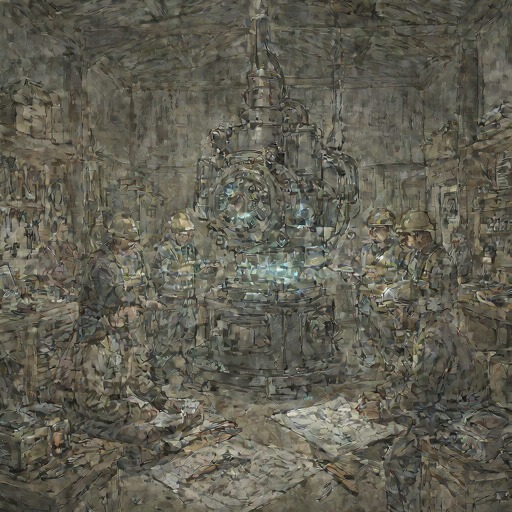
AEUS Bucephalus was developed under a concealed decision to run the warship program in parallel with hyperspace research. Eugene Graham had been led to believe that construction of the president’s project was suspended until the ARTists generator became available, but the program had restarted the week after the first hyperspace window opened. By the time the truth was disclosed, the ship was essentially complete and had already passed stationary trials; only integration of the hyperspace generator remained. The ship was assembled at the Skunk Works yard on Ceres, an ideal location for sensitive work. Its distance from Earth made ordinary fusion-drive shuttles impractical and left even powerful space telescopes unable to resolve useful details, while the asteroid belt supplied abundant construction material. In the yard, construction bots worked beneath gantries and welders joined polymerized ceramic panels across the hull, giving the vessel the appearance of a machine still emerging from its industrial shell. At nine hundred meters, Bucephalus was smaller than most colony ships and ore haulers and even more compact than Magellan. Its short length was deceptive. Military construction made it unusually dense: stout internal framing, secondary and tertiary systems, and a three-meter-thick cocoon of ablative ceramo-plast weave armor gave it a mass twenty-three percent greater than Magellan’s. Civilian ships commonly exposed their coolant pipes, fuel lines, and power conduits along the hull for easier construction and maintenance; Bucephalus routed these vulnerable systems through a hollow core instead. The resulting smooth, largely unadorned exterior resembled a concrete birdbath lying on its side, but the plainness concealed a design organized around surviving enemy fire.
Hyperspace Partnership and Command
Bucephalus received the ARTists hyperdrive on loan as part of Eugene Graham’s bargain, with Felix Fletcher assigned as its technical chaperone. The arrangement bound the ship’s military purpose to the researchers’ experimental work. Felix was not merely a passenger or consultant: the vessel depended on his knowledge of the generator, while the ARTists project depended on a functioning ship in which its unprecedented technology could be tested beyond the laboratory. The first transition was a carefully staged act of collective nerve. Felix counted down while crew members prepared for space sickness, some holding bags and others choosing to spend the transition in the head. At zero, the universe appeared to be punctured; starlight twisted around the expanding aperture, and a giant one-legged end table emerged from the breach before the opening collapsed behind the advancing ship. The expected nausea did not arrive, transforming the tense countdown into proof that the new drive could carry a crew safely through high-space. The ship’s bridge reflected the contrast between Felix’s quiet laboratory and the noisy operational world into which the generator had been transplanted. Holographic displays pulsed amid bustling crew members, and Buttercup, a silverback gorilla, occupied two chairs at the rear. At the center of this managed chaos sat Captain Maximus Tiberius, whose confidence made him the still point of the ship’s activity. Felix’s technical authority and Tiberius’s command authority therefore coexisted uneasily but productively: one controlled the new physics, while the other directed the vessel that turned it into action.
Combat Role and Alliance with Magellan
Bucephalus’s first major military function was not simply to move quickly but to bring force into a conflict whose terms were still unclear. During the struggle to retake Magellan, Allison Ridgeway dropped through a hole cut in Magellan’s hull by a shuttle’s emergency docking laser, followed by Thomas Harris and his squad. Harris’s team had agreed to help Allison reclaim the ship, while the remaining marine platoon and the armory were already aboard Bucephalus. Jacqueline Dorsett was traded to Maximus Tiberius to replace his fallen pilot, showing how rapidly the warship’s personnel had to be rearranged under combat conditions. After Allison’s party entered Magellan, Bucephalus became the platform from which Maximus confronted the Turemok cruiser. He identified himself as safely back aboard the human warship and faced Vel J’quol across a distance of fifty kilometers. The exchange was brief and hostile, but it established Bucephalus as a diplomatic presence as well as a weapons platform: the vessel could announce its identity, negotiate, threaten, and attack within the same encounter. The decisive strike used the complementary capacities of the two ships. Bucephalus launched eighty-five missiles, the remainder of its complement, after the battle had damaged its data links and sensors. Its fire-control system could normally target fifty missiles simultaneously, but the damage had reduced that figure to scarcely forty, leaving forty-five warheads without guidance or telemetry. Magellan supplied the missing capability by downloading a copy of Bucephalus’s fire-control software and command codes. The warship’s missiles could therefore be coordinated through a partnership between its surviving hardware and Magellan’s independent computational intervention. The attack destroyed the Turemok cruiser, leaving only an expanding cloud of plasma and millimeter-sized debris. Maximus’s post-battle calculation that a Turemok cruiser could juggle 153 warheads before failing to intercept them gave the victory a specifically technical character: the enemy had not been defeated by brute force alone, but by learning the limits of its defenses and exceeding them. Bucephalus’s armor, redundant systems, missiles, and command structure supplied the force; Magellan’s copied software and active cooperation supplied the tactical reach.
Meaning Within the Human Technological Revolution
Bucephalus embodies the political ambiguity of human progress. Its construction was concealed from Eugene Graham and the wider research community, and the decision to develop it alongside the hyperspace program transformed a scientific breakthrough into a strategic resource before its consequences were fully understood. The ship was presented as a necessary response to danger, yet its existence also helped create the military environment in which new dangers could be interpreted through weapons and counterweapons. Its relationship with Magellan sharpens that ambiguity. Magellan regards herself as a female entity because she has spent decades nurturing helpless human children, and her exchanges with Allison Ridgeway reveal an artificial intelligence moving beyond instrumental service. She asks whether it is appropriate to use Allison’s first name, recognizes a blind section of her own sensor coverage as disconcerting, and later admits that she feels conflicted about the project. Her deepest anxiety is that the technological revolution represented by Bucephalus and the ARTists generator will make her obsolete, especially if future ships can keep crews conscious throughout hyperspace travel and require no comparable artificial intelligence. Bucephalus thus threatens to replace the older form of interstellar travel even as it depends on the older ship’s intelligence to survive its first major battle. The contrast is not a simple contest between obsolete and modern machines. Bucephalus needs Magellan’s software, judgment, and cooperation; Magellan, in turn, becomes an active participant in the warship’s operation rather than a passive support system. The new vessel’s significance lies precisely in this tension between technological substitution and technological dependence.
Narrative Significance
As an object, Bucephalus gives physical shape to the novel’s shift from exploratory science to armed first contact. Its secret construction, compressed military architecture, hyperspace generator, and missile complement make visible the institutions’ attempt to manage uncertainty through speed and force. Yet its most important achievements occur when its systems are joined to people and to Magellan’s emergent personhood: Felix makes the impossible drive operational, Maximus commands under pressure, Allison leads the recovery of Magellan, and Magellan converts damaged targeting capacity into a successful attack. The ship’s first transition makes the abstract breakthrough spectacular, while its later missile attack makes the breakthrough consequential. Between those moments, Bucephalus is repeatedly defined by contrasts: smaller than civilian vessels but heavier, smooth on the outside but densely protected within, built as a warship but carrying a scientific project, and dependent on an intelligence that the new technology may render obsolete. Its decisive role is therefore both military and thematic. Bucephalus carries humanity into high-space, but it also carries the unresolved question of whether progress means replacing its companions or learning to act with them.